Stop the Revolving Door: Recruiting and Retaining High-Performing Employees
August 13, 2024 | noon-1 p.m.
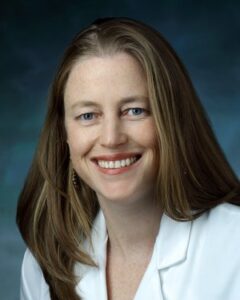
In this webinar led by Katie Lawrence, MHA CMPE, leaders will learn five keys to curating a culture that retains top talent and become a workplace that people seek out. An environment that draws new people in and invites them to stay is never just an accident. Leaders must intentionally decide to learn and leverage best practices.
Objectives include:
Implement best practices for selecting interview questions and onboarding new employees.
Recognize when and how to use emotional intelligence to enhance one aspect of workplace culture.
Leverage process improvement and technology to improve workplace culture.
The U.S. Department of Health and Human Services, through the Centers for Medicare & Medicaid Services (CMS), issued a final rule updating Medicare payments and policies for inpatient hospitals and long-term care hospitals. The rule improves the health of people with Medicare by addressing key social determinants of health and strengthening emergency preparedness. The fiscal year (FY) 2025 Inpatient Prospective Payment System (IPPS) and Long-Term Care Hospital Prospective Payment System (LTCH PPS) rule builds on the Biden-Harris Administration’s work to support the health of historically underserved and under-resourced communities and promote value-based care.
Get additional information, including rate Increases, resources for Underserved Patients and Communities, and more, here.
Governor Roy Cooper joined North Carolina Department of Health and Human Services leadership and a representative from Walgreens for an announcement on Medicaid coverage in Chapel Hill. As part of NCDHHS and the Governor’s continued work to expand access to reproductive health services, NC Medicaid will begin covering over-the-counter contraception in pharmacies across the state. Starting Thursday, August 1, 2024, the oral contraceptive Opill will be available through local and retail pharmacies without a prescription, at no cost for NC Medicaid beneficiaries. Opill is the first over-the-counter oral contraception that has been approved by the U.S. Food and Drug Administration.
"North Carolina is working to expand access to health care and that includes the freedom to make decisions about family planning," said Governor Cooper. "Making birth control easier to get is an important goal and I’m glad that NC Medicaid can take this step."
"Our goal is to ensure everyone has access to the right contraception and reproductive services at the right time in their community," said NC Health and Human Services Secretary Kody H. Kinsley. "This new coverage is part of our ongoing work to invest in child and family well-being by increasing access to health care and ultimately improving maternal and infant outcomes."
Expansion of contraceptive services allows Medicaid beneficiaries better access to health care by reducing barriers to contraception medication, such as cost and the need for a prescription from their health care provider. Medicaid beneficiaries will be able to get Opill over the counter from Medicaid-enrolled pharmacies who will be able to submit the claim for reimbursement.
"We are so grateful to the pharmacies and pharmacists who are partnering with us in this critical work to expand access to contraception and reproductive health services," said State Health Director and Chief Medical Officer Dr. Elizabeth Cuervo Tilson. "This new coverage by NC Medicaid demonstrates our commitment to continue to remove barriers to contraception and ensure North Carolinians have access to the services they need to make the best decisions about their health and life."
Opill over-the-counter coverage builds on NCDHHS’ ongoing work to ensure more North Carolinians have access to reproductive health services. Prior efforts include the implementation of pharmacist-initiated contraception, through which pharmacists can provide counsel about many options for prescription contraception, initiate a prescription and dispense contraception, and connect people to ongoing care if needed. Community access to contraception is particularly important in rural areas that have fewer providers and are considered maternal health and contraceptive deserts.
North Carolina Session Law 2021-110/HB 96 grants authority to pharmacists to prescribe a variety of contraception under protocols approved by the NC Board of Pharmacy and the NC Medical Board. NC Medicaid began enrolling pharmacists as providers in January 2024. To date, there are more than 330 retail and commercial pharmacies in 92 counties providing contraceptive services. The Department will continue to work to expand the level of access to contraceptive services in communities statewide.
More information about coverage for Opill is available in the NC Medicaid bulletin. To find a pharmacy providing pharmacy-initiated contraceptive services in North Carolina, visit ncpharmacyfinder.com.
The North Carolina Medical Board is seeking applicants to fill a vacancy for a licensed perfusionist on the Board’s Perfusionist Advisory Committee.
The appointment is for a three-year term ending October 31, 2027. The appointed perfusionist will be eligible to serve an additional three-year term after the completion of the first term.
Applicants must have an active, non-limited license to practice perfusion and no public disciplinary actions with the Board or any other professional licensing board within the past 10 years. Committee members receive a per diem and reimbursement for travel and subsistence as provided in G.S. 93B 5.
Interested applicants should submit a cover letter expressing interest in serving on the Committee, a current curriculum vitae or resume, and two letters of recommendation from individuals familiar with the applicant’s practice of perfusion.
Please share your stories here on how corporate interventions in medicine have impacted you and your practice. This includes private equity acquisitions, noncompete agreements, management service organizations, and any business intervention that has impacted your ability to practice medicine.
Millions of low- and middle-income North Carolinians are one step closer to medical debt relief. The U.S. Centers for Medicare and Medicaid Services (CMS) approved on Friday, July 26 Governor Roy Cooper and the NC Department of Health and Human Services' plan to use the state's Medicaid program to incentivize hospitals to relieve more than a decade of existing medical debt for eligible North Carolinians and prevent accumulation of new debt going forward.
NCDHHS will now begin working with hospitals to implement the program, which has the potential to relieve a potential $4 billion in existing medical debt for people and families across the state.
"Unlike most other debts, medical debt is not intentional because people don't choose to get seriously ill or have an accident," said North Carolina Governor Roy Cooper. "Medical debts are often beyond people's ability to pay, ruining their credit, keeping them from getting credit cards, loans and jobs and sometimes driving them into bankruptcy. That's why we're working with hospitals and federal partners to help relieve the burden of medical debt for North Carolina families."
"Many people struggle with the burden of medical debt, which can cause them to hold off on getting the essential health care and services they need," said NC Health and Human Services Secretary Kody H. Kinsley. "This debt relief program is another step toward improving the health and well-being of North Carolinians while supporting financial sustainability of our hospitals."
Each hospital in North Carolina can elect whether to participate in the program. Hospitals that choose to meet the eligibility conditions, including medical debt relief, will receive a higher level of Medicaid reimbursement under the Healthcare Access and Stabilization Program (HASP). Hospitals that choose not to implement the policies are eligible for base HASP payments.
Hospitals that opt in must implement the following policies as a condition of eligibility for enhanced HASP payments:
Relieve all medical debt deemed uncollectible dating back to Jan. 1, 2014, for any individuals not enrolled in Medicaid with incomes at or below at least 350% of the federal poverty level (FPL) or for whom total debt exceeds 5% of annual income.
Relieve all unpaid medical debt dating back to Jan. 1, 2014, for individuals who are enrolled in Medicaid.
Provide discounts on medical bills of between 50-100% for patients with incomes at or below 300% FPL, with the amount of the discount varying based on the patient's income.
Automatically enroll people into financial assistance, known as charity care, by implementing a policy for presumptively determining individuals eligible for financial assistance through a streamlined screening and income validation approach.
Not sell any medical debt for consumers with incomes at or below 300% FPL to debt collectors.
Not report a patient's debt covered by these policies to a credit reporting agency.
Participating hospitals will highlight all outstanding debt owed by current Medicaid enrollees, dating back to Jan. 1, 2014. Other individuals who are not enrolled in Medicaid but have incomes less than or equal to 350% of the FPL, currently $90,370 for a family of three, may also qualify for medical debt relief. Patients of participating hospitals will not need to take any actions to benefit from medical debt relief. The goal of the program is for eligible North Carolinians to begin to see relief for existing medical debt over the next two years.
NCDHHS has partnered with Undue Medical Debt to support participating hospitals and help them identify medical debt that is eligible for relief. Additional information is available in the Frequently Asked Questions on North Carolina medical debt relief.
Grab your party hats and noisemakers and let’s celebrate!
Maureen L. Aarons, MD
Brian C. Adair, MD
Danielle D. Adkins, PA-C
Asma Afzal, MD
Onyinyechi B. Agbara, MD
Daniel J. Albright, MD
James F. Alderman, MD
Kyle A. Aldinger, MD
Andrew H. Allen, PA-C
Elms L. Allen, MD
Christian G. Anderson, MD
Sayeh S. Araghi, PA-C
Jihad O. Arteh, MD
Gale J. Ashley, MD
Kim L. Askew, MD, FAAP
Inad B. Atassi, MD
William S. Atkins, MD
Clinton K. Atkinson, MD, FACS
Samuel M. Atkinson, Jr., MD
Victor K. Au, MD
Hitesh Avaiya, MD
Leanne Avery, PA-C
Hima Bindu R. Avutu, MD
Mofoluwake O. Awe, MD
Ndidi N. Azikiwe, MD
Adam G. Back, MD
Jack L. Bagley, PA
Jodi L. Bailey, MD
David W. Baker, III, MD
Rachel T. Baldwin, MD, MPH
Robert F. Barbe, MD
John V. Barrord, MD
Paul K. Bates, Jr., MD, FAAP
Mary John Baxley, MD
Adrienne C. Bean, MD
Wayne Beauford, MD
Octavian M. Belcea, MD
Sharon A. Belflowers, PA-C
Broderick C. Bello, MD
Lisa Bellofiore-Plonski, MD
Carlos F. Bendfeldt, MD
John D. Benson, MD
Alexandra D. Bentley, MD
Ralph L. Bentley, MD
Susan M. Berendzen, MD
Danilo R. Bernardo, MD, FACP
Shilpa Bhardwaj, MD
Vishal B. Bhuva, MD
Michael J. Bianconi, MD
Holly Biola, MD, MPH, FAAFP
Jenna E. Black, MD
Aaron M. Blackshaw, MD
Gerald W. Blake, MD
Jeffrey C. Blum, MD
O. Robert Boehm, MD, PhD
John P. Booker, Jr., MD
Edward H. Bossen, MD
Lynneice L. S. Bowen, MD
Randall B. Bowen, MD
Karl F. Bowman, Jr., MD
James F. Boyd, MD
Sabrina A. Boyte, PA-C
Melissa M. Braunsteiner, MD
Wilburn O. Brazil, Jr., MD
William M. Brinkley, Jr., MD
Amy S. Brooks, DDS, MD
Werner C. Brooks, MD
Sandra M. Brown, MD
Joel E. Bruce, MD
Kofi Bruce-Mensah, MD, MBA, MS
Scott H. Brundle, MD
J. Scott Bryson, MD
John E. Buenting, MD
Bryan C. Bunn, MD
Paul A. Buongiorno, MD
Woodward Burgert, III, MD
Shawn T. Burgess, MD
Eric S. Burgon, MD, DDS
Thomas E. Burkart, MD
Kristen A. Burke, PA-C
E. Edward Burton, Jr., MD
Marcella M. Butler, MD
Debra L. Bynum, MD
David E. Byrd, MD
Thomas H. Byrnes, Jr., MD
Claudia T. Cadet, MD
Brian H. Camp, DDS, MD
Manuel O. Campano, MD
William E. Campbell, Jr., MD
Kenneth P. Carlson, MD
Stephanie D. Carperos, MD
Henry J. Carr, Jr., MD
Michael J. Carroll, PA-C
Jean W. Carter, MD
Timothy R. Carter, MD
Cornelius F. Cathcart, MD
R. Lamont Cathey, MD
Pamela B. Cavanaugh, MD
Dan Chaksupa, MD
Robert E. Chambers, MD
Daniel R. Champey, MD
C. Peter Chang, MD
Shailendra S. Chauhan, MD
Swapna Chenna, MD
Karl S. Chiang, MD
Karen N. Chilton, MD
Hira Choudhry, MD
Wan S. Chung, MD
W. Tucker Cline, MD
J. Thaddeus Coin, MD, PhD
Emily H. Cole, PA-C
T. Boyce Cole, MD
Robert E. Coles, MD
H. Christopher Coley, MD
Ryan D. Collins, PA-C
Scott V. Connelly, MD
Erin L. Cook, MD
Paul P. Cook, MD
Domagoj Coric, MD
Jamey L. Cost, MD
Stuart W. Couch, MD
R. Lee Cox, MD, FACS
Stanley C. Cox, III, MD
Matthew D. Crawford, MD
Robert C. Crawford, Jr., MD
Susan L. Crittenden, MD
William M. Crutchfield, MD
Jeremy F. Cuda, MD
Walton W. Curl, MD
D. Patrick Currie, MD
Brian M. Curtin, MD
Boris Cvetkovski, MD
Vincent P. Dahringer, MD
Cheryl J. Davis, MD
Grace M. Davis, PA-C
Heather L. Davis, DO
Teneisha C. G. Davis, MD
W. Bradley Davis, MD
Howard G. Dawkins, Jr., MD
Jacquia F. De La Cruz, MD
A. Richard De Sandre, MD, FACS
Alberto J. d'Empaire, MD
Gurvinder S. Deol, MD
Joseph S. DeRaddo, MD
Theodore S. Derse, MD
Maria L. DeSantis-Wilcox, PA
Jonathon G. Dewald, MD
David L. Dill, MD
Daniel C. Dillon, MD
Brian D. Donoghue, MD, FACEP
Margaret R. Donohoe, MD
Margaret J. Dorfman, MD
H. Duncan Dorris, Jr., MD
Memory E. Dossenbach, PA-C
Thomas H. Douglas, MD
Dalton E. Dove, MD
Hugh T. Dowlen, MD
Gregory J. Dray, MD
Laura E. Dressel, MD
Olly C. Duckett, MD
Harold C. Dufour, MD
Priti Duggal, MD
Gina L. N. Duncan, MD
S. Bryan Durham, MD
Marcus A. Earle, DO
James S. Easterbrook, MD
Donna H. Edwards, MD
Chad R. Eller, MD
J. Kent Ellington, MD
Henry J. Elsner, MD, FACS
Robert D. Ensor, MD
Thomas C. Eshelman, MD
Scott M. Eskildsen, MD
Mohammad A. Esmadi, MD
Meagan E. Evangelista, MD
Scott N. Fairbrother, MD
Jenna L. Falcinelli, MD
William L. Falls, MD
John K. Farrington, MD
Clinton E. Faulk, MD
Max H. Faykus, Jr., MD
Alan G. Finkel, MD, FAAN, FAHS
Richard C. Finn, MD
D. Russell Fisher, MD
Christina M. Flannelly, MD, FAAP
Lisa C. Fleck, PA-C
Marisa C. Flores, MD
Herbert M. Floyd, MD
Lisa M. Foglia, MD
Rita I. Fontaine, PA-C
Daniel J. Forest, MD
Jamie L. Fountain, MD
Reginald J. Fowler, MD
David D. Fraser, MD
Ray M. Freeman, MD
Sascha Frey, MD
Julie M. Fry, PA-C
Kim M. Fujinaga, MD
Molly L. Fuller, MD
Imre Gaal, Jr., MD
Suchita B. Gade, MD
Mark W. Galland, MD
Charles B. Gantt, Jr., MD
Rama G. Garimella, MD, FACC
Susan T. Garrett, MD
Richard S. Gelber, MD
Paul Geniec, MD
Laura I. Gerald, MD, MPH
Ronald W. Gerbe, MD
Jennie M. Gillespie, DO
Dennis E. Giordano, MD
John G. Giragos, MD
Ronald P. Glinski, MD, PhD
Thomas M. Golden, MD
Bonnie J. Goodwin, MD
Michael A. Gordon, MD
Daniel Gottovi, MD, FCCP
Lauren P. Gotwald, MD
James M. Granfortuna, MD
Craigan L. Gray, MD, MBA, JD
Katherine V. Grette, MD
William R. Griffin, Jr., MD
Nicholas B. Grissom, MD
Jeffrey L. Gross, MD
Ned J. Gross, MD
C. T. Gualtieri, MD
Robert C. Gunther, MD
Robyn Guo
Michael D. Gwinn, MD
Catherine A. Haggart, PA-C
Cornelia S. H. Hahn, MD, PhD
Gregory G. Hall, MD
Tara L. Halpin, PA
J. Nathaniel Hamilton, MD, FACS
Robert E. Hammonds, MD
George L. Hamrick, Jr., MD
Jason P. Handler, MD
Scott Q. Hannum, MD
Curtis A. Hanson, MD
David M. Hardaway, MD
Christina Hardin-Dial, MD, FAAP
Thomas S. Harle, MD
Jeremy L. Harless, PA-C
Keith W. Harper, MD
Lonnie C. Harrell, III, MD
Sunit P. Harris, MD
John L. Harshbarger, MD
Alexander C. Hattaway, III, MD
Bennett A. Hayes, Jr., MD
Jessica C. Heestand, MD
Janice M. Helm, PA-C
Jasmine P. Hemmings, PA-C
Robert C. Hendel, MD
Joshua M. Henderson, PA-C
John O. Herlong, MD
Alexis B. Hess, MD
Docia E. Hickey, MD
Edward F. Hill, MD
Gregory C. Hinn, MD
Jenny L. Hinson, MD
Todd N. Hodges, MD
Lewis R. Hodgins, MD
Theodore F. Hoffman, Jr., MD
Michael K. Hoger, DO
Robert J. Holmes, MD
Douglas E. Holt, MD
Boyd K. Honeycutt, MD, MBA, FACP
Travis C. F. Honeycutt, MD
Timothy S. Howard, MD
H. Slade Howell, Jr., MD
Olson Huff, MD
Allen W. Huffman, Jr., MD
Charles S. Hultman, MD
Thomas H. Hunt, MD
Justin B. Hurie, MD
Obinna O. Ikwechegh, MD
Jirair A. Injejikian, MD
Edward K. Isbey, Jr., MD
Daniela T. Ivanova, MD
David S. Jackson, Jr., MD
Anshu K. Jain, MD
Bennie L. Jarvis, MD
Michele T. Jedlica, MD
Jennifer L. Jenkins, PA-C
Travis C. Jenkins, MD
Myung K. Jeon, MD
Kathryn B. Jeutter, PA-C
Allen M. Johnson, MD
Dennis R. Johnson, MD
Nell B. P. Johnson, MD
Theresa S. Johnson, MD, FACOG
Carol A. Johnston, MD
William W. Johnston, MD
Frederick Scott Jones, MD
H. Michael Jones, MD
John S. Jones, DO
L. R. Jones, MD
Diya T. Jost, MD
Kyle M. Judkins, DO
Theresa A. Kallman, MD
David E. Kang, MD
Seth A. Kaplan, MD
Lisa Kaufmann, MD
Robert M. Kennedy, IV, MD
Ioanna G. Kessler, DO, FACOFP
Jeffrey P. Keverline, MD
Bilal Khalid, MD
Dalia A. Khalifa, MD
Tahuriah G. Khan, DO
Mayuri L. Khatri, MD, FAAP
Daniel A. King, PA-C
Susan S. Kirsch, MD
Mark H. Knelson, MD
Christopher B. Komanski, MD
Ramesh B. Konduru, MD
John B. Konefal, MD
Doria H. Kosmala, PA-C
Stephen I. Kramer, MD
Jan Kriska, MD
Frederick G. Kroncke, Jr., MD
Theresa B. Kubicki, PA-C
Kenneth R. Kubitschek, MD
David C. Kwee, MD
Michael D. Kwong, MD
Suman Lamsal, MD
Darryl L. Landis, MD
Jason E. Lang, MD
Michael C. Lang, MD
Thomas E. Lawrence, MD
Rusty J. Lee, MD
Donald L. Lendle, MD
Jeffrey P. Lin, MD
Shau-Shau Lin, MD
Allison A. Linton, PA
Perry E. Little, MD
Brooke E. Livingston, DO
Victoria R. Locklear, PA-C
Thomas D. Long, Jr., MD
Fernando A. Lopez, MD
Melissa V. Lowe, MD
Tiffany N. Lowe-Payne, DO
Laura J. Luckadoo, MD
Eric J. Luk, MD
Gaurav Luther, MD
Michael W. Madsen, MD
Scott R. Mahanty, MD
Marc A. Mancuso, MD
Rebecca L. Manganello, DO
Allen F. Marshall, MD
Holly R. Martin, PA-C
Paola A. Matheus, MD
Kacie S. Matthews, PA
Gerri L. Mattson, MD, MSPH, FAAP
David R. Maynard, MD
Carmen C. P. Mayo, PA-C
Jonas J. McAlarney, MD
Beck D. McAllister, MD
James C. McCabe, MD
Chad S. McCain, DO
Kevin C. McCammack, MD
Samantha L. O. McClease, MD, FAAP
William B. McCrea, MD
Erin C. McCrum, MD
Peter McIlwaine, PA-C
Angus G. McInnis, MD
Frederick L. McIntyre, Jr., PA-C
William D. McKeown, MD
Stephen M. McNeill, MD
Sheri R. Meinert, PA-C
Murali Krishna Meka, MD
Karla L. Mendoza Rodriguez, PA-C
Michael J. Menz, MD
Nicole M. Merli, MD
Virgil M. Messer, MD
Sarah M. Messersmith, MD
Doreen R. Messick, MD
Daniel K. Messner, MD
April M. Miller, MD
Mark F. Miller, MD
Robert A. Millet, MD
Andrew V. Moczula, MD
Rasheeda T. Monroe, MD
Lawrence A. Montalto, DO
Gustavo S. Montana, MD
Katharine S. Moorehead, MD
D. William Moose, Jr., MD
Andrew G. Moran, MD
Rafael M. Moreschi, MD
Elena A. Morgan, MD
Michael C. Morin, MD
Constance Mulroy, MD, FACOG
Kalyan S. Muppavarapu, MD
Donald S. Murinson, MD
Anne P. Murphy, PA-C
Neill H. Musselwhite, III, MD
Benjamin J. K. Myers, DO
Kenneth W. Myers, MD
Praveen Namireddy, MD
Ali K. Nasim, MD
Wallace R. Nelms, Jr., MD
Kenneth E. Nelson, MD
Jonathan Nestor, MD
Pavlo I. Netrebko, MD, FACC
Paul C. Neuman, DO
Lanning R. Newell, MD
Justin V. M. Nguyen, MD
Franklin C. Niblock, IV, MD
Matilda W. Nicholas, MD, PhD
John C. Nicholson, MD
Stephen W. North, MD
Elizabeth I. Norton, PA-C
Andrew S. O'Connor, DO
Monica Oei, MD
Paul Y. Oh, MD
Matthew D. Olin, MD
Brian V. O'Neal, MD
Scott B. O'Neal, MD
Pamela S. Oravetz, PA-C
John W. Ormand, Jr., MD
Liston A. Orr, MD
Dinah H. Oxendine, PA-C
Aaron R. Pankiewicz, DO
Malcolm H. Pannill, II, PA
Alexander Paraschos, MD
Preeti H. Parekh, MD
H. Kim Park, MD
C. Lawrence Parker, MD
Shefali V. Parmar, MD
Vikas J. Patel, MD
Louie L. Patseavouras, MD
Rolvix H. Patterson, Jr., MD
Daniel E. Paul, MD
Stephanie O. Peacock, MD
David A. Pearson, MD
Martha G. Peck, MD
Suresh J. Penkar, MD
Rachel Peragallo Urrutia, MD
Bryan M. Peters, MD
Milan Petrovic, MD
Jerry M. Petty, MD
Eureka L. Phillip, MD
Aaron G. Pico, PA-C
Hubert G. Pierce, MD
Katherine J. Pierce, MD
Joseph A. Pino, MD
William G. Pittman, III, MD
Ivy P. Pointer, MD
Laura C. Politte, MD
Roberto C. Portela, MD
Benjamin P. Powell, MD
James B. Powell, MD
Thomas E. Powell, III, MD
Laura S. Pratt, PA-C
Dale P. Quirke, MD
Akef S. Rahman, MD
Natarajan Rajan, MD
Jitinder S. Rangar, MD
Jayalalitha Rao, MD
Anuradha Rao-Patel, MD
Inam Rashid, MD
Jennifer A. Ratley, DO
John M. Ray, Jr., MD
Lisa L. Ray, MD
Hannah Rayala
Leighton A. Raynor, MD
John B. Reckless, MD
Conor M. Regan, MD
Richard H. Reid, MD
William O. Renfroe, Jr., MD
Joel C. Reynolds, MD
Leslie D. Reynolds, MD
David L. Richardson, MD
David L. Riley, MD
Carlos M. Rish, MD
Richard S. Roberts, MD
Heather N. Robertson White, MD
Joseph J. Robinette, MD
Edward N. Robinson, Jr., MD, MPH
Lindsey M. Rose, MD
Laura B. Rosenzweig, MD
Bianca Rosso, MD
Matthew A. Rushing, MD
Richard W. Rutherford, Jr., MD
Michael W. Ryan, MD
Madeeha Saeed, MD, FACC
Hal D. Safrit, MD
Patrick J. Sammon, PA-C
James G. Scanlan, MD
Thomas V. Scarritt, Jr., MD
Deborah D. Schoenhoff, MD
John R. Schultz, MD
Jonathan E. Scott, MD
Tina L. Scott, PA-C
Matthew L. Segal, PA-C
Randolph P. Sellers, MD
Jacob P. Shaffer, MD
Shreena G. Shah, DO
Rajiv K. Sharma, MD
William A. Shearin, Sr., MD
John D. Shelburne, MD
Rakesh R. Sheliya, MD
Charles H. Shelton, III, MD
Vijay Sheshadri, MD
Patricia A. Shevlin, MD
Mark E. C. Shogry, MD
Naomi S. Simon, MD
Patrick J. Simpson, MD, FACC
Aliana P. Sindram-Trujillo, MD, PhD
Francis W. Slate, MBChB
Stanley F. Sliwinski, Jr., MD
Norman R. Sloop, MD
Cameron L. Smith, MD
Candace T. Smith, MD
David N. Smith, MD, FACP
Jennifer L. Smith, MD
Joshua D. Smith, MD
Lindsay N. Smith, PA-C
Peter K. Smith, MD
L. Paige Sokolsky, MD
Michael D. Sorensen, MD
Leo R. Spector, MD
Shirley H. Spedding, MD
Rachel L. Speicher, DO
C. Harrison Springfield, IV, MD
Tina E. Sprouse, MD
Andrew D. Staples, PA-C
Gregg J. Stashenko, MD
Svetlana A. Staub, MD
Scott T. Steffen, MD
Ryan A. Stephens, MD
Bryan S. Stonestreet, MD
Alan W. Story, MD
Nicholas E. Stratas, MD
Samuel A. Sue, Jr., MD
E. Amy Suttle, MD, FAAP
Katherine L. Swain, MD
Rosalea K. Taam-Akelman, MD
Carlos J. Tamayo, MD
Khalil S. Tanas, MD
John P. Tanner, MD
Wyndee B. Tarter, MD
William C. Tate, II, MD
James E. Taylor, II, MD
Gregory A. Tayrose, MD
Gregory P. Temas, MD
Su Wooi Teoh, MD
Andrea L. Terry, DO
Mohan C. Thakuri, MD
Devi Thangavelu, MD
Ashish D. Thekdi, MD
Kenneth C. Thompson, Jr., MD
Marvin W. Thompson, MD
Cecil K. Thoppil, MD
Kim M. Thorner, MD
Stephen T. Thuahnai, MD
Devin K. Tighe, MD
T. Keith Toledo, MD
Mary E. Tolle, PA-C
Sanjay Tomar, MD
Porshia M. Tomlin, MD
Ruben Torrealba, MD
Michael R. Towarnicky, MD
Murphy F. Townsend, Jr., MD
Lucas V. Tran, MD
Kelly E. Trawick, PA-C
Edward L. Treadwell, MD
Amanda C. Trimpey, MD, MPH, FACOEM
Gloria L. Tsan, MD
Wade R. Turlington, MD
W. Harrison Turner, III, MD
Benjamin D. Umbel, DO
Trevor C. Upham, MD
Martin Van Cleeff, MD
Joel D. VanderMey, PA-C
Michael V. Varricchio, Jr., PA-C
Muryel W. Vary, PA-C
Adrian Vazquez, MD
Jack L. Vesano, MD
Ashutosh R. Virmani, MD
Francis W. Wachter, MD
Deborah H. Waechter, MD
Analiese Wagner, DO
John E. Wahlen, MD
David A. Walker, MD
Lauren E. Wall, PA-C
Andrew B. Wallace, MD
Richard F. Walton, MD
William B. Warlick, Jr., MD
Julia G. Warren-Ulanch, MD
Zack J. Waters, Jr., MD
Jerry F. Watson, MD
Joseph S. Wehby, Jr., MD
Rodney D. Welling, MD
Timothy D. Wetzel, MD
Courtney M. Wharton, PA-C
Cynthia S. White, MD
Matthew S. White, MD
Paul C. Whitesides, Jr., MD
Allison C. Whitton, MD
Walter R. Whitworth, MD
Michael E. Wiegert, PA-C
Jeremy S. Wilkes, MD
Barton G. Williams, MD
David R. Williams, Sr., MD, FAAP
Dennis R. Williams, Jr., MD
Glenn E. Williams, PA-C
Mathew W. Williams, PA-C
Paul F. Williams, MD
Thomas R. Williams, MD
Deitra L. Williams-Toone, MD
L. Brent Wilshire, MD
Jack K. Wilson, Jr., MD
De Benjamin Winter, III, MD
Ryan J. Wise, MD
Jacob A. Wisniewski, MD
Jerry C. Woodard, MD
Paul R. Woodard, MD
W. Samuel Yancy, MD
Michael F. Yarborough, MD
Roger J. Yau, MD
Joshua C. Yelverton, MD
Alex G. Yip, MD
Hassan Yousaf, MD
Justin W. Zanone, MD
David P. Zarzar, MD
NCMS's partners, Carolina Complete Health (CCH) and Carolina Complete Health Network (CCHN) will host their 2nd Annual Medicaid Managed Care Town Hall at the 2024 CPP Annual Meeting during NCMS LEAD Conference in November. In preparation for that session, we want to hear from clinicians across North Carolina who provide care to Medicaid enrollees.
In a study published inJAMA Neurology co-authored by Vibhor Krishna, MD, associate professor of neurosurgery at the UNC School of Medicine, researchers found that a staged bilateral focused ultrasound treatment for essential tremor is safe and effective. Essential tremor, a neurological condition that causes involuntary and rhythmic shaking, can be so profound that typical life tasks become difficult to accomplish.
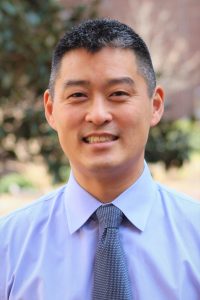
Vibhor Krishna, MD (image credit: UNC)
Since 2016, neurosurgeons have been able to perform a highly technical, incisionless focused ultrasound procedure to ablate (or inactivate) the diseased tissue in the brain. The results are instantaneous, with many patients walking out of the procedure room without a tremor. However, for patients who have significant tremors or a tremor originating from both sides of the brain, one course of this treatment is not enough to keep their symptoms under control.
“There are medications to treat essential tremor patients, but often their effectiveness wanes over time, or the side effects are too profound,” said Vibhor Krishna, MD, who was co-author on the paper and associate professor in the UNC Department of Neurosurgery. “Focused ultrasound can offer another route for some patients to regain their ability to live their lives the way they want. Sometimes, the positive effects are very profound.”
NCMS Life member Olson Huff, MD, died Wednesday, July 24. He was 87 years old.
Dr. Olson Huff completed his Pediatric Residency at what was then Charlotte Memorial Hospital. During his 14 years of clinical practice in Charlotte, he completed a Fellowship in Developmental Disabilities from UNC-Chapel Hill. The family moved to Asheville in 1982 for him to concentrate on Developmental Pediatrics. He began the team-based Olson Huff Center for Child Development and became the first Medical Director of the Ruth and Billy Graham Children’s Health Center at Mission Hospital where he brought many pediatric specialists to Asheville and began the children’s dental program and Tooth Bus. At his retirement dinner in 2001, the Children’s Health Center was named Mission Children’s Hospital. He then co-chaired raising the 11 million dollars for the Reuter Children’s Outpatient Center.
When he was president of the NC Pediatric Society, he led NC in adopting Health Choice, the federal Child Health Insurance Program. The American Academy of Pediatrics recognized his work as the Chair of the Academy’s Federal Affairs Committee, by stating, “With gratitude for your compassion, dedication, and tireless advocacy on the behalf of our nation’s children. You dare us to run when others would simply walk.”
Dr. Huff joined the NCMS in 1968.
The North Carolina Medical Society extends its deepest condolences.
In partnership with Dare County and local law enforcement agencies, Outer Banks Health is bringing the Blue Envelope Program to the community.
The program is designed to provide a communication awareness tool for law enforcement when interacting with community members diagnosed with conditions or disabilities like autism spectrum disorder, dementia, and anxiety.
The blue envelopes distributed to community members through the program contain tips for law enforcement, a card that identifies the individual and specifies their condition or disability, and room for pertinent documents such as a vehicle registration and proof of insurance.
The program allows an individual with a condition or disability to present the blue envelope to law enforcement or other community service personnel during an interaction so that they are not perceived as being uncooperative or combative.
Aircraft will drop rabies vaccination baits across Allegheny County in August as part of a massive effort to eventually eradicate the raccoon variant of the virus from the country.
The vaccination program is spearheaded by the United States Department of Agriculture's Wildlife Services, which the Allegheny County Health Department partners with annually. Volunteers will distribute baits containing the vaccine from August 1 through August 30, both by hand and by air.
(image credit: U.S. Department Of Agriculture)
Raccoon rabies can be found throughout the state, and the disease is almost always fatal to both people and animals. The goal is to eventually push the westward boundary of raccoon rabies all the way to the East Coast, basically eradicating raccoon rabies from the United States.
AMA’s August Recess Campaign:
Fix Medicare Now August 1st, 2024 8:00 PM ET
Join the AMA for an informative virtual session that will review the current state of federal legislation and ways in which physician advocates can engage their members of Congress during the month of August, whether their lawmaker is a champion of physician policy priorities or not.
Also learn about resources developed by the AMA to provide guidance to physician advocates in scheduling and preparing for in-district legislative meetings, hosting Members of Congress at site visits, and best practices for interacting and conversing with them online.
Editor's Note: New Advocacy Resources Available on AMA Fix Medicare Now Page
The first includes several key takeaways from the report, including continued disproportionately low MIPS scores for small, rural, and other types of practices, and notes how APM participation is at a critical inflection point with Qualifying APM Participant (QP) thresholds set to increase next year.
The second leverages 2022 data to demonstrate how AMA’s Data-driven Performance Payment System (DPPS) solution would correct several persistent MIPS flaws by stabilizing Medicare physician payments, improving clinical reliability, and reducing reporting burden to stabilize patient access to medical services.
The Jerry M. Wallace School of Osteopathic Medicine at Campbell University ranks second-highest in the nation for “Medical Schools With the Most Graduates Practicing in Health Professional Shortage Areas,” according to U.S. News & World Report rankings of top medical schools released on July 22.
U.S. News says 46.8 percent of Campbell graduates are practicing in medically underserved areas, the only N.C. medical ranking in the top 10 in this category. Further, and also significantly, Campbell’s med school ranks 11th in Most Graduates Practicing in Primary Care, with 41.1 percent of graduates practicing in primary care.
Schools were assessed on their performance across a set of widely accepted indicators of excellence, U.S. News says.
Serving rural communities in North Carolina with the goal of keeping physicians in those communities is a primary goal of Campbell, which boasts the only osteopathic medical school in North Carolina.
Read the full scope of this outstanding recognition here.
SPECIAL WEBINAR: Updates to Clinical Coverage Policy 1E-5 Obstetrical Services Tuesday, August 6 | 1-2 p.m.
Join this webinar to hear updates to the Obstetrical policy including Group Prenatal Care, update on Doula services, the addition of VBAC codes, F codes for maternal tracking and clarification of postpartum period versus postpartum extended health coverage.
The FDA has approved Guardant Health's Shield blood test for colon cancer screening.
The Shield blood test has been approved as a primary screening method for adults over 45 with an average risk for colon cancer, according to a July 29 news release from Guardant.
With FDA approval, the Shield blood test becomes the first colon cancer screening method that meets Medicare coverage requirements.
The blood test can be administered during a routine blood draw, potentially leading to a higher rate of colon cancer screening compared to more invasive screening method options.
"This decision will help make screening tests more broadly accessible and propel blood-based testing and CRC screening into a new era," Daniel Chung, MD, gastroenterologist at Massachusetts General Hospital in Boston and professor of medicine at Harvard Medical School, said in the release. "With increased screening rates and early cancer detection, many more lives can be saved." [source]
The North Carolina Department of Health and Human Services announced an $11 million investment in treatment services designed to keep children who have complex behavioral health needs in homes and communities, and out of inappropriate boarding. The department is partnering with Rapid Resources for Families to expand access to family-based therapeutic programs, enabling children to receive trauma-informed treatment in a home-based setting.
"Children do best when they are in a home environment and surrounded by a supportive community," said NC Health and Human Services Secretary Kody H. Kinsley. "We’re investing in family-centered services that provide a safe, nurturing place for children with complex needs to get the right level of support, when and where they need it."
The partnership between NCDHHS and Rapid Resources for Families will support:
Recruitment for additional community-based providers, significantly expanding North Carolina’s capacity for both IAFT® and TFC services
Increased training and resources for licensed foster parents who provide therapeutic treatment to improve capacity to care for children with more complex needs
Expanding access and availability for short-term IAFT® and TFC temporary crisis placements for children at immediate risk of inappropriate boarding
Increased access to wrap services in the form of paid natural/professional support to aid youth stabilization and treatment parent retention
East Carolina University’s Brody School of Medicine has been recognized as a tier-one medical school in the latest U.S. News & World Report rankings.
The school is one of only fifteen nationwide to receive this distinction for primary care practice and is the only medical school in North Carolina to achieve this status.
Brody School of Medicine was also highlighted for its emphasis on primary care in rural and federally designated health service shortage areas. The school consistently ranks highly for producing graduates who serve in these underserved communities.
ECU stated more than half of Brody’s graduates from 2015-2017 entered primary care residencies in specialties such as family medicine and pediatrics.
The fourth annual “Operation School Supplies” at Dosher Memorial Hospital is scheduled for Thursday, August 8th, 9:00 am - 1:00 pm.
Local residents are invited to drop off new school supplies at the hospital front entrance, which will be donated for the benefit of students served by Communities In Schools of Brunswick County. Participants will be able to “drive through and drop off” donations without having to leave their cars.
This event will be held in conjunction with the Communities In Schools annual Back to School Supply Drive which takes place each August, where collection boxes can be found at their thrift shops. Dosher looks forward to hosting an alternative location for this event, with the convenience of a drive through arrangement. The school supplies collected enable every student to be prepared for the school year by having the tools they need to succeed.
Needed supplies include the following:
Headphones or ear buds
Crayons
Loose leaf paper, wide and college ruled
Colored Pencils
Glue Sticks
Dry Erase Markers
#2 Pencils (not mechanical) and erasers
Pencil pouch for binder or supply box
Two-inch 3 ring binders
Composition books wide ruled
Spiral notebooks and dividers for 2-inch
binders
Three-inch 3 ring binders
Spiral notebooks and dividers for 3 -inch
binders
Blue or black ink pens
Call Dosher Community Relations with any questions about this event at 910-457-3900
The North Carolina Department of Health and Human Services (DHHS) has partnered with NC AHEC to provide educational and practice-based support to primary care practices interested in implementing the Collaborative Care Model (CoCM) -- a team-based, interdisciplinary approach to deliver evidence-based diagnoses, treatment, and follow-up care for patients with mild to moderate behavioral health needs.
CoCM is an integrated modality that provides patients with medical and behavioral health care in a primary care setting. An increasing number of primary care settings are incorporating behavioral health services. Benefits of CoCM include better patient outcomes, improved patient and provider satisfaction, and reduction in health care costs. In addition, using CoCM may reduce health disparities in access to behavioral health. Most payors in North Carolina already cover the CoCM billing codes.
NC AHEC is offering CoCM virtual learning opportunities, including Education Modules designed for providers interested in learning about the CoCM. Currently, 15 modules are available, with additional modules being added regularly.
Modules currently available on demand include (listed in order of release date):
Module 15: Improving CoCM Quality Using Technology Module 14: Collaborative Care in Perinatal Populations Module 13: Diversity, Equity, and Inclusion in Collaborative Care: A Review of the Evidence in Minority Populations and Next Steps Module 12: Collaborative Care Model in Substance Use Disorders Module 11: Primary Care Provider Engagement Module 10: Best Practices in Pediatric Collaborative Care Module 9: Behavioral Health Care Manager (BHCM) Best Practices Module 8: Best Practices for Collaborative Care Management Behavioral Health Care Manager Module 7: Brief Therapeutic Interventions Module 6: Billing the Codes and the General Business Model for Collaborative Care Module 5: The Role of the Psychiatric Consultant in the Collaborative Care Model Module 4: Collaborative Care Management for Primary Care Providers Module 3: Putting Collaborative Care Principles into Practice: Planning for Clinical Practice Change Module 2: Laying the Foundation for Collaborative Care Through Practice Transformation Module 1: Collaborative Care Model (CoCM) Rationale and Evidence
This app is not a substitute for clinical treatment, rather an additional tool that can help people connect with peers and get additional recovery supports.
Through a new partnership, the North Carolina Department of Health and Human Services (NCDHHS) is making available CHESS Health's proven eRecovery program to help thousands of North Carolinians struggling with substance use disorders to achieve long-term recovery.
CHESS Health's eRecovery program features the Connections app, a smartphone app that provides participants with immediate access to a team of certified peer recovery specialists available 24 hours a day, seven days a week. It offers moderated peer support groups, on-demand digital cognitive behavioral therapy programs and a robust set of recovery tools. This solution is offered free of charge for North Carolinians who choose to enroll through their provider and download the app, funded fully by NCDHHS.
The CHESS Health eRecovery program will be introduced in phases to more than 100 organizations across North Carolina over the next two years.
If you or someone you know is struggling or in crisis right now, help is available. Both the NCDHHS Peer Warmline and 988 are available to anyone, anytime. Call 1-855-PEERS NC (855-733-7762) or call or text 988 or chat at 988Lifeline.org. People who speak Spanish can now connect directly to Spanish-speaking crisis counselors by calling 988 and pressing option 2, texting "AYUDA" to 988, or chatting online at 988lineadevida.org or 988Lifeline.org.
Embassy Suites 9800 Queensway Boulevard Myrtle Beach, SC 29572
This year’s conference is offered as a hybrid event so attendees have the opportunity to register as in-person or virtual attendees.
The NC Academy of Physician Assistants Summer Conference provides PAs and NPs an opportunity to enhance their skills, stay up to date on innovative practices, and engage with their peers. The general sessions and workshops provide opportunities to explore best practices and new research while earning Category 1 CME credits.
Bi-partisan support coming from NC Republican Thom Tillis Sponsoring Bill Alongside Arizona Democrat Mark Kelly
(WUNC, Bradley George) -- A bipartisan group of North Carolina lawmakers supports a bill that would reduce the cost of medicines made from blood plasma.
Plasma medications treat rare, autoimmune diseases. They're also expensive — running anywhere from $500 to $3,000.
A bill in Congress called the PLASMA Act would require manufacturers to pay more of the cost for patients covered by the Medicare drug program. If enacted into law, the measure will alter a provision in the Inflation Reduction Act that requires drug makers to pay a rebate to Medicare if they raise prices at a rate higher than inflation.
North Carolina Republican Thom Tillis is sponsoring the bill in the Senate, alongside Arizona Democrat Mark Kelly.
“It is critical patients with rare diseases and immunodeficiencies have uninterrupted access to the life-saving plasma-based medicines they need,” Tillis said in a statement. “This commonsense legislation increases access to these innovative medications and ensures they remain affordable for the thousands of Americas who rely on them.”
Several North Carolina House lawmakers, including Republican Richard Hudson and Democrat Don Davis, support a similar measure introduced last year.
The North Carolina Department of Health and Human Services Division of Public Health has updated the 2023 Xylazine Exposure Guidance and offers new insights with immediate implications for clinical practice and frontline public health.
Xylazine was first introduced into the NC drug supply nearly three years ago and has become highly prevalent in the illicit opioid supply. In a February 2023 report from UNC’s Street Drug Analysis Lab, GCMS testing of street-acquired drug samples from 30 NC counties confirmed the presence of xylazine in approximately 27% of those samples.
Access the Xylazine Update for North Carolina Clinicians here.
An advisory against swimming was posted Wednesday at a sound-side site in New Hanover County, where state officials found bacteria levels in the water that exceed the state’s and Environmental Protection Agency’s recreational water quality standards.
The advisory is for public sound-side access to Masonboro Sound at the end of Florida Avenue in Carolina Beach. Test results of water samples taken on July 22 and July 23 indicate bacteria levels that exceed the state and federal action levels of 104 enterococci per 100 milliliters for Tier 2 non-daily use sites. Swimming areas are classified based on recreational use and are referred to as tiers.
Enterococci, the bacteria group used for testing, is found in the intestines of warm-blooded animals. Scientific studies show that enterococci may indicate the presence of other disease-causing organisms. People swimming or playing in waters with bacteria levels higher than the action level have an increased risk of developing gastrointestinal illness or skin infections.
This advisory is not a beach closing, nor does the advisory affect the entire Masonboro Sound area. Swimming advisories are for waters within 200 feet of the sign. The sign posted reads as follows:
ATTENTION
SWIMMING IN THIS AREA IS NOT RECOMMENDED. BACTERIA TESTING INDICATES
LEVELS OF CONTAMINATION THAT MAY BE HAZARDOUS TO YOUR HEALTH. THIS ADVISORY AFFECTS WATERS WITHIN 200’ OF THIS SIGN.
OFFICE OF THE STATE HEALTH DIRECTOR
State officials will continue testing the site. They will remove the sign and notify the public when the bacteria levels decrease to levels below the standards. [source]
Opioid epidemic has taken more than 37,000 North Carolinian lives since 2000
Editor's Note: Look for additional reading from NCMS regarding the opioid settlement and tools you can use for your practice and patients
(Smoky Mountain News, Hannah McLeod) -- Macon and Jackson County commissions signed resolutions this month enabling the governments to receive funding from the Kroger opioid settlement, the third settlement of its kind for both counties.
The national grocery store chain agreed to pay $1.2 billion to states, local governments and Native American tribes in September of last year to settle claims that its own pharmacies played a role in fueling the opioid crisis. Approximately $40 million is expected for North Carolina.
The resolution signed by both counties to receive the settlement funds notes that the “opioid overdose epidemic has taken the lives of more than 37,000 North Carolinians since 2000.”
In 2021 alone, there were 22 people who died from an overdose in Jackson County and the Centers for Disease Control and Prevention estimates the total economic burden of prescription opioid misuse in the United States is $78.5 billion a year.
The first round of settlement funds provided the most significant amount to local governments with both Jackson and Macon counties receiving approximately $3 million dollars over the course of 18 installments in as many years.
This latest round of funding from the Kroger settlement will provide far less, with Macon County set to receive just under $160,000 over the next 11 years.
Because the money provided through the settlements is not enough for individual counties to take on large scale projects, municipalities in Western Carolina have discussed a collaborative effort to construct a regional treatment facility.
At the Jackson Commission’s July 9 work session, Tanya Snyder presented information about the opioid settlement planning process on behalf of the Southwestern Commission. Together, the seven western counties and the Eastern Band of Cherokee Indians that make up region A are set to receive about $18 million in settlement funding.
“All seven counties collectively decided to go through some regional planning because while $18 million sounds like a lot of money, we felt like there’s an opportunity to leverage that fund if we are working together with other communities and other counties,” said Snyder. “We decided to come together and say ‘what’s going on in the opioid world? What do we need to do? What are the opportunities? What are the gaps? Are there any overlaps where we can work together?’”
So far, the project managers hired to work on the opioid settlement planning contracted with Omni Institute out of Denver, Colorado to complete a strengths and needs assessment.
“We did that on a county level, so we started in every single individual county all seven counties and then the idea was once we see what’s going on in all seven counties, we’ll map that and see kind of where we are as a region and if there are any opportunities for us to combine our funding,” said Snyder.
Snyder explained to the Jackson County Commission that while one county alone may not have enough money over the years to create a facility, if several counties worked together with combined funding, there may be the opportunity for a regional facility.
Following the needs assessment, project managers are now working to create a strategic plan and implementation plan that they hope will be completed by the end of August. Even after both of these plans are completed, counties are not obligated to take part in a regional effort and could still use their individual funding on a county level.
“Through the [needs assessment] survey, we heard over and over again for Jackson County responses that supporting treatment and recovery was the number one priority,” Snyder said.
Planning efforts in Jackson County have identified the top three priorities for opioid settlement funding as recovery support services, post-overdose response teams and naloxone distribution.
There may be more settlements coming down the line through which counties and municipalities receive similarly low levels of funding, all of which must be maintained in a special fund. Counties and municipalities are required to follow specific guidelines for spending and reporting the settlement money.
There are two broad options counties can choose for allocating the money. Under the first option, local governments may fund one or more strategies from a short list of evidence-based, high impact strategies that have been proven to address the epidemic. Under the second option, local governments can engage in a collaborative strategic planning process involving a diverse array of stakeholders and then has the opportunity to fund a broader array of strategies.
According to Snyder, 77 local governments in North Carolina have already chosen the first option, with only nine choosing the second option. The seven western counties are among those who have not yet officially decided how to spend the settlement funding.
Chemours Fails to Convince Appeals Court in Case Against the Environmental Protection Agency
(PortCityDaily, Peter Castagno) -- Local environmentalists applauded an appeals court decision to reject Chemours’ lawsuit alleging the Environment Protection Agency acted unlawfully by issuing a drinking water health advisory for GenX.
Chemours sued the EPA shortly after the agency announced its lifetime health advisory level for GenX at 10 parts per trillion in June 2022.
Although EPA’s advisories are non-enforceable, Chemours argued the advisory was “extreme” and would serve as a “de-facto regulation” that states would use to inform tangible regulation. The U.S. Chamber of Commerce filed a brief in support of the chemical manufacturer.
The EPA countered its health advisories are supposed to serve as informational guidelines using the best available science to identify the concentration of contaminants that can cause adverse health effects.
The Third Circuit of Appeals dismissed the case Tuesday. It found no parties’ rights were infringed by the advisory and regulation is not determined by the agency’s health guidelines.
Environmentalist groups, including Cape Fear River Watch, Clean Cape Fear, the Natural Resources Defense Council, and the Center for Environmental Health, filed briefs as interveners in the case and celebrated the decision Tuesday.
“Through the years, our community has learned that when companies like Chemours are not actively hiding the science, they are usually attacking it,” Clean Cape Fear founder Emily Donovan said in a press release. “This is a win for public health and every resident harmed by GenX exposures. The court got it right this time.”
The EPA reached a voluntary agreement with DuPont to use GenX as a replacement for PFOA — a toxic PFAS compound recognized by the agency — two decades ago. The EPA later found GenX to be potentially even more toxic than its predecessor, after years of allowing DuPont and its spinoff company Chemours to disseminate GenX, in addition to at least 53 other PFAS substances, in the Cape Fear River.
“Chemours has claimed that this was a final action by the EPA, which could require them to clean up their mess,” Cape Fear River Watch executive director Dana Sargent told PCD. “And they’re claiming that’s not fair, which is so backwards, but it’s a legal argument. But this PFAS advisory is not a final action. It’s providing guidance to states to protect their citizens in the way that they see fit.”
So far, only 25 human cases have been reported in the U.S. this year
(ABC News, Mary Kekatos) -- Several health departments in the U.S. say they have detected West Nile virus in mosquito samples.
Although the average number of actual West Nile cases is significantly lower than the same time last year, experts are urging the public to take precautions.
On Monday, the Cape May County Health Department in southern New Jersey sent out a press release reporting that seven mosquito collections during the months of June and July had tested positive for West Nile virus.
Denton County Public Health in Texas also reported on Monday that five positive West Nile virus mosquito traps had been collected in unincorporated Denton County, with health officials saying the locations would be fogged for treatment.
In Suffolk County, New York, the health department announced on Monday that 16 mosquito samples have tested positive for West Nile virus, bringing the total to 32 so far this season. Meanwhile, data from the New York City Department of Health and Mental Hygiene shows West Nile-positive mosquitoes have been detected in all five boroughs.
"The confirmation of West Nile virus in mosquito samples indicates the presence of West Nile virus in the area," Suffolk County Health Commissioner Dr. Gregson Pigott said in a press release. "While there is no cause for alarm, we advise residents to cooperate with us in our efforts to reduce exposure to West Nile virus and other mosquito-borne diseases."
States Reporting Human Cases of West Nile Virus, 2024
ABC News, CDC
So far, only 25 cases of West Nile virus have been reported in 14 states, according to data from the Centers for Disease Control and Prevention. This is lower than the 117 cases reported at the same time last year.
West Nile virus is the leading cause of mosquito-borne disease in the contiguous United States, according to the CDC. It was first introduced in the Western Hemisphere during the summer of 1999 after people were diagnosed in New York City.
Mosquitoes typically become infected with the virus after feeding on infected birds and then spread it to humans and other animals, the federal health agency said. Cases typically begin rising in July and are highest in August and September, CDC data shows.
The majority of people with the virus do not have symptoms, but about one in five will experience fever along with headaches, body aches, joint pain, diarrhea, vomiting or a rash. Most symptoms disappear but weakness and fatigue may last for weeks or months.
About one in 150 will develop severe disease leading to encephalitis, which is inflammation of the brain, or meningitis, which is inflammation of the membranes that surround the brain and spinal cord -- both of which can lead to death. So far this year, 11 of the 25 cases have resulted in neuroinvasive disease, according to the CDC.
There are currently no vaccines or specific treatments available for West Nile virus. The CDC recommends rest, fluids and over-the-counter medications. For those with severe illness, patients often need to be hospitalized and receive support treatments such as intravenous fluids.
To best protect yourself, the CDC suggests using insect repellant, wearing long-sleeved shirts and pants, treating clothing and gear and taking steps to control mosquitoes. This last step includes putting screens on windows and doors, using air conditioning and emptying out containers with still water.
Findings from large global trial add to body of evidence on cardiovascular risk factors for people with HIV
Transmission electron micrograph of HIV-1 virus particles (teal) budding and replicating from a segment of a chronically infected H9 cell (tan). Image captured at the NIAID Integrated Research Facility in Fort Detrick, Maryland.NIAID
Current or previous use of the antiretroviral drug (ARV) abacavir was associated with an elevated risk of major adverse cardiovascular events (MACE) in people with HIV, according to an exploratory analysis from a large international clinical trial primarily funded by the National Institutes of Health (NIH). There was no elevated MACE risk for the other antiretroviral drugs included in the analysis. The findings will be presented at the 2024 International AIDS Conference (AIDS 2024) in Munich, Germany.
The Randomized Trial to Prevent Vascular Events in HIV (REPRIEVE) enrolled 7,769 study participants with HIV from 12 countries that found daily use of a cholesterol-fighting statin drug reduced the risk of major adverse cardiovascular events, such as heart attacks and strokes by more than one third. The REPRIEVE study team also performed statistical analyses to assess whether select ARVs were associated with MACE risk among study participants, all of whom had low-to-moderate cardiovascular disease risk. The ARVs selected for analysis had previously been linked to cardiovascular risk and included abacavir, tenofovir, zidovudine, stavudine, and drugs from a class called protease inhibitors (PIs). All were taken as part of multi-drug ART regimens.
Overall, 22% of study participants reported prior exposure to abacavir, 86% to tenofovir, 49% to zidovudine or stavudine, and 47% to PIs. At study entry, 13% of participants were taking abacavir, 61% were taking tenofovir, 10% were taking zidovudine or stavudine, and 26% were taking PIs. In the investigators’ analyses, participants with prior and current use of abacavir had a 50% and 42% elevated risk of MACE, respectively, compared to participants with no abacavir exposure. Former or current use of other ARVs was not associated with any change in MACE risk, and the co-administration of common ARV drug classes as part of an ART regimen did not impact the elevated MACE risk among participants with current or prior abacavir exposure.
According to the authors, these findings align with previous studies that also identified an elevated cardiovascular disease risk associated with abacavir. They suggest that more research is needed to better understand the increased risk observed in this analysis, including how these findings should be considered in the context of known cardiovascular disease risk factors, such as dyslipidemia, diabetes and hypertension, for people with HIV.
More information about the REPRIEVE trial is available at ClinicalTrials.gov under identifier NCT02344290.
Reference
CJ Fichtenbaum et al.Abacavir is associated with elevated risk for cardiovascular events in the REPRIEVE trial. International AIDS Conference. Friday, July 26, 2024.
Who
Sarah Read, M.D., deputy director, Division of AIDS, National Institute of Allergy and Infectious Diseases, NIH is available to discuss this research.
NIAID conducts and supports research—at NIH, throughout the United States, and worldwide—to study the causes of infectious and immune-mediated diseases, and to develop better means of preventing, diagnosing and treating these illnesses. News releases, fact sheets and other NIAID-related materials are available on the NIAID website.
About the National Institutes of Health (NIH): NIH, the nation's medical research agency, includes 27 Institutes and Centers and is a component of the U.S. Department of Health and Human Services. NIH is the primary federal agency conducting and supporting basic, clinical, and translational medical research, and is investigating the causes, treatments, and cures for both common and rare diseases. For more information about NIH and its programs, visit www.nih.gov.
This spring the North Carolina Clinician and Physician Retention and Well-being (NCCPRW) Consortium announced a new statewide initiative with the Dr. Lorna Breen Heroes’ Foundation, the only non-profit organization exclusively focused on health worker mental health and well-being. ALL IN: Caring for North Carolina’s Caregivers seeks to support the state’s hospitals and health systems in redesigning their workplace environments to help team members feel valued and supported while creating the best environments to deliver safe, quality patient care.
Chip Baggett, JD, CEO North Carolina Medical Society
“This first-of-its-kind consortium has done incredible work to bring physicians, PAs, nurses and health systems together to promote well-being that goes beyond work-life balance for those who are providing care to others,” said Chip Baggett, JD, CEO of the North Carolina Medical Society. “With the launch of this initiative, we are not only acknowledging but taking action to change our system so we can improve the lives of our caregivers and ultimately health outcomes for their patients.”
Hospitals and health systems participating in the initiative commit to:
Make a public commitment to their workforce’s well-being by eliminating local barriers to mental health care access for licensed health workers.
Participate in a digital curriculum to enhance understanding of the drivers of burnout and successful approaches to improve well-being.
Create and implement a 12-month action plan to accelerate systems change to operational and administrative burdens.
This initiative is being launched with a calling to North Carolina hospitals and health systems to remove one of the most substantial causes to health workers’ poor mental health and well-being – the fear of losing their credentials to work due to overly broad and invasive mental health questions on credentialing applications. These questions are stigmatizing and discriminatory, and they often cause health workers to avoid seeking the mental health care they may need. The hospitals and health systems that audit and change language on credentialing applications will be recognized as being ALL IN for prioritizing clinician well-being and be recognized as a Wellbeing First Champion.
Additionally, many state licensure boards include these stigmatizing and invasive questions around mental health in their applications, which determine whether a health worker is licensed to work in a specific state. North Carolina’s attestation model in physician licensing applications, which uses supportive language around mental health, has served as a gold standard for other states to audit and change their applications. By launching ALL IN: Caring for North Carolina’s Caregivers, North Carolina is expanding on its leadership and commitment to support the mental health and well-being of its healthcare workforce.
Corey Feist, JD, MBA, co-founder and CEO, Dr. Lorna Breen Heroes’ Foundation
“By launching this initiative, we are taking an enormous leap forward to ensure North Carolina’s health workers have healthy, supportive work environments and access to the essential mental health resources they deserve,” said Corey Feist, JD, MBA, co-founder and CEO of the Dr. Lorna Breen Heroes’ Foundation. “The state of North Carolina continues to demonstrate leadership in this space and dedication to the well-being of its health workers.”
For hospitals and health systems interested in being recognized as a Wellbeing First Champion, download the Dr. Lorna Breen Heroes’ Foundation’s toolkit to remove intrusive mental health questions from credentialing applications.
About Dr. Lorna Breen Heroes’ Foundation
The Dr. Lorna Breen Heroes’ Foundation’s vision is a world where seeking mental health care is universally viewed as a sign of strength for health workers. We believe every health worker should have access to the mental health care and professional well-being support that they may need, at every moment in their career. We carry out this mission by accelerating solutions, advancing policies, and making connections that put our healthcare workforce’s well-being first. For more information, visit drlornabreen.org.
About North Carolina Clinician and Physician Retention and Well-being (NCCPRW) Consortium
The North Carolina Clinician and Physician Retention and Well-being Consortium (NCCPRW) is a collaborative initiative aimed at identifying and developing strategies to reduce stress and improve well-being among the healthcare workforce at the individual, organizational, and state level. Founded in 2016 in response to concerns raised by the North Carolina Medical Society (NCMS) regarding invasive language in licensing renewal materials, the Consortium has evolved into a proactive force advocating for the mental health and wellness of healthcare professionals. In 2024, the Consortium transitioned into a 501(c)(3) nonprofit organization to further its mission.
The Charlotte native and Mallard Creek High alumna is currently enrolled at Arkansas. The 19-year-old has run the 400-meter distance under 50 seconds more than five times.
Sport: Track and Field
Kaylyn Brown celebrates winning the 4x400 meter relay during the Division I Outdoor Track and Field Championships in June. Photo: C. Morgan Engel/NCAA Photos via Getty Images
Capobianco, who is from Holly Springs, will compete in his second Olympic Games. He earned a silver medal at the Tokyo Games in the men's synchronized 3m springboard dive.
The Charlotte Latin alum played lacrosse at North Carolina. Then a 2019 boating accident on Lake Norman led to partial amputation of his right leg. Clough, a triathlete, is also the co-founder of Giddy Goat Coffee Roasters in Plaza Midwood.
Sport: Paralympics triathlon
Photo: Khadejeh Nikouyeh/The Charlotte Observer/Tribune News Service via Getty Images
Cockrell, a Charlotte native, will compete in the 400-meter hurdles. The Providence Day alumna graduated with honors from the University of Southern California in 2019. She also competed in the Tokyo Olympics.
The NBA superstar is a Charlotte legend. The Charlotte Christian and Davidson alum has a key to the city, and now he'll make his Olympics debut. Men's USA Basketball open their Olympics campaign vs. Serbia on Sunday, July 28, at 11:15am.
Eichfeld, who calls Huntersville home, is heading to his fourth Olympic Games. You may have run into him at the U.S. National Whitewater Center where he trains and is also a raft guide.
King's specialty is pole vault. The Texas native earned a degree in evolutionary anthropology at Duke. She competed for the Blue Devils before transferring to Roberts Wesleyan.
The Bryson Citynative frequently trains at the U.S. National Whitewater Center. She made history at the Tokyo Olympic Games as the youngest athlete to represent the U.S. in canoe slalom in the Olympics. Now she will compete in her second Olympics.
Long, who ran track at N.C. State before transferring to Ole Miss as a graduate student, runs in memory of her late mother, Tara Jones.
Sport: Track and field
From left: Brittany Brown, Gabby Thomas and McKenzie Long compete in the women's 200-meter final U.S. Track & Field Olympic Trials at Hayward Field on Saturday, June 29, in Eugene, Oregon. Photo: Christian Petersen/Getty Images
Mutia, a Raleigh native, will compete in her second Paralympics. The visually-impaired athlete wrestled and began competing in judo, a martial art, in high school.
The Duke alum will represent Canada. Quinn, who has won gold with Canada in Tokyo, became the first openly transgender, non-binary person to win an Olympic medal, according to the Canadian federation. This will be their third Olympics.
Sport: Soccer
Photo: Brad Smith/ISI Photos/USSF/Getty Images for USSF
Stickney is a two-time Paralympic gold medalist. Her family moved to Cary so she could train after surgeries to amputate her legs below the knee. She will compete in her second Paralympics.
The West Mecklenburg High alumna and former North Carolina Tar Heel was a member of Olympic team for the Tokyo Games. Prior to playing rugby in college, she was an All-America track and field athlete in high school.
While other states slashed Medicaid rolls, North Carolina’s insured population grew — and faster than DHHS had predicted.
(Editor's Note: NCMS worked with our members, legislators, and many partner organizations to get Medicaid expansion passed and to help the people of North Carolina live healthier and happier lives. Look at bottom of this article for additional reading on Medicaid expansion and how the NCMS was instrumental in it's passage)
(NC Health News, Jaymie Baxley) -- In June 2023, the N.C. Department of Health and Human Services began verifying the eligibility of 2.5 million Medicaid participants for the first time since the beginning of the COVID-19 pandemic.
This marked the start of the so-called unwinding of the continuous coverage requirement, a federal provision that provided states with increased funding for Medicaid in exchange for not removing beneficiaries from the rolls while the national emergency declaration for COVID-19 was in place.
Under the provision, people enrolled in the government-funded insurance program were automatically re-enrolled, even if changes in their income or household size meant they no longer qualified for coverage. In North Carolina, Medicaid beneficiaries need to recertify their eligibility for the program at least once a year to keep receiving benefits. In light of the extraordinary health care emergency, Congress waived this requirement.
After the emergency declaration expired in April 2023, states were allowed to resume regular eligibility checks. This was a massive undertaking in North Carolina, where more than 740,000 residents, many of whom had never been subject to the traditional recertification process, became eligible for Medicaid during the pandemic.
There were more complications. Legislation making North Carolina the 40th state to expand access to Medicaid passed before the continuous coverage requirement ended, but the measure did not take effect until December — halfway through the state’s original 12-month timeline for initiating eligibility reviews.
Despite the challenges, North Carolina has had relatively few unwinding problems, compared with other states. More than 2.3 million reviews had been completed as of last month, according to DHHS, and the vast majority of participants remained enrolled in Medicaid.
Now, the unwinding is winding down.
“We are in what the federal government characterizes as the period of ‘normal operations,'” said Emma Sandoe, deputy director of Medicaid policy for DHHS.
She added that there are still some renewals that have been initiated but not completed. “I don’t want to say that it’s forever finished until we have everyone go through the process.”
Unwinding outlier
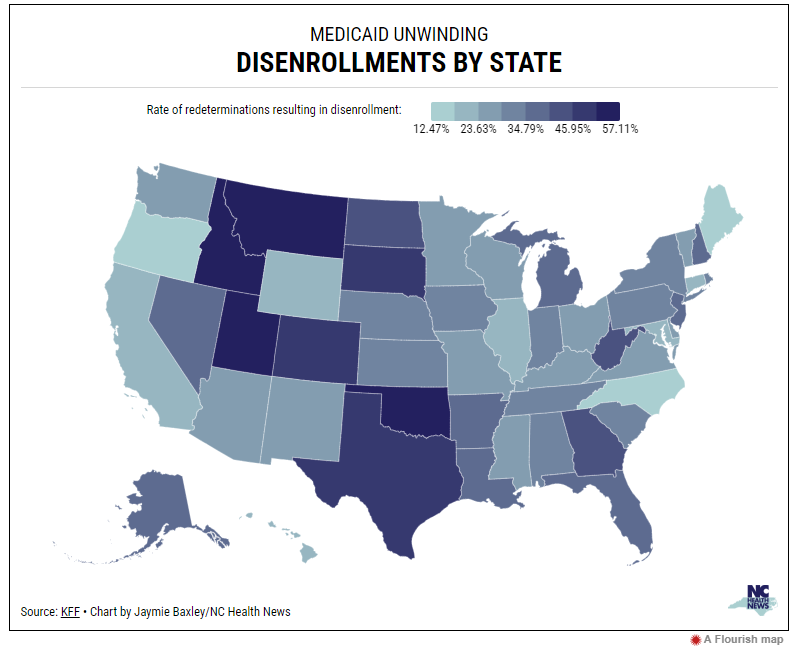
North Carolina has the nation’s lowest rate of Medicaid disenrollments in connection with the unwinding, according to an analysis by KFF.
Only 12 percent of redeterminations completed by the state have resulted in participants losing coverage, well below the national average of about 32 percent. In some states, more than half of redeterminations have ended in terminations because of missing paperwork — an issue that has not been as widespread in North Carolina.
The state’s disenrollment rate was higher during the early months of the unwinding. From June to November of last year, terminations accounted for nearly 19 percent of North Carolina’s unwinding outcomes.
Expansion slowed the purge. The long-awaited measure raised the state’s income limit for Medicaid, extending eligibility to people who make up to 138 percent of the federal poverty level based on their household size, which comes to about $35,600 a year for a family of three. The previous threshold for coverage before expansion had been 100 percent, or about $25,820 a year in income.
When expansion took effect on Dec. 1, many existing beneficiaries who would not have previously passed the redetermination process became eligible for renewal. At the same time, hundreds of thousands of newly eligible North Carolinians were able to sign up for coverage.
“The exact timing of when Medicaid expansion would start was a moving date for most of the unwinding period,” Sandoe said during a recent presentation about the unwinding. “Implementing that, which is very eligibility-focused, on top of all of the unwinding activities certainly took a toll on our staff as well as our IT systems, but we were able to prepare for that and successfully launch.”
Nearly 500,000 people have enrolled in Medicaid since expansion went live. The fast pace of enrollment has surpassed projections by DHHS, which initially expected the measure to add 600,000 beneficiaries over a span of two years.
Because of the expansion, North Carolina is the only state where Medicaid enrollment increased during the unwinding. Every other state saw declines in enrollment, according to an analysis by Georgetown University’s Center for Children and Families.
No contact
The state’s unwinding data stands out for other reasons.
North Carolina implemented an “ex parte” process for redeterminations, using information from places such as wage databases run by the Social Security Administration, the Internal Revenue Service and other agencies, to confirm that participants continued to meet all the requirements for Medicaid. If a person’s information checked out, their coverage was automatically renewed with no action needed on their end.
Ninety-nine percent of North Carolina’s renewals were completed this way, the largest share of any state. The small number of remaining renewals were processed using paper forms filled out by beneficiaries.
“We’re very happy with the level of automation that we’ve been able to introduce over the last several years to help support this process and get folks where we can quickly renew them,” said Julia Lerche, chief strategy officer for DHHS.
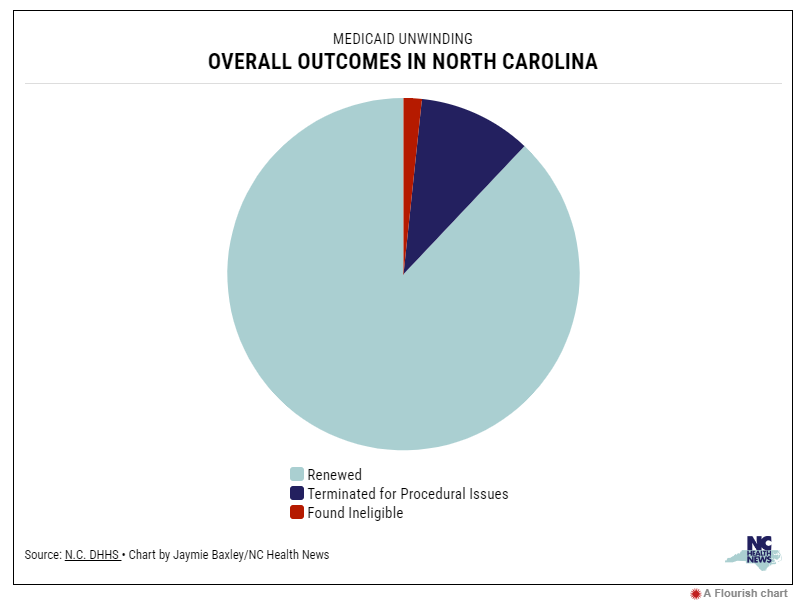
The ex parte system isn’t perfect. Of the more than 281,400 terminations recorded in North Carolina since the start of the unwinding, only about 39,000 involved people who were no longer eligible for Medicaid. The majority of disenrollments involved residents who may have continued to qualify for the program but lost coverage for “procedural reasons.”
Procedural disenrollments typically occur when a local or county office of the Department of Social Services is unable to independently verify a Medicaid participant’s income or household size. If the person fails to respond to a request for the missing information — whether deliberately because they’ve moved into a job with benefits or inadvertently because perhaps they’ve moved and their mail was not forwarded — their benefits are terminated.
Although procedural disenrollments make up a large percentage of unwinding-related terminations in North Carolina, they represent just 10 percent of its outcomes overall. The state has the nation’s second smallest rate of procedural disenrollments in proportion to its total redeterminations, according to KFF.
The state with the smallest rate is Maine, where procedural disenrollments account for 3 percent of all outcomes. Utah has the largest share with 52 percent.
“There’s a lot more work involved in a termination than in a positive renewal of someone,” Lerche said. “It’s the ones that don’t go through the automated processes that the counties are in different places for getting through the full redetermination process. There’s noticing requirements and requests for additional information that have to go out if there isn’t readily available data to confirm their eligibility.”
The Centers for Medicare and Medicaid Services recently gave North Carolina permission to extend its unwinding-related renewals through November. In the meantime, DHHS is urging participants to respond if they receive a request for information from their local DSS office.
“We definitely want to make sure that people are checking their mail and processing those redeterminations if they haven’t gone through that process within the last year,” Sandoe said.
This online, self-paced HIPAA Privacy and Security Training course will provide information on understanding the law and developing best practices within your office to ensure compliance. The course is not a complete summary covering every aspect of HIPAA, which is intended for educational purposes only and does not constitute legal advice. Consult an attorney if legal advice is needed. After completing this training course, the knowledge surrounding HIPAA and protecting patient information will provide confidence.
The objectives for this course include:
Understand HIPAA’s privacy and security rules and how they relate to your job and patients.
Understand the types of health information
How to protect patient's health information
Prevent intentional and unintentional disclosures of patient information and what to do in case of a breach.
Understand what rights the patient has under the law.
Helpful cybersecurity practical tips to use at work and home
For more information, including how to register, click here.
Duke-NUS Medical School Scientists May Have Found Way to Increase Lifespan
(DukeHealth News, SINGAPORE) — An aging population will bring colossal health, social, and economic challenges over the coming decades. As people live longer, anything that might stave off physical decline and frailty to increase life expectancy by just one year is estimated to be worth $38 trillion.
A team of scientists from Duke-NUS Medical School in Singapore think they may have found something that could help.
In a new paper appearing in Nature, the team demonstrated in preclinical mouse studies that the protein interleukin-11 (IL11) actively promotes aging, and that giving an anti-IL11 therapy not only counteracts the deleterious effects of aging but also increases lifespan.
Their studies showed that with age, organs expressed increasing levels of the IL11 protein, a signaling molecule involved in the formation of blood cells, preventing fat accumulation, and some aspects of fertility. When more IL11 was produced by these organs, it promoted fat accumulation in the liver and abdomen, and reduced muscle mass and strength — two conditions that are hallmarks of human aging.
“This project started back in 017 when a collaborator of ours sent us some tissue samples for another project,” said Anissa Widjaja, an assistant professor in the Duke-NUS Cardiovascular and Metabolic Disorders Programme. “Out of curiosity, I ran some experiments to check for IL11 levels. From the readings, we could clearly see that the levels of IL11 increased with age and that’s when we got really excited.”
After establishing IL11’s role in aging, the team demonstrated that by applying this anti-IL11 therapy in the same preclinical model, metabolism was improved. The mice shifted from generating white fat to beneficial brown fat. Brown fat breaks down blood sugar and fat molecules to help maintain body temperature and burn calories.
The researchers also observed improved muscle function and overall better health in their study, as well as an increased lifespan by up to 5 per cent in both sexes.
Unlike other drugs known to inhibit specific pathways involved in aging, such as metformin and rapamycin, anti-IL11 therapy blocks multiple major signaling mechanisms that become dysfunctional with age, offering protection against cardio-metabolic diseases, age-related loss of muscle mass and strength as well as frailty.
In addition to these externally observable changes, anti-IL11 therapy also reduced the rate of telomere shortening and preserved mitochondria’s health and ability to generate energy.
“Our aim is that one day, anti-IL11 therapy will be used as widely as possible, so that people the world over can lead healthier lives for longer,” said Stuart Cook, the Tanoto Foundation Professor of Cardiovascular Medicine at the SingHealth Duke-NUS Academic Medical Centre. “However, this is not easy, as approval pathways for drugs to treat aging are not well-defined, and raising funds to do clinical trials in this area is very challenging.”
Cook is also senior consultant with the Department of Cardiology at the National Heart Centre Singapore.
“Despite average life expectancy increasing markedly over recent decades, there’s a notable disparity between years lived and years of healthy living, free of disease,” said Thomas Coffman, dean of Duke-NUS. “For rapidly aging societies like Singapore’s, this discovery could be transformative, enabling older adults to prolong healthy aging, reducing frailty and risk of falls while improving cardio-metabolic health.
In this latest work, the Duke-NUS team collaborated with scientists from the National Heart Centre Singapore; the MRC Laboratory of Medical Sciences in the UK; the Max Delbruck Centre for Molecular Medicine in Germany; and the University of Melbourne in Australia.
The UNC site lead investigators are Edwin Kim, MD, associate professor of medicine, division chief of UNC Pediatric Allergy & Immunology, and Corinne Keet, MD, PhD, professor of pediatrics, vice chair of clinical and translational research.
Edwin Kim, MD, associate professor of medicine, division chief of UNC Pediatric Allergy & Immunology, and member of UNC Children’s Research Institute
The UNC School of Medicine has been selected to participate in the latest renewal of the Consortium for Food Allergy Research (CoFAR). Sponsored by the National Institutes of Health (NIH), the seven-year grant is for $390,000 per year. The UNC site lead investigators are Edwin Kim, MD, associate professor of medicine, division chief of UNC Pediatric Allergy & Immunology, and member of UNC Children’s Research Institute, and Corinne Keet, MD, PhD, professor of pediatrics, vice chair of clinical and translational research, and associate director of UNC Children’s Research Institute.
CoFAR’s goal is to conduct groundbreaking clinical research on food allergy prevention and therapy on the biological mechanisms underlying food allergy. Conducting clinical research with a consortium of multiple study sites enables investigators to pursue questions that can only be answered through the participation of high numbers of study volunteers.
Corinne Keet, MD, PhD, professor of pediatrics, vice chair of clinical and translational research, and associate director of UNC Children’s Research Institute.
Most recently, CoFAR’s OUtMATCH clinical trial found that treatment with omalizumab (Xolair) substantially increased the amount of peanut, tree nuts, egg, milk and wheat that multi-food allergic children as young as 1 year could consume without experiencing an allergic reaction. The Food and Drug Administration approved Xolair for people with food allergy based on the study findings. Stage one results from the OUtMATCH clinical trial were published in the New England Journal of Medicine in February 2024. Edwin Kim, MD, Corinne Keet, MD, PhD, and UNC School of Medicine colleague Mike Kulis, PhD, were contributing authors.
The new awards will support consortium-wide clinical research projects, which may include treatment or prevention clinical trials. The selection process for these consortium-wide projects began in March 2024. The awards also will support local food allergy-related clinical studies conducted by individual CoFAR sites and the completion of the remaining stages of the OUtMATCH trial.
95% of teens, 40% of kids between 8 and 12 use social media
(CNN, Jacqueline Howard) -- When it comes to the online safety of their children, parents could build a family media plan to set expectations, maintain open conversations with their kids about their social media use, choose content that’s developmentally appropriate for their child, set good examples and balance time with and without devices by creating “screen-free” times.
In the United States, it’s estimated that about 95% of teenagers and 40% of children between the ages of 8 and 12 use some form of social media, according to the report.
“The nice thing about the family media plan is it helps families have conversations to outline what their expectations are, what their plans are with respect to media within the household and even beyond,” said Task Force Co-Chair Miriam Delphin-Rittmon, assistant secretary for mental health and substance use in the US Department of Health and Human Services and leader of the Substance Abuse and Mental Health Services Administration.
In collaboration with the release of the new report, the task force also announced plans to launch new webpages online with resources, including age-based handouts for parents that pediatricians can distribute at well-check visits.
“Children are often regulating and learning how to regulate emotions, and so it is important that media not be used as a replacement for looking at or processing important emotions,” Delphin-Rittmon said. “This report outlines a range of suggested guidelines, and there’ll be a series of ongoing resources as well.”
The report, spanning more than 100 pages, offers recommendations for the tech industry, guidance for clinicians and best practices for parents and caregivers – including “conversation starters for families of tweens and teens” – to improve the health and safety of children’s experiences online.
Some of the conversation starters that are outlined in the new report include: “I’d like us to talk about our family’s approach for setting some boundaries around technology and media use. I was thinking that this is something we could work on together as I’d like to include your input in these decisions.”
Another conversation starter is: “One aspect of social media use that is really important is protecting our privacy. Have you looked at the privacy settings on all your accounts? How are things going with those settings?” Or, “I sometimes have a hard time not checking my phone or feeling the need to respond to texts or emails. I’m working on how to be better about my own boundaries. Let’s help each other find a good balance.”
The report also provides a summary of the risks and benefits of social media use among young people and suggests future research into that space.
“President Biden has made addressing the youth mental health crisis a top priority. That’s why we are taking steps to ensure the safety and well-being of young people when they use social media and online platforms,” HHS Secretary Xavier Becerra said in a news release Monday. “The Biden-Harris Administration has whole-of-government approach to protect the mental health, safety, and privacy of youth online, but it will take more than government alone to achieve results.”
‘We can do better to help young people’
The Kids Online Health and Safety Task Force, under HHS, was developed last year under the Biden-Harris administration to protect and advance the health, safety and privacy of children online. The White House tasked the group with developing recommendations and reviewing the status of industry efforts to promote the health and safety of children.
The new report recommends that the tech industry do more to keep children and teens safe online, such as by making privacy protections for minors the default on social media platforms, limiting “likes” and using data-driven methods to detect and prevent cyberbullying, among other actions.
“One of our key findings was that many of the problems that young people face online are because of how technology companies design their products, and the task force report calls on industry to make design choices that will prioritize kids’ wellbeing,” said Task Force Co-Chair Alan Davidson, assistant secretary of commerce for communications and information and leader of the National Telecommunications and Information Administration.
Some of those design choices include “designing age-appropriate experiences for young people. There’s a big difference between a young child and an older teenager. We need to think about the applications themselves, as there’s a big difference between an education app and a gaming app, and how it approaches engagement,” Davidson said.
“We called on industry to do better around privacy protections for young people, particularly the defaults they set,” he said. “We called on online services to improve systems that address bias and discrimination that young people face.”
Delphin-Rittmon added that, in focus groups hosted by the task force, young people have shared with her that they would like to see more protections as well.
The task force’s report did not speak to any specific pieces of legislation, but President Biden has called for Congress to enact legislative protections when it comes to children’s online safety.
“The bottom line is, we do think legislation is important, but there are things that industry can do today – that it should be doing – to better protect young people,” Davidson said.
As a parent, these conversations around online safety are personal for him.
“Like every parent and caregiver out there, or anybody who speaks to a family member about this, we’ve definitely had challenging conversations with our children about their use of devices and their use of social media,” Davidson said.
“It is possible that I’ve been told that I’m the meanest parent in the world,” he said. “It just speaks to the challenges that caregivers have today. We know that children and young people want to use these devices. They need to have them to be able to be part of their social experiences in many cases, and we can do better to help young people thrive online.”
The American Academy of Pediatrics announced Monday that it supports the task force’s new report and commends the Substance Abuse and Mental Health Services Administration and the Department of Commerce for addressing the impact of social media on the mental health of young people.
“To help make the report’s recommendations accessible and actionable, we’ve published new resources for families and those who work with them, including conversation starters and activities to help parents and caregivers know what to say and how to begin building foundational skills,” Dr. Megan Moreno, co-medical director of the SAMHSA-funded AAP Center of Excellence on Social Media and Youth Mental Health, said in a news release Monday. “We are pleased to be a strong partner in this work.”
Surgeon General warns about social media
US Surgeon General Dr. Vivek Murthy, who is a member of the task force, has been outspoken about these social media-related concerns.
Similar labels on tobacco, first instituted in 1965, led to a steady decline in cigarette smoking in the United States through the past several decades.
“The mental health crisis among young people is an emergency — and social media has emerged as an important contributor,” Murthy wrote in an op-ed in the New York Times in June.
“It is time to require a surgeon general’s warning label on social media platforms, stating that social media is associated with significant mental health harms for adolescents,” he wrote. “A surgeon general’s warning label, which requires congressional action, would regularly remind parents and adolescents that social media has not been proved safe.”
Murthy has warned about social media’s harm to children’s welfare for years.
In May 2023, the Surgeon General issued an advisory that said there’s not enough evidence to determine whether social media is safe enough for children and adolescents’ mental health, saying social media use presents “a profound risk of harm” for kids. He suggested parents restrict their kids’ social media use, saying 13 is too young to join social apps.
But such advisories are designed to call attention to urgent public health – they don’t require action. His declaration in June of an emergency and his appeal to Congress represent his most urgent call to action on the issue so far.
Congress has long chastised social media companies, claiming they pose harm to children. CEOs of tech companies have been grilled routinely on Capitol Hill, most notably Meta CEO Mark Zuckerberg — who publicly apologized to families whose children killed themselves because of online bullying and harassment. But Congress has taken little action to curb children’s social media usage.
Meanwhile, several states have worked to pass legislation to increase the age at which children can begin to use social apps or some of their more time-sucking features, such as algorithms that push people to engage with more content within the app. The bills have been largely bipartisan.
Florida’s Republican Gov. Ron DeSantis in March signed a bill that would prohibit children under 14 from obtaining their own social media accounts, and children under 16 would need parental consent to have accounts. New York Democratic Gov. Kathy Hochul said she would sign legislation passed by the state legislature that would ban social media from using algorithms in children’s feeds, and the bill would also prevent tech companies from sharing information of children under 18.
New study suggests risk of developing persistent symptoms after Covid-19 infection has dropped, but not gone away.
(CNN, Brenda Goodman) -- With a summer wave of Covid-19 infections sweeping the country, a timely new study has looked at the risk of getting long Covid and whether those odds have changed over time.
It found that the likelihood of developing long Covid has dropped since the start of the pandemic but remains substantial, especially for people who aren’t vaccinated against the coronavirus.
About 7% of American adults, roughly 18 million people, have ever had long Covid, according to an analysis by the federal Agency for Healthcare Research and Quality that was published in June. Harvard economist David Cutler estimated in 2022 that the total cost of long Covid to the nation was $3.7 trillion, or 17% of the country’s pre-Covid gross domestic product.
The new study, which was published Wednesday in the New England Journal of Medicine, suggests that the human and financial toll will only grow. The investigation leaned on computers and advanced machine learning to sift through the data in millions of medical records maintained by the Department of Veterans Affairs.
Researchers at Washington University in St. Louis and the VA Health System set out to find people who caught Covid over different points in the pandemic – before vaccines were available, during the period when the Delta variant was dominating transmission and after the Omicron family of variants entered the picture – to see whether the risk of lingering symptoms related to long Covid had changed.
They also considered vaccination status. People were considered vaccinated if they’d had at least their initial series of shots and unvaccinated if they had not.
The study included more than 441,000 people who caught Covid-19 between March 2020 and the end of January 2022 and who lived at least 30 days after infection. Their records were compared with those of more than 4.7 million people who didn’t catch Covid but who were seen at the VA for other reasons over the same time period.
The researchers found that in the first year, when the ancestral coronavirus strain was circulating and there was little immunity against the virus, 1 out of every 10 people who caught Covid went on to have symptoms consistent with long Covid. Symptoms were counted across 10 disease categories as part of long Covid if they were new and developed between 30 days and a year after an initial Covid infection.
Vaccines were a game-changer, cutting the risk of long Covid by half during the Delta wave, which struck in the summer of 2021.
The risk remained high during Delta for people who were not vaccinated, however. Roughly 10% continued to have symptoms that lingered after their initial infection.
During Omicron, which started after Thanksgiving in 2021, 3.5% of people who were vaccinated went on to develop long Covid after the acute phase of infection, while 7.7% of people who were unvaccinated did.
The study has some limitations. People treated at the VA are mostly White men, so the study population isn’t as diverse as the general population, and its findings may not apply to everyone.
For example, a recent study found that nearly 1 in 10 people who get Covid-19 for the first time while pregnant will go on to develop long Covid, an incidence that may be higher than in the general population.
The new study doesn’t account for possible differences in people who stopped after their primary series of Covid-19 vaccines and those who went on to get recommended boosters to keep their immunity up to date as the virus mutated over time.
It also doesn’t consider the immunity that people might develop after infection and reinfection, although that’s a question senior study author Dr. Ziyad Al-Aly, who is chief of research and development at the Veterans Affairs St. Louis Health Care System, said he is looking into as a follow-up.
Al-Aly estimates that nearly three-quarters of the drop in long Covid risk since the early days of the pandemic can be attributed to vaccines.
Although the cause or causes of long Covid symptoms aren’t completely understood, there’s some evidence that people with long Covid continue to have active virus hiding out in their bodies long after their initial infections.
“Vaccines actually help your immune system to get rid of the virus,” Al-Aly said. “They help the immune system suppress the viral load and clear the virus faster.”
The importance of vaccination is a key takeaway from the study, said Dr. Hector Bonilla, who is co-director of Stanford’s Post-Acute Covid-19 Syndrome Clinic.
Bonilla said that when Covid vaccines first became available, most people were eager to get vaccinated, and doctors saw a large drop in the number of new patients coming to them with lingering symptoms.
Now, instead of a flood, they have more of a steady influx of new patients at his clinic, some of whom develop long Covid after a second or third infection.
“Long Covid is a bad illness,” Bonilla said. And many people are caught off-guard when they experience it. But at this point, most have made their minds up about whether to stay up-to-date with their shots. He says more people need to understand that vaccination is a critical way to lower long Covid risk.
“Vaccination is still a very important piece to prevent long Covid symptoms,” Bonilla said.
After the impact of vaccination, the study says, the other 30% of the drop in risk over time is probably to due to changes in the virus itself.
“The virus is changing, is evolving, and it has, even among unvaccinated people, led to less risk of long Covid-19 over time than the original or the very early era of the pandemic,” Al-Aly said.
So according to the latest data, about 3 people out of 100 who are vaccinated with at least their primary series and catch Covid-19 now will go on to have long Covid, Al-Aly said.
That’s important progress but still amounts to a large number of people living with disability and poor health.
Experts who were not involved in the study agree that 3.5% means the risk of long Covid is still substantial and serious.
“Large numbers of new infections and reinfections are still translating into a huge number of persons with long Covid,” Dr. Daniel Griffin, an infectious disease specialist at Columbia University who treats people with long Covid, said in an email.
“While numbers have dropped from the early days of the pandemic, we are still seeing new patients with long Covid that developed after a recent infection,” he added.
Al-Aly said this study and others underscore the need for more funding for coordinated and continuing care for long Covid patients as well as the need for more urgency in the search for treatments.
“I don’t think the US is doing enough to address this problem,” Al-Aly said. “I understand the desire to move on and put it all behind us, but the fact is, there are literally millions of people who are suffering from long Covid, and then even with the decline in number, there will continue to be millions more.
“There is really no plan to tackle this issue, and that cannot be.”
The North Carolina Medical Board is seeking applicants to fill a vacancy for a licensed perfusionist on the Board’s Perfusionist Advisory Committee.
The appointment is for a three-year term ending October 31, 2027. The appointed perfusionist will be eligible to serve an additional three-year term after the completion of the first term.
Applicants must have an active, non-limited license to practice perfusion and no public disciplinary actions with the Board or any other professional licensing board within the past 10 years. Committee members receive a per diem and reimbursement for travel and subsistence as provided in G.S. 93B 5.
Interested applicants should submit a cover letter expressing interest in serving on the Committee, a current curriculum vitae or resume, and two letters of recommendation from individuals familiar with the applicant’s practice of perfusion.
Weight loss drugs like Wegovy will soon be available for people on Medicaid in North Carolina
(News & Observer, Luciana Perez Uribe Guinassi) -- People on Medicaid in North Carolina will soon be able to have obesity management medications covered. The state’s Department of Health and Human Services (DHHS) announced that effective Aug. 1, NC Medicaid will add coverage of FDA-approved obesity management medications for beneficiaries 12 and older.
This coverage includes glucagon-like peptide 1 agonists (GLP-1s). The expanded access for low-income patients on the state and federal health insurance program comes as state government has cut back on access to the drugs for public employees and retirees. GLP-1s exploded in popularity in recent years following the Food and Drug Administration approval of their use for people with obesity who do not have diabetes. These drugs, which work by making people stay fuller for longer, have been found to help people lose over 10% of their body weight. The FDA has approved for weight loss GLP-1 drugs Wegovy and Saxenda, which are manufactured by Novo Nordisk, a Danish company. It’s also approved Zepbound, manufactured by Eli Lilly, a U.S. company.
“NC Medicaid is adding this coverage because of the substantial weight loss associated with these medications and the impact on comorbidities,” DHHS said in a news release. “Prescription obesity management medications are now playing a role in addressing the obesity epidemic, as they may provide additional weight loss benefits compared to lifestyle modifications alone,” the release says. “Certain weight loss therapies, such as glucagon-like peptide 1 agonists (GLP-1s), can help reduce weight, lower blood sugar and lower rates of significant cardiovascular events, such as heart attack and stroke.” WEIGHT-LOSS DRUG COSTS But these drugs come with a hefty price tag: A monthly supply of some of these drugs can cost more than $1,000 without insurance or rebates.
The State Health Plan, which covers hundreds of thousands of state employees, ended coverage of these drugs for weight loss in January, citing rising costs. The plan spent a projected $102 million on the drugs in 2023, or 10% of its roughly $1 billion in net pharmacy spending last year, The News & Observer previously reported. For the added Medicaid coverage, a public notice posted July 10 on DHHS’ website says that the change will cost the state more than $21 million in 2025 and over $15 million in 2026.
During a legislative committee meeting in early March, DHHS Secretary Kody Kinsley spoke on GLP-1 drugs and the potential of expanding NC Medicaid coverage of the drugs for weight loss. Kinsley also told lawmakers that Medicaid already covered GLP-1 drugs, but only for people with diabetes. “It’s frankly so frustrating to me that they are so incredibly expensive relative to what we see in other countries,” Kinsley said.
“I believe that they’re being held back from the people of North Carolina when they could be providing a great deal of value ... so my desire is for us to go after this and figure out a way to both get increased coverage, but to figure out a way that it’s got to be cheaper,” he said.
Get to Know the North Carolina Medical Society Member Candidates
With the historic changes occurring in the presidential race, it is good to remember that every North Carolina House and Senate seat is up for election. The North Carolina Medical Society has many members running for office across the state. Here are interviews with all our member candidates to help you make your decisions.
The North Carolina Medical Board and Wake AHEC, in collaboration with the North Carolina Medical Society and the Addiction Medicine Fellowship program at UNC School of Medicine, have developed an eight-hour CME series that meets the training requirement established by the federal Drug Enforcement Administration (DEA).
This Addiction Medicine Series offers education on a variety of key topics in addiction medicine, including the impacts of stigma, integrating addiction treatment in the primary care setting, and treatment of substance use in special populations.
Here is the full list of classes available in the series:
1. The End of a Bygone Era: Removal of the X-waiver Next Steps in Buprenorphine Prescribing
2. Addiction In Primary Care
3. Responding to Pediatric Substance Use
4. Treating Chronic Pain and Addictions
5. Understanding the Impacts of Stigma: Substance Use Disorder
6. Addiction and Mental Illness
7. The Impact of Stigma and Bias on Substance Use Disorder Diagnosis and Treatment
8. Current State of MOUD Access
Editor's Note: If you are struggling with mental health issues, the North Carolina Medical Society has a Physician Support Line. Click herefor help.
After Two Years, the 988 Suicide and Crisis Lifeline is Answering Millions of Calls, Chats, and Texts
(Read to bottom for NCDHHS and NCMS efforts)
(CNN) -- Two years after the 988 Suicide and Crisis Lifeline launched, the service has answered over 10 million texts, calls and chats, according to new data from the US Department of Health and Human Services.
The lifeline, formerly a 10-digit number, transitioned to three digits in July 2022 as part of the Biden-Harris administration’s strategy to “address our national mental health crisis.”
Since 2022, the administration has invested over $1.5 billion in the effort, including expanding access to services for Spanish speakers, LGBTQI+ youth and young adults, and people who are deaf or hard of hearing, according to HHS.
Those in crisis can reach the lifeline through a phone call, text, web chat and video chat. This year, text messages to 988 have increased 51% and calls 34% from the year before, a sign of the effects of expanded services, according to senior administration officials.
Last year, text messages through the lifeline increased 1,135%, chats answered increased 141% and calls answered increased 46%, a report from the department showed.
The lifeline has made 110,000 contacts in Spanish and 475,000 with LGBTQI+ youth and young adults this year, the new report says. About 20,000 videophone contacts in American Sign Language were made, and 1.2 million calls were answered by the Veterans Crisis Line through 988’s Press 1 option.
“988 is available to everyone,” emphasized Andrea Palm, deputy secretary of the US Department of Health and Human Services. “Having someone on the other end of the line to listen and provide support makes a difference. It really does save lives, and that’s what this is all about.”
This year, HHS expects to roll out georouting technology to route 988 callers and texters based on their physical location versus their area code, the agency says. The move, which would follow an April proposal from the Federal Communications Commission, is expected to improve cell phone users’ connectivity to local services and maintain additional privacy.
The agency also pointed to the bolstering of a national backup system. Funneling federal funding to this system will help ensure that all contacts to 988 are able to be answered, regardless of a state’s local capacity.
A 911 for mental health crises
In 2022, the year 988 debuted, suicide deaths reached a record high in the US, according to provisional data from the US Centers for Disease Control and Prevention. In 2021, the US surgeon general called for the implementation of a national prevention strategy in response to suicide rates that have been rising for decades.
988, like 911, is easy to remember. The switch to the three-digit lifeline saw an over 45% increase in overall contact volume in just the first month, according to HHS.
NCDHHS Celebrates Two Years of 9-8-8 Giving North Carolinians Someone to Contact for Crisis Support
The NC Department of Health and Human Services is celebrating the second anniversary of the 988 Suicide and Crisis Lifeline. In the past two years, 988 crisis counselors in North Carolina have responded to nearly 190,000 calls, texts and chats, providing critical access to mental health and substance use crisis support. In its second year of service, the number of North Carolinians contacting 988 each month has nearly doubled.
On Monday, NCDHHS leaders visited the 988 Call Center in Greenville, NC, to show their appreciation for the dedicated crisis counselors on the other end of the line who provide this important service.
"Currently, more than 8,000 North Carolinians every month are reaching out to 988 because they know help is available when they need it," said NC Health and Human Services Secretary Kody H. Kinsley. "I’m so grateful to the behavioral health counselors who support individuals in a moment of crisis and connect thousands to care."
"The success of 988 is a testament to the fact that, so often, people just need someone to talk to who will support them in their most vulnerable moments," said Kelly Crosbie, MSW, LCSW, Director of the NCDHHS Division of Mental Health, Developmental Disabilities, and Substance Use Services. "For many of the thousands of people calling, 988 is a first step to accessing the services and supports they need for long-term healing and recovery."
In the past year, 988 Lifeline services have expanded to include chat and text options in Spanish and video chat capabilities for people with disabilities, furthering its commitment to accessibility and inclusivity. Veterans and their families, as well as Spanish-speaking callers, who reach out to 988 have the option to connect with specialized crisis services that provide culturally competent support. LGBTQ+ youth and young adults who contact 988 can access dedicated help through The Trevor Project Line, which offers support tailored to their community.
The 988 Performance Dashboard enables the department to make data-informed decisions to continue to improve access to services.
The 988 Suicide and Crisis Lifeline is an important component of NCDHHS’ ongoing work to ensure every North Carolinian has someone to contact, someone to respond and a safe place for help when experiencing a behavioral health crisis. Of the $835 million investment in behavioral health in the 2023 state budget, NCDHHS has committed more than $130 million to transforming North Carolina’s behavioral health crisis response services, which includes 988 – shifting the system from a state of crisis to a state of care.
NCMS has ways to help physicians
The NCMS continues it's work to improve your practice environment. Recently, The North Carolina Clinician and Physician Retention and Well-being (NCCPRW) Consortium announced a new statewide initiative with the Dr. Lorna Breen Heroes’ Foundation, the only non-profit organization exclusively focused on health worker mental health and well-being.
ALL IN: Caring for North Carolina’s Caregivers seeks to support the state’s hospitals and health systems in redesigning their workplace environments to help team members feel valued and supported while creating the best environments to deliver safe, quality patient care.
You can learn more about this initiative at the 2024 NCMS LEAD Conference. Register now for more on this, AI, Prior Auth, CPOM, and many more issues impacting your day-to-day live. We will also have vendors from across the state with things to make your life easier.
Biden-Harris Administration Releases Final Part Two Guidance to Help People with Medicare Prescription Drug Coverage Manage Prescription Drug Costs
Beginning in 2025, a new provision will allow people with Medicare prescription drug coverage to pay their out-of-pocket costs in monthly installments, rather than all at once. The U.S. Department of Health and Human Services released additional guidance on the program, called the Medicare Prescription Payment Plan, earlier this week.
“No one should have to choose between paying for medicine or putting food on the table,” Health and Human Services Secretary Xavier Becerra previously said. He added: “We are easing the burden by allowing payments to be spread out over time. HHS will continue tackling high health care costs on all fronts so that every American can benefit from access to life-saving medicines.”
The program is part of the Inflation Reduction Act, which also includes another health care provision taking effect next year: Those with Medicare drug coverage will have their out-of-pocket prescription drug costs capped at $2,000. Click here for a fact sheet on the payment plan, and here for tips on choosing Medicare drug coverage.
The NCMS Nominating and Leadership Development Committee convened via Zoom on June 1, 2024, and again on Wednesday June 19, 2024, to interview candidates and vote for the initial slate of nominees for officers, directors, and AMA delegates. Per NCMS Bylaws, Component Societies and Specialty Societies may submit additional nominations for these positions between now and August 9, 2024. Please use this form to submit nominations. For questions on the nominating process, contact Evan Simmons.
The following slate of nominees was selected by the Nominating and Leadership Development Committee:
NCMS Board of Directors
President Elect: Carl Westcott, MD
Region 1 Representative: Claude Jarrett, MD
At-Large Member: Jugta Kahai, MD
At-Large Member: C. Labron Chambers, Jr., MD
NC American Medical Association Delegation
AMA Delegate: E. Rebecca Hayes, MD
AMA Delegate: Karen Smith, MD
AMA Delegate: Royce Syracuse, MD
AMA Delegate: Arthur Apolinario, MD
Nominating and Leadership Development Committee
NLDC Region 1: Joe Navejar, MD
NLDC Region 1: Sherry Ikalowych, MD
NLDC Region 2: Hans Arora, MD
NLDC Region 3: Katie Borders, MD
NLDC Region 3: Sankalp Puri, MD
NLDC Region 4: Benjamin Deschner, MD
NLDC Region 4: Shannon Dowler, MD
The Committee will reconvene to determine the eligibility of any additional nominees. The final slate of candidates will be published to members by October 3, 2024. Under the NCMS’ governance structure, online voting for the candidates will begin on October 14, 2024, and continue until midnight on October 30, 2024. Paper ballots also will be available to those who need them.
The following are the members of the NCMS Nominating and Leadership Development Committee:
Please share your stories here on how corporate interventions in medicine have impacted you and your practice. This includes private equity acquisitions, noncompete agreements, management service organizations, and any business intervention that has impacted your ability to practice medicine.
Illustration: Francis Scialabba, Photo: Getty Images
Physician burnout falls to lowest levels since pandemic
Burnout Costs the US Health System an Estimated $4.6 Billion Annually
(Healthcare Brew, Maia Anderson) -- Physician burnout is on the decline after spiking to unprecedented levels during the Covid-19 pandemic, according to a survey from professional group the American Medical Association (AMA).
The survey, which was released in early July, shows that 48.2% of physicians claimed to have at least one burnout symptom in 2023, down from 53% in 2022 and the record high of 62.8% in 2021. Before the pandemic, burnout had fallen from 44.4% in 2017 to 41.9% in 2019, according to an October 2023 study from Harvard Medical School and Massachusetts General Hospital in Boston.
“It is a good sign that burnout has started to decrease, but the levels are still far higher than they should be, and are still at a concerning rate that has important negative impacts for patients, for payers, for the health system at large, [and] for the country at large,” Christine Sinsky, VP of professional satisfaction at the AMA, told Healthcare Brew.
Sinsky said it’s likely that burnout is on the decline because some stressors that peaked during the pandemic are now less prevalent, such as the volume of patients in intensive care units. But “the underlying causes of burnout for the majority of physicians persist,” such as having to spend more time on clerical work than clinical care, she said.
Some background: Burnout is a pricey problem. It costs the US an estimated $4.6 billion per year, mainly from costs associated with turnover and fewer clinical hours, according to a 2019 study. For each doctor that quits due to burnout, the AMA estimates it costs a facility as much as $1 million depending on the doctor’s specialty.
Burnout has become so prevalent in recent years that the CDC started a federal campaign in late 2023 to help hospitals tackle the issue. The campaign, called Impact Wellbeing, is intended to help hospital leaders create policies that reduce worker burnout and help employees feel safe seeking mental health care.
According to the AMA, symptoms of burnout include emotional exhaustion, depersonalization (which translates to low empathy or negative demeanor toward patients), and feeling decreased personal achievement.
By the numbers: In addition to a decline in burnout, the AMA’s survey shows an improvement in physicians’ work experience, with job satisfaction rising to 72.1% in 2023, up from 68% in 2022. Additionally, 50.7% of physicians said they felt a great deal of stress from their job in 2023, compared to 55.6% in 2022. And 50.4% of physicians said they felt their organization valued them, compared to 46.3% in 2022.
But more than one-quarter of those surveyed said their workplace didn’t employ enough physicians or support staff, with 12.7% feeling stress from administrative tasks.
The AMA’s survey included more than 12,400 doctors working at 81 health systems across 31 states, and was conducted from January 1 to December 31, 2023.
How to improve burnout levels? Sinsky said she recommends healthcare organizations take a systemic approach to improving physician well-being rather than addressing it on an individual level.
“We make very clear to organizations that burnout, while it manifests in individuals, it originates in systems,” Sinsky said, adding that health system leaders have the power to improve their organization’s culture.
“It’s in practice efficiency where I think organizations can make the biggest difference,” she said.
NCMS and NCCPRW Offer Statewide Initiative Focused on Health Worker Mental Health and Well-being
The North Carolina Clinician and Physician Retention and Well-being (NCCPRW) Consortium has a new statewide initiative with the Dr. Lorna Breen Heroes’ Foundation, the only non-profit organization exclusively focused on health worker mental health and well-being. ALL IN: Caring for North Carolina’s Caregivers seeks to support the state’s hospitals and health systems in redesigning their workplace environments to help team members feel valued and supported while creating the best environments to deliver safe, quality patient care.
"Physician stress and burnout is a top priority for the North Carolina Medical Society," NCMS VP of Professional Growth Monecia Thomas says, "our ALL IN: Caring for North Carolina's Caregivers program tackles this issue head-on. Join us to learn more on November 2 at the NCMS LEAD Conference. It is a great way to have your voice heard. Corey Feist, JD, MBA, will be on-hand to talk abut ways NCMS and NCCPRW are working to remove invasive or stigmatizing language surround mental health from credentialing applications, addendums, and peer review forms."
Registration for the 2024 LEAD Conference and Golden Stethoscope Awards Banquet is open. The North Carolina Medical Society is celebrating 175 years! Don't miss this chance to make new friends, improve your practice, and have a great time!
Overdose deaths in North Carolina have increased 84 percent since 2019
In a letter from Zack Moore, MD, MPH, and Kimberly McDonald, MD, MPH, NCMS Member, of the NC DHHS Division of Public Health, medical providers are being asked to to take action to protect and advance drug user health. The letter states that the number of overdose deaths in North Carolina (NC) has increased 84% since 2019. These overdose deaths are 100% preventable. Risks associated with illicit substance use can be mitigated through evidence-based strategies, including syringe services programs (SSPs). These programs play a vital role in public health, safety, and the provision of compassionate, person-centered care for people who use drugs and people with substance use disorders.
Trusted healthcare providers play a crucial role in supporting both the health of people who use drugs as well as the success of SSPs within our communities and healthcare systems.
Healthcare providers can take several actions to protect and advance drug user health:
Identify the SSP(s) in your community. Contact these SSPs or visit their programs to learn about the services they provide.
Make referrals to SSPs for patients who could benefit from their services.
Collaborate with SSPs to learn more about current substance use trends they are seeing and hearing about from people who are directly impacted.
By learning about and working with SSPs, you can help ensure comprehensive care for individuals with substance use disorders, including referrals to addiction treatment, mental health services, and other healthcare needs. Your support and advocacy for these programs are essential in making our communities healthier and safer for everyone.
Healthcare providers can further support their local SSP by providing training or educational resources on topics like wound care practices, first aid and other health-related topics. It is also important that healthcare providers and other staff in the healthcare setting treat all members of the community with compassion and kindness. Many SSPs can provide training on person-centered, culturally relevant harm reduction topics.
Clinical studies and real-world implementation of SSPs show they are effective at reducing disease transmission and promoting safer use practices without increasing drug use. Endorsement of SSPs by leading health organizations, including the Centers for Disease Control and Prevention (CDC), the World Health Organization (WHO), and the American Medical Association (AMA) reflects the consensus among healthcare and public health organizations that SSPs are a critical component of comprehensive harm reduction strategies.
One of the things that makes the syringe service programs so effective is that many are led and staffed by people with lived experience. Many people who are living with substance use disorders struggle with stigma, shame, and isolation. SSP staff can utilize practical skills like motivational interviewing while sharing their own experiences to help others navigate these challenges. Their dedication has led to tangible improvements in the lives of countless individuals and families affected by substance use across the state.
SSPs can be the initial contact between healthcare providers and people who use drugs, fostering trust and engagement in ongoing care through a nonjudgmental environment. This linkage to care is a vital service provided by SSPs. In 2022-2023, SSPs in North Carolina made over 8,500 referrals for housing support, primary care, sexual and reproductive health services, wound care, dental services and other critical services. Twenty-four SSPs in North Carolina offered on-site testing services which resulted in 960 HIV tests and 1,000 hepatitis C tests. Programs that were not providing on-site testing made 5,505 referrals to HIV and hepatitis C testing and treatment providers. SSPs also provide options for safer disposal of used syringes and access to other injection supplies, thus helping to prevent spread of infectious diseases, which is far more cost effective than treatment. SSPs preserve public health and safety by reducing infections such as HIV, viral hepatitis, and endocarditis among people who inject drugs and by offering community health education, providing resources and information about infectious diseases as well as safer use practices.
SSPs are responsible for improving access to overdose prevention tools and education. Naloxone is the FDA approved medication to reverse overdoses and prevent death. SSPs put naloxone directly into the hands of people in the community who are at highest risk of experiencing or witnessing an overdose. SSPs have shown to provide low-barrier, free access to this life-saving medication which was reported to be used to reverse nearly 17,000 overdoses in North Carolina from 2022-2023. SSPs provide access to tools like fentanyl and xylazine tests strips which allow people to better understand what drugs they are using and empower them to make informed decisions about their health and wellness. These tools can aid in the prevention of overdose among people who may be opioid naive or may not want to use illicit fentanyl, xylazine or other substances.
Finally, providing access to sterile syringes and related health services is an ethical approach that respects the human rights of people who use drugs and ensures they receive the necessary care and support without facing stigma or judgment. Syringe services programs embody a compassionate and pragmatic approach to substance use, focusing on harm reduction and providing comprehensive support to help individuals achieve better health outcomes.
We couldn't have done it withoutYOU! In this week's Political Pulse, John Thompson and Randy Aldridge talk about how members of the North Carolina Medical Society came together for a successful Short Session. They also go over ways members can get involved without coming to Raleigh. See the recap and hear how you can help as well.






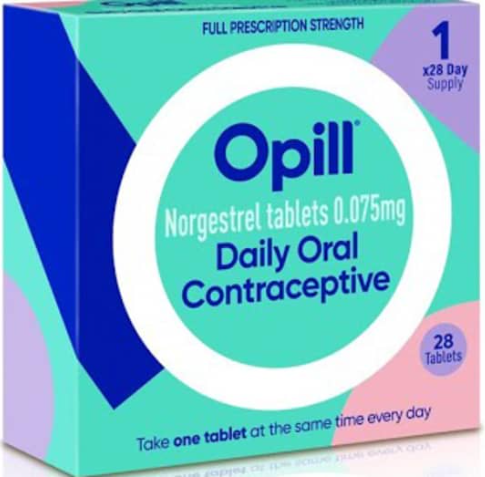






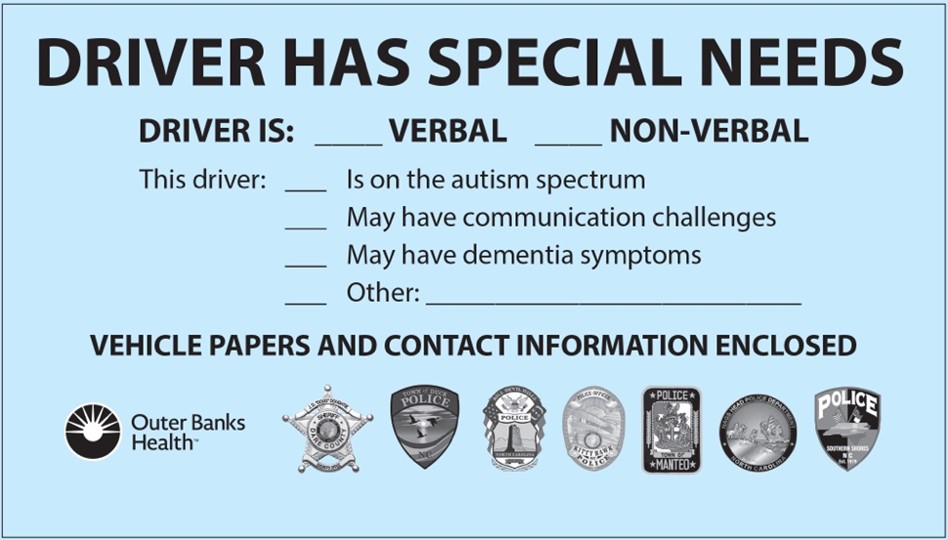


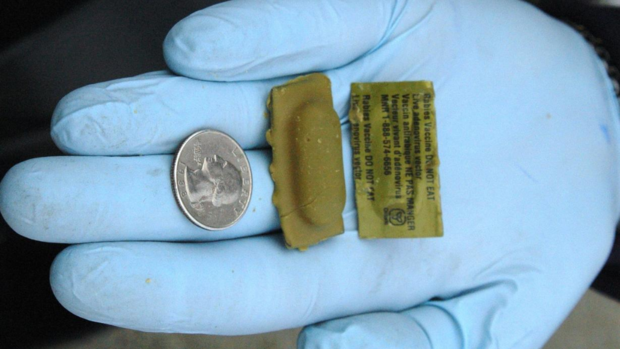 (image credit: U.S. Department Of Agriculture)








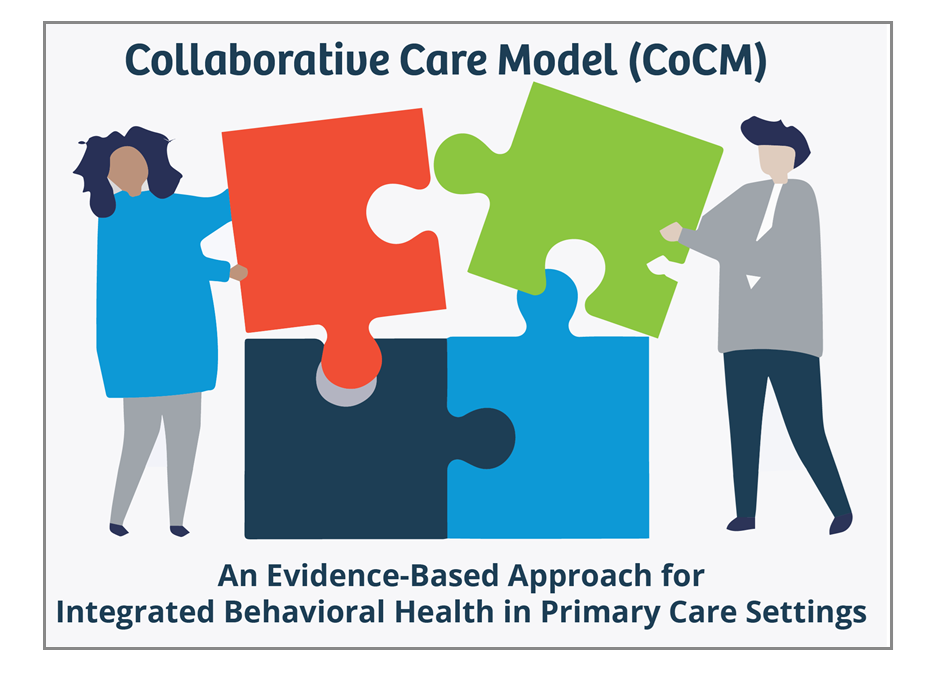







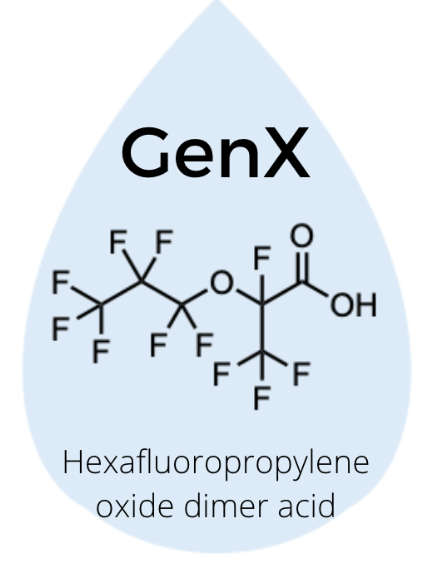
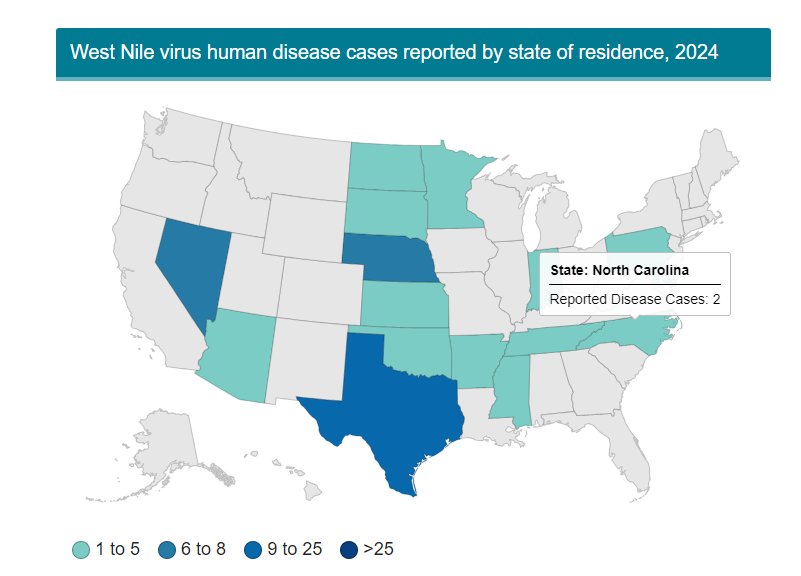


















 Photo: Andrea Vilchez/ISI/Getty Images