Register Now for Thursday's Medicaid Managed Care Back Porch Chat
Medicaid Managed Care Back Porch Chat:
Key Medicaid Updates
Thursday, May 16 | 5:30 p.m.
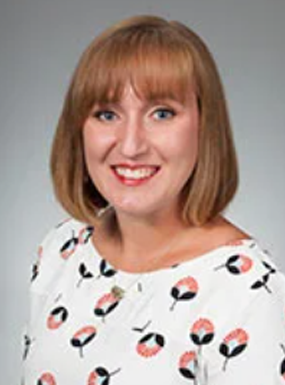
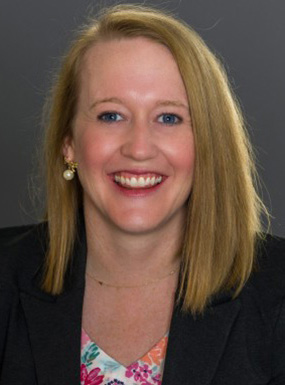
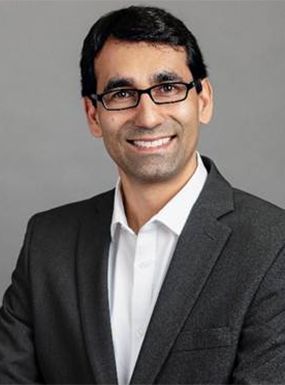
Join this chat on Thursday, May 16 from 5:30-6:30 p.m. for the May Back Porch Chat, hosted by Janelle White, MD, Chief Medical Officer of Medicaid, Sarah Gregosky, Chief Operating Officer, NC Medicaid, and Arianna Keil, MD, Chief Quality Officer, NC Medicaid.
Get important news for all providers about NC Medicaid on preparing for Tailored Plan Launch, results from the 2023 PCP OBGYN Experience Survey, and additional clinical updates, including:
- Pharmacy Updates
- Making Care Primary Request for Information
- Stakeholder Communication Updates
- Maternity Coverage and Reimbursement Bulletin

Medicaid Managed Care Additional Webinar:
Tailored Plan Claim Support for Providers
Wednesday, May 22 | 5:30 p.m.
This webinar is designed for billing staff involved in claim submission to understand how to submit claims when Tailored Plans go live on July 1.


Using ACT to Help Cancer Survivors Move Forward After Treatment
Using Acceptance and Commitment Therapy (ACT) to Help Cancer Survivors Move Forward After Treatment
Wednesday, May 15
4:00 – 5:00 PM EST/EDT
Cancer survivors may face many unique psychosocial challenges. Acceptance and Commitment Therapy (ACT) is an evidence-based psychotherapeutic approach that can effectively teach patients skills to manage these challenges after completing cancer treatment. We will take you through case vignettes to show you how ACT can be applied to this patient population.
Learning Objectives:
- Describe the psychosocial challenges faced by cancer survivors
- Identify core concepts of Acceptance and Commitment Therapy
(ACT) - Explain how ACT can be used to address psychosocial concerns in
cancer survivorship
Get additional information and register here.
Download a sharable flyer here.

NCDHHS Pilots Mobile Crisis, Co-Responder Models for Behavioral Health Crisis Response
The North Carolina Department of Health and Human Services announced a $1.35 million investment to begin piloting trauma-informed mobile crisis and crisis co-responder services. These services will deploy teams who are trained and experienced to respond to people experiencing a behavioral health emergency, including mental health professionals and peer support specialists who can de-escalate crisis situations and provide appropriate support. This investment is part of the department’s ongoing effort to transform the behavioral health crisis response system to ensure North Carolinians have someone to call, someone to respond and somewhere to go for care. These pilots focus on the second piece of that crisis response system: someone to respond.
“We’re building the behavioral health care system in North Carolina from the ground up,” said NC Health and Human Services Secretary Kody H. Kinsley. “By intervening earlier and with better care options, we can break the cycle that funnels people in crisis towards emergency departments and incarceration. This starts with having the right responders to de-escalate situations and connect people with the support they truly need, paving the way for a healthier future for both them and our communities.”
In communities lacking robust behavioral health services, law enforcement becomes the default response for those experiencing mental health emergencies, contributing to the continued cycle of overrepresentation of people with complex behavioral health needs and substance use disorder among the justice-involved population. In North Carolina, serious mental illness affects 15% of men and 31% of women in jails, and 85% of the prison population has a substance use disorder or was incarcerated for a crime related to substance use.
Read NCDHHS's full press release on this important initiative here.
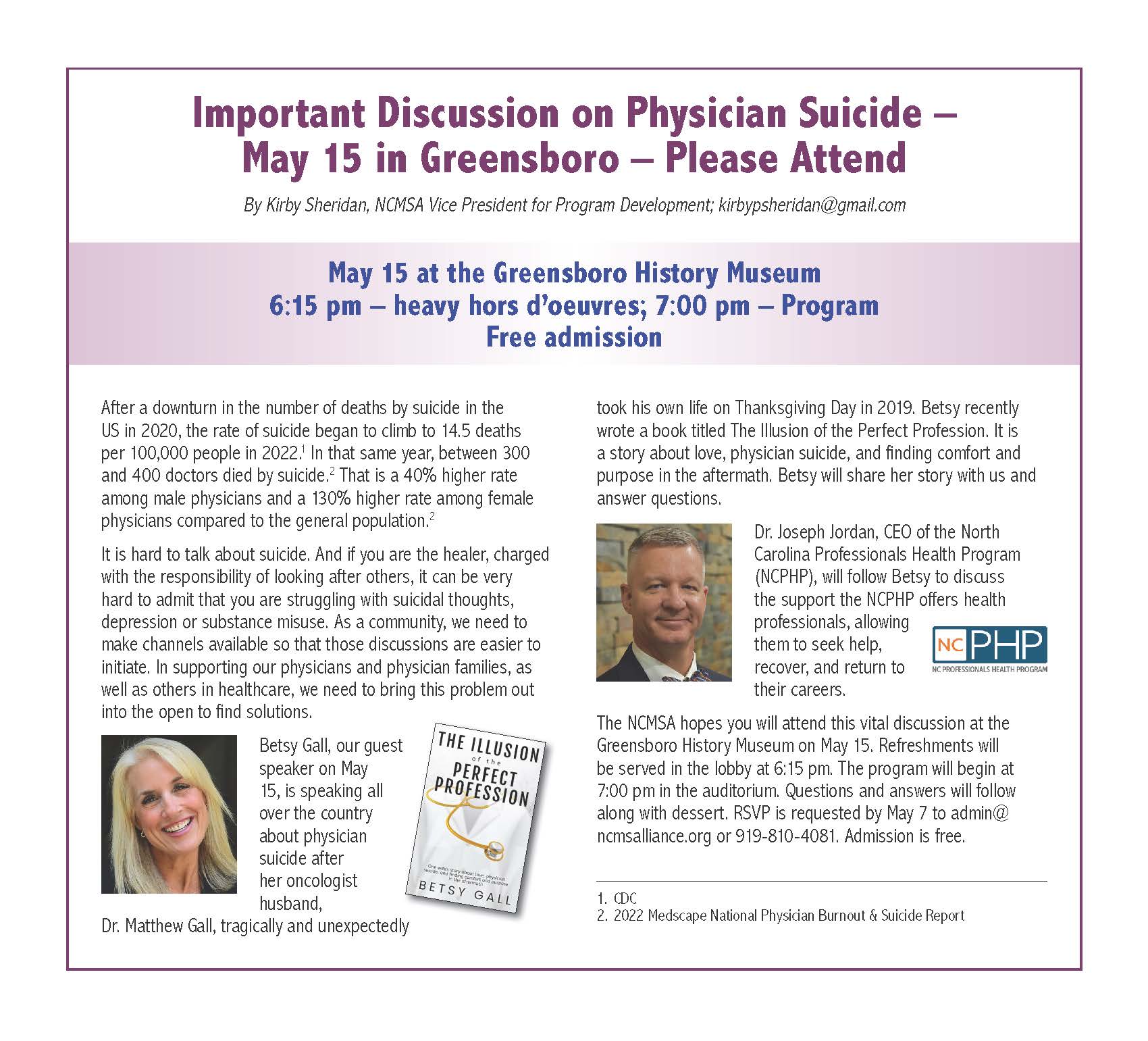
Register Now! Talking About Physician Suicide and "The Illusion of the Perfect Profession"
The North Carolina Medical Society Alliance is planning a free event on Wednesday, May 15, in Greensboro, to address an important topic, physician suicide.
This event features speaker and author, Betsy Gall with a follow-up discussion from Dr. Joseph Jordan, CEO of the North Carolina Professionals Health Program (NCPHP).
Greensboro History Museum
130 Summit Ave.
Greensboro, NC 27401
Wednesday, May 15
6:15 pm – heavy hors d’oeuvres
7:00 pm – Program
Free admission
Download below flyer here (PDF).
RSVP to admin@ncmsalliance.org or 919-810-4081.

Register Now! Advancing Health Equity Through Resistance: A State of the Union on Threats and Opportunities
Advancing Health Equity Through Resistance:
A State of the Union on Threats and Opportunities
Thursday, May 30, 2024
3:30 PM - 5:00 PM CST
This National Health Equity Grand Rounds event will serve as a proverbial State of the Union for health justice work in the United States.
Nationally renowned speakers including public health leaders, healthcare professionals, policy experts and organizers with deep experience in community-based health justice work will gather to share their perspectives on where we collectively stand in our efforts to advance public health for all people living in the United States.
They’ll delve into successful efforts to advance health equity, discuss the coordinated efforts to dismantle this work in various parts of the country, and identify strategies to counter resistance while building a stronger multiracial democracy equipped to support health for every individual and community.
For more information, including a full list of panelists, click here.

30 Year Study: The Ultra-Processed Foods You and Your Patients Need to Avoid
Health professionals have long warned that ultra-processed foods can have detrimental impacts on the body
(CNN - Madeline Holcombe) -- Eating ultraprocessed foods is associated with an early risk of death, according to a 30-year study — but different foods have different impacts.
Processed meats and sugary foods and drinks aren’t correlated with the same risks as ultraprocessed whole grains, for example, said lead study author Dr. Mingyang Song, associate professor of clinical epidemiology and nutrition at Harvard’s TH Chan School of Public Health.
The study analyzed data from more than 100,000 health professionals in the United States with no history of cancer, cardiovascular disease or diabetes. From 1986 to 2018, the participants provided information on their health and lifestyle habits every two years.
Every four years, they completed a detailed food questionnaire.
The group eating the least ultraprocessed food ate about three servings a day on average, while the highest averaged seven servings a day, according to the study published Wednesday in The BMJ journal.
Those who ate the most had a 4% higher risk of deaths by any cause, including a 9% increased risk of neurodegenerative deaths, the data showed.
Song described the correlation as “moderate,” noting that the connection was not equally strong among all kinds of ultraprocessed foods.
“The positive association is mainly driven by a few subgroups including processed meat and sugar sweetened or artificially sweetened beverages,” he said.
Findings in this study were consistent with hundreds of others in the field, but what makes this one unique is its parsing out of different subgroups within the ultraprocessed food category, said Dr. Marion Nestle, the Paulette Goddard professor emerita of nutrition, food studies and public health at New York University.
Do we need to get rid of all ultraprocessed foods?
Song wouldn’t necessarily advise a complete rejection of all ultraprocessed foods because it is a diverse category, he said.
“Cereals, whole grain breads, for example, they are also considered ultraprocessed food, but they contain various beneficial nutrients like fiber, vitamins and minerals,” he said. “On the other hand, I do think people should try to avoid or limit the consumption of certain ultraprocessed foods, such as processed meat, sugar-sweetened beverages and also potentially artificially sweetened beverages.”
There are also more questions that need to be answered when it comes to ultraprocessed foods.
First, the recent study is strong because of the length of time covered, but it is an observational study. That means that while researchers can observe a correlation, they can’t say that the foods were the cause of the deaths, said Dr. Peter Wilde, emeritus fellow at Quadram Institute Bioscience in the United Kingdom.
Researchers also need to look more at the components of ultraprocessed foods that might be affecting health — whether they be food additives, emulsifiers or flavors — to advise governments and institutions on how to regulate foods, Song said.
Overall diet matters most
Researchers also found that the most important factor to reducing risk of death is the quality of a person’s overall diet, Song said.
“If people maintain a generally healthy diet, I don’t think they need to be like scared or be freaked out,” he said. “The overall dietary pattern is still the predominant factor determining the health outcomes.”
Researchers also need to look more at the components of ultraprocessed foods that might be affecting health — whether they be food additives, emulsifiers or flavors — to advise governments and institutions on how to regulate foods, Song said.
Overall diet matters most
Researchers also found that the most important factor to reducing risk of death is the quality of a person’s overall diet, Song said.
“If people maintain a generally healthy diet, I don’t think they need to be like scared or be freaked out,” he said. “The overall dietary pattern is still the predominant factor determining the health outcomes.”
“If you are worried about food additives, then choose foods that have low levels of additives,” he said in an email. “Just be mindful of the nutritional content of (the ultraprocessed foods) that you do choose to consume.”
It is also important to recognize that foods need to be eaten in balance. Fruit juice contains beneficial vitamins, minerals and antioxidants when consumed in moderation, but too much will have high levels of sugar that may override their benefits, Wilde said.
“This is not black and white,” he said. “A particular food is not either good or bad, it will contain elements of both, and the balance between the two may depend on how much you eat.”

AI is Dreaming Up Drugs That No One Has Ever Seen. Now We've Got to See if They Work.
MIT Technology Review Looks at What is Happening with Artificial Intelligence and Drug Research
(MIT Tech Review, Will Douglas Heaven) -- At 82 years old, with an aggressive form of blood cancer that six courses of chemotherapy had failed to eliminate, Paul appeared to be out of options. With each long and unpleasant round of treatment, his doctors had been working their way down a list of common cancer drugs, hoping to hit on something that would prove effective—and crossing them off one by one. The usual cancer killers were not doing their job.
With nothing to lose, Paul’s doctors enrolled him in a trial set up by the Medical University of Vienna in Austria, where he lives. (Paul's real name is not known because his identify was obscured in the trial.) The university was testing a new matchmaking technology developed by a UK-based company called Exscientia that pairs individual patients with the precise drugs they need, taking into account the subtle biological differences between people.
The researchers took a small sample of tissue from Paul. They divided the sample, which included both normal cells and cancer cells, into more than a hundred pieces and exposed them to various cocktails of drugs. Then, using robotic automation and computer vision (machine-learning models trained to identify small changes in cells), they watched to see what would happen.
In effect, the researchers were doing what the doctors had done: trying different drugs to see what worked. But instead of putting a patient through multiple months-long courses of chemotherapy, they were testing dozens of treatments all at the same time.
The approach allowed the team to carry out an exhaustive search for the right drug. Some of the medicines didn’t kill Paul’s cancer cells. Others harmed his healthy cells. Paul was too frail to take the drug that came out on top. So he was given the runner-up in the matchmaking process: a cancer drug marketed by the pharma giant Johnson & Johnson that Paul’s doctors had not tried because previous trials had suggested it was not effective at treating his type of cancer.
It worked. Two years on, Paul was in complete remission—his cancer was gone. The approach is a big change for the treatment of cancer, says Exscientia’s CEO, Andrew Hopkins: “The technology we have to test drugs in the clinic really does translate to real patients.”
Selecting the right drug is just half the problem that Exscientia wants to solve. The company is set on overhauling the entire drug development pipeline. In addition to pairing patients up with existing drugs, Exscientia is using machine learning to design new ones. This could in turn yield even more options to sift through when looking for a match.
The first drugs designed with the help of AI are now in clinical trials, the rigorous tests done on human volunteers to see if a treatment is safe—and really works—before regulators clear them for widespread use. Since 2021, two drugs that Exscientia developed (or co-developed with other pharma companies) have started the process. The company is on the way to submitting two more.
“If we were using a traditional approach, we couldn’t have scaled this fast,” Hopkins says.
Exscientia isn’t alone. There are now hundreds of startups exploring the use of machine learning in the pharmaceutical industry, says Nathan Benaich at Air Street Capital, a VC firm that invests in biotech and life sciences companies: “Early signs were exciting enough to attract big money.”
Today, on average, it takes more than 10 years and billions of dollars to develop a new drug. The vision is to use AI to make drug discovery faster and cheaper. By predicting how potential drugs might behave in the body and discarding dead-end compounds before they leave the computer, machine-learning models can cut down on the need for painstaking lab work.
And there is always a need for new drugs, says Adityo Prakash, CEO of the California-based drug company Verseon: “There are still too many diseases we can’t treat or can only treat with three-mile-long lists of side effects.”
Now, new labs are being built around the world. Last year Exscientia opened a new research center in Vienna; in February, Insilico Medicine, a drug discovery firm based in Hong Kong, opened a large new lab in Abu Dhabi. All told, around two dozen drugs (and counting) that were developed with the assistance of AI are now in or entering clinical trials.
“If somebody tells you they can perfectly predict which drug molecule can get through the gut … they probably also have land to sell you on Mars.”
Adityo Prakash, CEO of Verseon
We’re seeing this uptick in activity and investment because increasing automation in the pharmaceutical industry has started to produce enough chemical and biological data to train good machine-learning models, explains Sean McClain, founder and CEO of Absci, a firm based in Vancouver, Washington, that uses AI to search through billions of potential drug designs. “Now is the time,” McClain says. “We’re going to see huge transformation in this industry over the next five years.”
Yet it is still early days for AI drug discovery. There are a lot of AI companies making claims they can’t back up, says Prakash: “If somebody tells you they can perfectly predict which drug molecule can get through the gut or not get broken up by the liver, things like that, they probably also have land to sell you on Mars.”
And the technology is not a panacea: experiments on cells and tissues in the lab and tests in humans—the slowest and most expensive parts of the development process—cannot be cut out entirely. “It’s saving us a lot of time. It’s already doing a lot of the steps that we used to do by hand,” says Luisa Salter-Cid, chief scientific officer at Pioneering Medicines, part of the startup incubator Flagship Pioneering in Cambridge, Massachusetts. “But the ultimate validation needs to be done in the lab.” Still, AI is already changing how drugs are being made. It could be a few years yet before the first drugs designed with the help of AI hit the market, but the technology is set to shake up the pharma industry, from the earliest stages of drug design to the final approval process.
The basic steps involved in developing a new drug from scratch haven’t changed much. First, pick a target in the body that the drug will interact with, such as a protein; then design a molecule that will do something to that target, such as change how it works or shut it down. Next, make that molecule in a lab and check that it actually does what it was designed to do (and nothing else); and finally, test it in humans to see if it is both safe and effective.
For decades chemists have screened candidate drugs by putting samples of the desired target into lots of little compartments in a lab, adding different molecules, and watching for a reaction. Then they repeat this process many times, tweaking the structure of the candidate drug molecules—swapping out this atom for that one—and so on. Automation has sped things up, but the core process of trial and error is unavoidable.
But test tubes are not bodies. Many drug molecules that appear to do their job in the lab end up failing when they are eventually tested in people. “The whole process of drug discovery is about failure,” says biologist Richard Law, chief business officer at Exscientia. “The reason that the cost of coming up with a drug is so high is because you have to design and test 20 drugs to get one to work.”
This new generation of AI companies is focusing on three key failure points in the drug development pipeline: picking the right target in the body, designing the right molecule to interact with it, and determining which patients that molecule is most likely to help.
Computational techniques like molecular modeling have been reshaping the drug development pipeline for decades. But even the most powerful approaches have involved building models by hand, a process that is slow, hard, and liable to yield simulations that diverge from real-world conditions. With machine learning, vast amounts of data, including drug and molecular data, can be harnessed to build complex models automatically. This makes it far easier—and faster—to predict how drugs might behave in the body, allowing many early experiments to be carried out in silico. Machine-learning models can also sift through vast, untapped pools of potential drug molecules in a way that was not previously possible. The upshot is that the hard, but essential, work in laboratories (and later in clinical trials) need only be carried out on those molecules with the best chances of success.
Before they even get to simulating drug behavior, many companies are applying machine learning to the problem of identifying targets. Exscientia and others use natural-language processing to mine data from vast archives of scientific reports going back decades, including hundreds of thousands of published gene sequences and millions of academic papers. The information extracted from these documents is encoded in knowledge graphs—a way to organize data that captures links including causal relationships such as “A causes B.” Machine-learning models can then predict which targets might be the most promising ones to focus on in trying to treat a particular disease.
Applying natural-language processing to data mining is not new, but pharmaceutical companies, including the bigger players, are now making it a key part of their process, hoping it can help them find connections that humans might have missed.
Jim Weatherall, vice president of data science and AI at AstraZeneca, says that getting AI to crawl through lots of biomedical data has helped him and his team find a few drug targets they would not otherwise have considered. “It’s made a real difference,” he says. “No human is going to read millions of biology papers.” Weatherall says the technique has revealed connections between things that might seem unrelated, such as a recent finding and a forgotten result from 10 years ago. “Our biologists then go and look at that and see if it makes sense,” says Weatherall. It’s still early days for this target-identification technique, though. He says it will be “some years” before any AstraZeneca drugs that result from it go into clinical trials.
But picking a target is just the start. The bigger challenge is designing a drug molecule that will do something with it—and this is where most innovation is happening.
The interaction between molecules inside a body is vastly complicated. Many drugs have to pass through hostile environments, such as the gut, before they can do their job. And everything is governed by physical and chemical laws that operate at atomic scales. The goal of most AI-powered approaches to drug design is to navigate the vast possibilities and quickly home in on new molecules that tick as many boxes as possible.
Generate Biomedicines, a startup based in Cambridge, Massachusetts, founded by Flagship Pioneering, is aiming to do that using the same kind of generative AI behind text-to-image software like DALL-E 2. Instead of manipulating pixels, Generate’s software works with random strands of amino acids and finds ways to twist them up into protein structures with specific properties. Since the functions of a protein are dictated by its 3D folding, this, in effect, makes it possible to order up a protein capable of doing a particular job. (Other groups, including David Baker’s lab at the University of Washington, are developing similar tech.)
“Patients can have this terrible experience of going in and out of hospital, sometimes for years, getting drugs that don’t work.”
Richard Law, chief business officer of Exscientia
Absci is also trying to create new protein-based drugs using machine learning, but through a different approach. The company takes existing antibodies—proteins that the immune system uses to remove bacteria, viruses, and other unwanted assailants—and uses models trained on data from lab experiments to come up with lots of new designs for the parts of those antibodies that glom onto foreign matter. The idea is to redesign existing antibodies to make them better at binding to targets. After making adjustments in simulation, the researchers then synthesize and test the designs that work best.
In January, Absci, which has partnerships with larger pharmaceutical companies such as Merck, announced that it had used its approach to redesign several existing antibodies, including one that targets the spike protein of SARS-CoV-2, the virus that causes covid-19, and another that blocks a type of protein that helps cancer cells grow.
Apriori Bio, another Flagship Pioneering startup based in Cambridge, also has its eye on covid, hoping in particular to develop vaccines capable of protecting people from a wide range of viral variants. The company builds millions of variants in the lab and tests how well covid-fighting antibodies grab onto them. It then uses machine learning to predict how the best antibodies would fare against 100 billion billion (1020) more variants. The goal is to take the most promising antibodies—the ones that seem able to take on a large range of variants or might combat particular variants of concern—and use them to design variant-proof vaccines.
“It’s just not viable to ever do this experimentally,” says Lovisa Afzelius, a partner at Flagship Pioneering and CEO of Apriori Bio. “There is no way that your human brain can put all those bits and pieces in place and figure out that entire system.”
For Prakash, this is where AI’s real potential lies: opening up a huge untapped pool of biological and chemical structures that could become the ingredients of future drugs. Once you strip out very similar molecules, Prakash says, all of Big Pharma taken together—Merck, Novartis, AstraZeneca, and so on—has an ingredient list of at most 10 million molecules to build drugs from, some proprietary and some commonly known. “That’s what we’re testing across the entire planet—the total product of the last hundred years of toil from a lot of chemists,” he says.
And yet, he says, the number of possible molecules that might make drugs, according to the rules of organic chemistry, is 1033 (other estimates have put the number of drug-like molecules even higher, in the realm of 1060). “Compare that number to 10 million and you see we’re not even fishing in a tide pool next to the ocean,” Prakash says. “We’re fishing in a droplet.”
Crucially, simulation allows researchers to zip past a lot of the messiness that generally characterizes the drug design process. Companies traditionally create batches of molecules they hope have certain properties and then test each in turn. With machine learning, they can instead start with a wish list of basic characteristics—encoded mathematically—and produce designs for molecules that have those properties at the push of a button. This flips the early phase of development on its head, says Salter-Cid: “It’s not something we used to be able to do at the beginning.” A company might ordinarily make 2,500 to 5,000 compounds over five years when developing a new drug. Exscientia made 136 for one of its new cancer drugs, in just one year.
“It’s about speeding up cycles of exploration,” says Weatherall. “We’re getting to the stage now where we can make more and more decisions without actually having to make a molecule for real.”
However they are made, drugs still have to be tested in humans. These final phases of drug development, which involve recruiting large numbers of volunteers, are hard to run and generally take a long time—around 10 years on average and sometimes up to 20. Many drugs take years to get to this stage and still fail.
AI won’t be able to speed the clinical trial process, but it could help drug companies stack the odds more in their favor, by cutting down the time and cost involved in searching for new drug candidates. Less time spent testing dead-end drug molecules in the lab should mean that promising candidates will make it to clinical trials faster. And with less money on the line, companies might not feel as much pressure to stick with a drug that isn’t performing particularly well.
Better targeting of patients could also help improve the process. Most clinical trials measure the average effect of a medicine, tallying up how many people it worked for and how many it didn’t. If enough people in the trial see an improvement in their condition, then the drug is considered successful. If the drug isn’t effective for a large enough percentage, then it’s a failure. But this can mean that small groups of people for whom a drug worked get overlooked.
“It’s a very crude way of doing it,” says Weatherall. “What we’d actually like to do is find the subset of patients who would get the most benefit from a drug.”
This is where Exscientia’s matchmaking technology comes in. “If we can select the right patients, it does fundamentally change the economic model of the pharma industry,” says Hopkins.
It will all also dramatically improve the lives of patients, like Paul, who do not respond to the most common drugs. “Patients can have this terrible experience of going in and out of hospital, sometimes for years, getting drugs that don’t work, until either there’s no drugs left anymore or they finally get to the one that does work for them,” says Law.
After Exscientia found a drug that worked for Paul, the company followed up with a scientific study. It took tissue samples from dozens of cancer patients who had undergone at least two failed courses of chemotherapy and evaluated the effects of 139 existing drugs on their cells. Exscientia was able to identify a drug that worked for more than half of them.
The company now wants to use this technology to shape its approach to drug development, incorporating patient data into the earliest stages of the process to train even better AI. “Instead of starting with a model of a disease, we can start with tissue from a patient,” says Hopkins. “The patient is the best model.”
For now, the first batch of AI-designed drugs is still making its way through the clinical trial gauntlet. It could be months, or even years, before the first ones pass and hit the market. Some may not make it.
But even if this initial group fails, there will be another. Drug design has changed forever. “These are just the first drugs that these companies are trying,” says Benaich. “Their best drugs might be the ones that come after.”
May 17th is World Hypertension Day!
Friday, May 17, 2024, marks World Hypertension Day dedicated to raising awareness about high blood pressure and its impact on health. On this day, individuals and organizations worldwide come together to educate communities about the importance of monitoring blood pressure, adopting healthy lifestyle habits, and seeking early intervention for hypertension. Physicians and PAs can share hypertension information and resources with your patients and on social media and in your office – several resources can be found here.
Through various initiatives such as health screenings, educational campaigns, and advocacy efforts, Hypertension Day aims to empower individuals to take control of their cardiovascular health and reduce the prevalence of hypertension-related complications. It serves as a reminder of the critical need for preventive measures and on-going management to promote heart health and overall well-being.
Click here to view a hypertension fact sheet.

Keep Your Patients Cool this Summer with Help from Operation Fan Heat Relief!
The North Carolina Department of Health and Human Services’ Division of Aging is partnering with the N.C. area agencies on aging and local service providers to distribute fans to eligible recipients through Operation Fan Heat Relief from May 1–Oct. 31.
People 60 and older, as well as adults with disabilities, are eligible to sign up for assistance from May 1–Oct. 31 at local aging agencies across the state. Since 1986, the relief program has purchased fans for older adults and adults with disabilities, providing them with a more comfortable living environment and reducing heat-related illnesses.
The program is made possible by donations from Duke Energy Carolinas, Duke Energy Progress, Dominion and Valassis. Operation Fan Heat Relief allows regional area agencies on aging and local provider agencies to purchase fans for eligible individuals. Local provider agencies can also purchase a limited number of air conditioners based on a person’s specific health conditions.
Last year, the division received $86,000 in donations, allowing for the distribution of 3,097 fans and 21 air conditioners.
As individuals age and develop chronic medical conditions, they are less likely to sense and respond to changes in temperature, and they may also be taking medications that can worsen the impact of extreme heat. Operation Fan Heat Relief helps vulnerable adults at risk for heat-related illnesses stay safe during the summer.
In addition to applying for fans, people age 60 and older, as well as adults with disabilities, can take the following steps during high temperatures:
- Increase fluid intake
- Spend time in cool or air-conditioned environments regularly
- Reduce strenuous activity during the afternoon
- Speak with their physician before summer about how to stay safe while taking medication that can affect the body's ability to cool itself (e.g., high blood pressure medications)
For more details, individuals may contact their area agency on aging or the Division of Aging at 919-855-3400.
More information about Operation Fan and Heat Relief, including tips on preparing for extreme heat and a list of local agencies distributing fans, is available at www.ncdhhs.gov/divisions/aging/operation-fan-heat-relief.

Practice Manager Looking to Hone Their Skills? Send Them to Bootcamp!

WHAT IS THE PRACTICE MANAGER BOOTCAMP?
The Practice Manager Bootcamp is a completely virtual program designed to teach medical practice managers the basic knowledge and skills they need to make their practices thrive.
WHO WILL BENEFIT FROM THE PRACTICE MANAGER BOOTCAMP?
The Practice Manager Bootcamp is designed for the novice practice manager, but experienced practice managers wanting to fill gaps in their knowledge of practice management will also benefit, as well as providers who want to learn more about practice management.
CUSTOMIZE YOUR LEARNING!
Sessions are presented live via Zoom and are recorded for later viewing. The Practice Management Academy’s mobile app makes it easy for you to learn any time or any place that works for you. For a complete overview of practice management, select the Complete Practice Manager Bootcamp for (36 hours with a 30% discount) or select only the modules you need. To register search the keywords “practice manager bootcamp” or the course number in our continuing education calendar at www.southernregionalahec.org/courses-and-events.
Download the Practice Manager Bootcamp flyer with course options here.
The Physicians Foundation Releases 2023 Annual Report, NCMS CEO Chip Baggett Responds
The Physicians Foundation is celebrating progress on behalf of physicians and spotlighting solutions to safeguard the future of medicine
The Physicians Foundation is releasing its 2023 Annual Report. It highlights the first-ever national primary care scorecard which identifies issues important to physicians and provides a benchmark on the state of primary care. Here are the highlights:
- Primary care scorecard found that underinvestment, workforce shortages, and lack of research threaten healthcare.
- Annual survey on physician wellbeing found a majority of physicians feel burned out and resident and students feel even worse. System changes are needed to improve the future of medicine. Dear FutureDoc has been launched in response.
- Work continues with Dr. Lorna Breen Heroes' Foundation continues.
- Support physicians in addressing DOH remains significant focus area.
- Launched new Leadership Award Program to empower and honor the work of early career physicians
- Continued support for the publication and promotion of new research.

The North Carolina Medical Society EVP/CEO Chip Baggett says of the report: "The Physicians Foundation continues to advance research-based initiatives that support physicians across the US. The primary care scorecard is an essential tool for decision-making for the NCMS, and the Annual Survey serves as a vital reminder that the well-being of our members is key to the future of healthcare in North Carolina. Our joint collaboration with the Dr. Lorna Breen Heroes' Foundation, which reaches millions of people to raise well-being awareness and encourage system changes impacting our members, is especially poignant. As NCMS marks its 175th anniversary, we are excited to continue our 20+ year partnership with The Physicians Foundation, working together to enhance the lives of physicians and PAs."
To read the letter from the President of The Physicians Foundation click here.

Study Sheds Light on How Our “Neural Compasses” Keep Us on Track
New study of human motion-tracking released
Our ability to get from point A to point B, whether we’re just going from the front door to our car or hiking through a forest, is something we often take for granted, and hasn’t been extensively studied. Now, researchers are trying to change that: For the first time, a study has pinpointed how the brain’s “neural compass” helps humans orient themselves and avoid getting lost.
“Keeping track of the direction you are heading in is pretty important,” lead author Benjamin J. Griffiths said in a statement. “Even small errors in estimating where you are and which direction you are heading in can be disastrous.”
He and his colleagues conducted a series of motion-tracking experiments on 52 participants who were asked to orient themselves while an EEG scalp monitor tracked brain activity. They found that the brain sends out a “directional signal” before any physical movement is made, thus indicating an internal “compass” of sorts.
“Isolating these signals enables us to really focus on how the brain processes navigational information and how these signals work alongside other cues such as visual landmarks,” Griffiths explained, noting that the work could be used in research on neurodegenerative diseases like Alzheimer’s and Parkinson’s.

We're Actively in NC Hurricane Preparedness Week! What's Your Plan?
The Atlantic Hurricane Season runs from June 1 to November 30 with the peak season from mid-August to late October.
North Carolina’s coast is one of the nation’s most vulnerable areas to a direct hurricane strike because its coastline extends out into the ocean. All areas of the state – from coastal and sound counties to the mountains – have been impacted by hurricanes in the past 20 years. Heavy winds, tornadoes, strong thunderstorms, flooding, storm surge and landslides can all be caused by hurricanes causing tragic damage.
Hurricane Categories:
Tropical Depression - contains winds up to 39 miles per hour (mph).
Tropical Storm - 39 - 73 mph winds
Category 1 – 74 to 95 mph winds
Category 2 – 96 to 110 mph winds
Category 3 – 111 to 129 mph winds
Category 4 – 130 to 156 mph winds.
Category 5 – winds 157 mph or greater.
Know the terms:
- Hurricane Watch – hurricane conditions (sustained winds greater than 74 mph) are possible. Watches are usually issued 48 hours before the beginning of tropical-storm-force-winds.
- Hurricane Warning – hurricane conditions (sustained winds greater than 74 mph) are expected. Warnings are usually issued 36 hours before the beginning of tropical-storm-force-winds.
- Tropical Storm Warning – tropical storm conditions (sustained winds of 39 to 73 mph) are possible within 36 hours.
The National Weather Service, the North Carolina Department of Public Safety, and the South Carolina Emergency Management Division are teaming up to bring this hurricane safety campaign to all of North and South Carolina’s residents.
With warmer weather quickly approaching, now is the time to prepare for hurricane season. Each North & South Carolina resident should take a few moments this week to learn about hurricane safety and implement a hurricane safety plan to be better prepared when hurricanes threaten our area.
Visit here for additional National Weather Service Hurricane Preparedness information and material, as well as the SECART Hurricane Webinar Series of events taking place during May.
Check out the South Carolina Hurricane Guide webpage from SCEMD for localized info, evacuation routes, resources, and contacts.
Check out the Local Hurricane Guide for southeast North Carolina and northeast South Carolina and our Hurricanes 101 webinar recording for additional information on tropical cyclone hazards, forecasts, climatology, and more.
Check out the Ready NC website for even more guidance.
National Hurricane Preparedness Week is Monday, May 5 - Saturday, May 11 and South Carolina Hurricane Preparedness Month is May.


Available Now! NC Dementia and Brain Health Outreach and Awareness Tool

NC DHHS has announced the availability of the North Carolina Dementia and Brain Health Toolkit. This resource is intended to increase awareness and promote education about:
- The importance of risk reduction, early diagnosis of Alzheimer’s disease and related dementias (ADRD),
- Prevention and management of chronic conditions and avoidable hospitalizations, and
- The role of caregiving for persons with dementia.
The Toolkit was developed for:
- Local public health agencies and their partners,
- Community-based organizations,
- Dementia care programs,
- Dementia-capable services within home and community-based service (HCBS) systems,
- Community health workers,
- Insurance companies,
- ADRD advocates, and
- Other professionals.
The purpose of the toolkit is to be a resource for staff, the public, older adults, adults with disabilities, and those who are caring for them about brain health and dementia.
NC DHHS and partner agencies (Division of Aging and Adult Services, and Division of Public Health), collaborated to build NC’s capacity to advance cognitive health as an integral component of public health through the North Carolina Building Our Largest Dementia Infrastructure Project (NC BOLD) by
1) Integrating cognitive health into ongoing public health efforts;
2) Implementing policy, environmental, and systems changes; and
3) Expanding the number of stakeholders engaging in collaboration and action to protect brain health.
To meet its objective, DHHS implemented selected CDC’s Healthy Brain Initiative (HBI) Road Map (RM) activities.
To access the Toolkit, click here.

Ending Soon! Share Your Thoughts on New Environmental Health Draft Policy.

The North Carolina Medical Society's (NCMS) Policy Committee is charged with developing policies that align with the NCMS Mission and the NCMS Guiding Principles.
The Policy Committee recently came together to create a policy addressing environmental health. This policy will serve as an effective tool to guide and support NCMS advocacy efforts addressing environmental health in North Carolina.
The NCMS Policy Committee invites you to review the draft policy and share your feedback. The form will close on May 17th.
NC Commission for the Blind Call for Nominees Closing Soon!

The NCMS has an opportunity to appoint a new member to the NC Commission for the Blind. This appointment will fill an unexpired term until 6/30/25. Learn more about responsibilities of the NC Commission for the Blind here.
The commission serves in an advisory capacity on issues relating to services for persons with disabilities, especially independent living programs and services. The council also develops and submits a state plan to monitor, review and evaluate such issues and programs.
Physicians interested in the NC Commission for the Blind position should complete the application form and return it to Evan Simmons, esimmons@ncmedsoc.org, by Friday, May 10th. Interview Date for NC Commission for the Blind Appointment (Virtual): the evening of Tuesday, May 14th.

Nominations Open for E. Harvey Estes, Jr., MD, Physician Community Service Award
 The North Carolina Medical Society is accepting nominations for the E. Harvey Estes, Jr., MD, Physician Community Service Award.
This award is to provide recognition for the many and varied services rendered by physicians to their communities apart from their practice of medicine.
The recipient must be a physician licensed in North Carolina; must not have received the award previously; and must have compiled an outstanding record of community service, which, apart from his or her specific identification as a physician, reflects well on the medical profession.

All nominations must be received by June 1, 2024.

Do People With Diabetes Need to Fast Longer Before Surgery?
Expert Identifies Noteworthy Study Limitations
(Medscape, Miriam Tucker) -- People with diabetes don't have higher gastric volumes than those without diabetes after following standard preoperative fasting instructions, suggested a study from a team of anesthesiologist researchers.
However, an endocrinologist faulted the study in part because the participants appeared to be healthier than typical populations with type 1 and type 2 diabetes. Moreover, the issue is now further complicated by the widespread use of glucagon-like peptide-1 (GLP-1) receptor agonists for the treatment of both type 2 diabetes and weight loss. These drugs, which were introduced after the study's enrollment period, work in part by delaying gastric emptying.
The new data come from a prospective study of 84 people with diabetes (85% with type 2) and 96 without diabetes, all with a body mass index (BMI) < 40, who were undergoing elective surgery. A gastric ultrasound was used to assess their gastric contents after they had followed the standard preoperative fasting guidelines of stopping solids 8 hours prior to the procedure and clearing liquids 2 hours prior.
There was no significant difference between the two groups in gastric volume (0.81 mL/kg with diabetes vs 0.87 mL/kg without) or in the proportion with "full stomach," as designated by the American Society of Anesthesiologists (ASA) guidelines (any solid content or > 1.5 mL/kg of clear fluid), which was seen in 13 with diabetes (15.5%) and 11 (11.5%) without.
Published in Anesthesiology, the findings offer reassurance that different fasting instructions generally aren't needed for people with diabetes in order to minimize the risk for perioperative pulmonary aspiration, lead author Anahi Perlas, MD, professor of anesthesiology and pain medicine at the University of Toronto, Toronto, told Medscape Medical News.
"We never change practice completely based on a single study, but I think in general, based on our findings, that most diabetic patients aren't any different from nondiabetics when it comes to their gastric content after fasting, and our standard fasting instructions seem to be just as effective in assuring an empty stomach."
But she added, "If someone has symptoms of gastroparesis or when in doubt, we can always do a gastric ultrasound exam at the bedside and see whether the stomach is full or empty…it's very quick, and it's not difficult to do."
Expert Identifies Noteworthy Study Limitations
In an accompanying editorial, Mark A. Warner, MD, professor of anesthesiology at the Mayo Clinic in Rochester, Minnesota, said the findings "will be very helpful to anesthesiologists," although he noted that the exclusion of people with a BMI > 40 is a limitation.
However, Michael Horowitz, MBBS, PhD, FRACP, director of the Endocrine and Metabolic Unit at the Royal Adelaide Hospital and professor of medicine at Adelaide Medical School in Adelaide, Australia, disputed the study's conclusions. He noted that the sample was small, and the participants had an average A1c of 7.2%. Fewer than half had microvascular or neuropathic complications. Thus, they were healthier than the general population with diabetes.
People with diabetes don't have higher gastric volumes than those without diabetes after following standard preoperative fasting instructions, suggested a study from a team of anesthesiologist researchers.
However, an endocrinologist faulted the study in part because the participants appeared to be healthier than typical populations with type 1 and type 2 diabetes. Moreover, the issue is now further complicated by the widespread use of glucagon-like peptide-1 (GLP-1) receptor agonists for the treatment of both type 2 diabetes and weight loss. These drugs, which were introduced after the study's enrollment period, work in part by delaying gastric emptying.
The new data come from a prospective study of 84 people with diabetes (85% with type 2) and 96 without diabetes, all with a body mass index (BMI) < 40, who were undergoing elective surgery. A gastric ultrasound was used to assess their gastric contents after they had followed the standard preoperative fasting guidelines of stopping solids 8 hours prior to the procedure and clearing liquids 2 hours prior.
There was no significant difference between the two groups in gastric volume (0.81 mL/kg with diabetes vs 0.87 mL/kg without) or in the proportion with "full stomach," as designated by the American Society of Anesthesiologists (ASA) guidelines (any solid content or > 1.5 mL/kg of clear fluid), which was seen in 13 with diabetes (15.5%) and 11 (11.5%) without.
Published in Anesthesiology, the findings offer reassurance that different fasting instructions generally aren't needed for people with diabetes in order to minimize the risk for perioperative pulmonary aspiration, lead author Anahi Perlas, MD, professor of anesthesiology and pain medicine at the University of Toronto, Toronto, told Medscape Medical News.
"We never change practice completely based on a single study, but I think in general, based on our findings, that most diabetic patients aren't any different from nondiabetics when it comes to their gastric content after fasting, and our standard fasting instructions seem to be just as effective in assuring an empty stomach."
But she added, "If someone has symptoms of gastroparesis or when in doubt, we can always do a gastric ultrasound exam at the bedside and see whether the stomach is full or empty…it's very quick, and it's not difficult to do."
Expert Identifies Noteworthy Study Limitations
In an accompanying editorial, Mark A. Warner, MD, professor of anesthesiology at the Mayo Clinic in Rochester, Minnesota, said the findings "will be very helpful to anesthesiologists," although he noted that the exclusion of people with a BMI > 40 is a limitation.
However, Michael Horowitz, MBBS, PhD, FRACP, director of the Endocrine and Metabolic Unit at the Royal Adelaide Hospital and professor of medicine at Adelaide Medical School in Adelaide, Australia, disputed the study's conclusions. He noted that the sample was small, and the participants had an average A1c of 7.2%. Fewer than half had microvascular or neuropathic complications. Thus, they were healthier than the general population with diabetes.
"They've picked the wrong group of diabetics," said Horowitz, who specializes in gastrointestinal complications of diabetes. "This is not a group where you would expect a very high prevalence of delayed emptying."
Gastric emptying of solids and liquids varies widely even among healthy people and more so in those with type 2 diabetes. About a third of those with above-target A1c levels have gastroparesis, while those more in the target range tend to have accelerated emptying, he explained.
And regarding the use of gastric ultrasound for those who are symptomatic, Horowitz said, "The relationship of symptoms such as nausea, vomiting, fullness, whatever it may be, with the rate of gastric emptying is weak at best. The association is not simply cause and effect."
Are the Fasting Guidelines Flawed, Regardless of Diabetes Status?
Horowitz also faulted the ASA's 2017 guidance revision for allowing clear liquids to be consumed up to 2 hours in advance of anesthesia because it doesn't distinguish between liquids with and without calories.
"Whether you have diabetes or not, if you are allowed to have a sugar drink up to 2 hours before your operation, the majority of people empty at about 4 kcal/min, so they will still have some of that drink in their stomach," he said. "If you want an empty stomach, the ASA guidelines are wrong."
That explains why the study found relatively high rates of "full stomach" in both groups, 15.5% of those with diabetes and 11.5% of those without, he said.
The GLP-1 Agonist Factor
Although the study didn't address GLP-1 receptor agonist use, Warner did in his accompanying editorial, noting that the drugs' rapid expansion "will likely change how we use perioperative fasting guidelines. With these medications delaying gastric emptying times, we now have another risk factor for pulmonary aspiration to consider when applying fasting guidelines. The inconsistent impact of GLP-1 agonists on gastric emptying, ranging from little to significant, makes it difficult for anesthesiologists to gauge whether or not patients taking GLP-1 agonists are likely to have preoperative gastric liquid or solid contents that could cause subsequent damage if regurgitated."
Gastric ultrasound can be helpful in this situation, Warner wrote. In addition, he endorsed the 2023 ASA guidance, which calls for withholding daily-dosed GLP-1 agonists on the day of the surgery and the weekly formulations for a week. And if gastrointestinal symptoms are present, delay elective procedures.
But Horowitz said those recommendations are likely insufficient as well, pointing to data suggesting that daily liraglutide can delay gastric emptying for up to 16 weeks in about a third of patients. Such studies haven't been conducted by the manufacturers, particularly on the once-weekly formulations, and the ensuing risk for aspiration isn't known.
"The slowing occurs in much lower doses than are used for glucose lowering," Horowitz said. "It is very likely that plasma levels will need to be extremely low to avoid gastric slowing. The current guidelines fail to appreciate this. So, to withhold the short-acting drugs for 1 day is probably wrong. And to stop long-acting drugs for 1 week is almost certainly wrong too."
But as for what should be done, he said, "I don't actually know what you do about it. And no one does because there are no data available to answer the question."
Early Voting Ends Saturday! Meet Your NCMS Member Candidates Here
In-Person Early Voting Ends May 11
The nation is at the six month mark for the November election. In North Carolina, there are tight races across the state. The run-off election is May 14, but early in-person voting ends soon.
The North Carolina Medical Society has interviewed several member candidates on issue important to members. Click here to see what they have to say.
Overview of Early Voting
During the early voting period, voters may cast a ballot at any early voting site in their county. This is different than Election Day, when registered voters must vote at their assigned polling place. During the early voting period, eligible individuals may also register to vote and vote at the same time. See Same-Day Registration below.
Note: In-person early voting for the May 14, 2024, statewide Republican second primary election begins Thursday, April 25, and ends at 3 p.m. on Saturday, May 11. New registration of voters is not permitted between the first and second primaries. This means same-day registration is not available during early voting for the second primary. However, individuals who become eligible to vote between the primary and second primary and who are otherwise eligible to vote in the second primary may register and vote on the day of the second primary — May 14.
For an overview of North Carolina’s current elections, visit Upcoming Election.
Early Voting Sites
Early voting sites and schedules for the 2024 statewide Republican second primary election are available at the Early Voting Site Search. Locations and voting hours are also available to download here: Early Voting Sites for the May 14, 2024 Election (PDF).
Unsure if You Are Registered?
Find out if you are registered to vote by entering your information into the Voter Search.
Don’t Forget Your Photo ID
North Carolina voters will be asked to show photo ID when they check in to vote. Learn more: Voter ID.
Same-Day Registration
When you check in to vote at an early voting site, you may update your name or address within the same county if necessary. Individuals who are not registered to vote in a county may register and immediately vote at that same site. This process is called “same-day registration.” Find more information at Register in Person During Early Voting. Although same-day registration is available for voters during early voting, same-day registration is not available for most voters on Election Day.
Note: Same-day registration at early voting sites is not available during second primaries. However, individuals who become eligible to vote between the primary and second primary and who are otherwise eligible to vote in the second primary may register and vote on the day of the second primary.
Your Sample Ballot
To view sample ballots, registered voters must enter their information into the Voter Search and navigate to “Your Sample Ballot.” Voters can practice making selections with the accessible sample ballot: “Option 4” at the N.C. Absentee Ballot Portal.
Note: Sample ballots for each election are only available once finalized.
By-Mail Absentee Ballot Drop-Off
Voters who receive an absentee ballot by mail may deliver their ballot to their county board of elections office or to an election official at an early voting site during any time that site is open for voting. Ballots will be kept securely and delivered to the county board of elections for processing.
Voting Equipment
Curious which equipment will be at your voting site? Check the interactive map and table: Early Voting Equipment by County.
Voter Assistance and Curbside Voting
Any voter who qualifies for assistance may ask for help at their polling place under Assistance to voters. N.C.G.S. § 163-166.8. To find more information, visit Help for Voters with Disabilities. Curbside voting is available for eligible individuals. For more information, see Curbside Voting.
After You Vote
You can find out whether your vote counted in the “Your Absentee Ballot” section of the Voter Search database. Under North Carolina law, all early votes — by-mail or in-person — are considered absentee votes. Your ballot status also will show up in the “Voter History” section as soon as your county completes the post-election process of assigning voter history to your record. This may take up to a few weeks after Election Day.

NCMS is Celebrating 175 Years!
The North Carolina Medical Society is moving into celebration mode! As the 175th Anniversary Gala gets closer, the headquarters building is getting spruced up!
Check the new sign and flags on Person Street the next time you are in Raleigh (we are right behind the Governor's Mansion).
A special thanks to Garry Linton and Kristen Shipherd for the design and creation of these new banners!

Celebrating AAPI Month at Duke Hospital!

Traveling Mural Symbolizes Connection within Duke’s Asian American and Pacific Islander Community
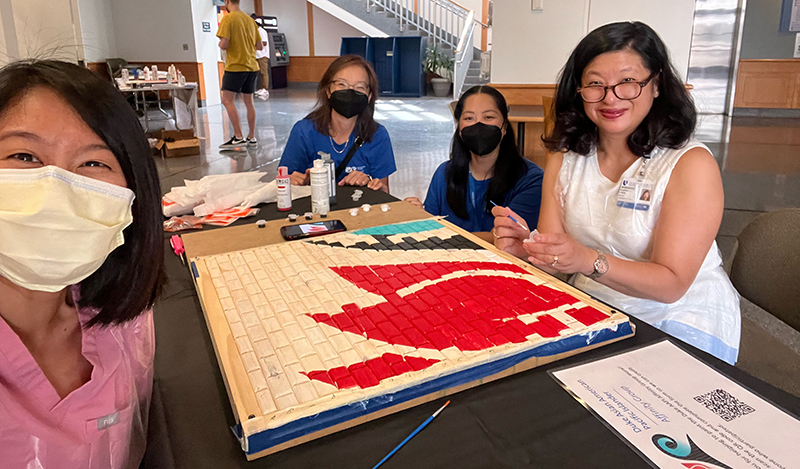
(Duke News, Bernadette Gillis) -- May is Asian American and Pacific Islander Heritage Month. The Duke Asian American and Pacific Islander Affinity Group will kick off a month of celebrations with the unveiling of a unique traveling mural at Duke Regional Hospital on May 3. The unveiling is the culmination of several events that brought together employees from across Duke, symbolizing the sense of belonging and inclusiveness that the affinity group strives to create.
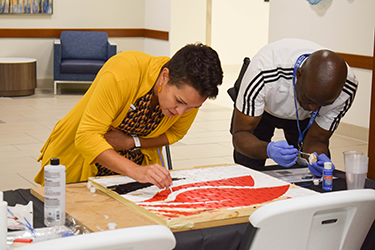
Made up of more than 300 wooden blocks, the mural depicts the affinity group’s logo and is 4 feet by 6 feet when put together. Over the course of a year, the AAPI affinity group held five events where the Duke community was invited to paint the individual blocks.
The first community painting event, held during the group’s AAPI Heritage Month celebration in May 2023, was the first time members of the affinity group had a chance to come together in person. Prior to that, the group, which was founded in 2021, had held meetings and other events by Zoom.
The painting events, which were also held at Duke Health’s three hospitals and Duke TechExpo, were special in that they offered a chance for members to connect and create a sense of community, said Rebecca Lee, one of the affinity group’s founders and a SharePoint Developer II with Duke Health Technology Solutions.
The idea for the AAPI mural first came about after Lee saw a mural that Brandon Johnson created in 2022 for DiversifyIT, a staff-led community that works towards awareness and support for all identities in IT at Duke. The DiversifyIT mural was also created as a community-building event where employees came together to paint the individual blocks.
“With the DiversifyIT project, we found that it was a nice way to build connections between people, so I wanted that for our group as well,” Lee said. “It was very important to us to build these connections because we are stronger together, and it's been a great partnership.”
Lee asked Johnson to partner with the AAPI affinity group. An IT analyst at Duke who enjoys woodworking as a hobby, Johnson described the mural painting events as “art therapy meets the water cooler.”
“People are able to get to know one another and sit beside people that they normally wouldn't have any interaction with on a day-to-day basis, outside of passing them in the hall,” Johnson said. “It facilitates connection.”
Suephy Chen, MD, chair of the Department of Dermatology and one of the AAPI affinity group’s founders, said the mural has created connection for AAPI employees and their allies. She said it was especially meaningful to partner with Johnson and others in the process.
“I thought it was quite symbolic of that partnership with our allies, and given how beautiful the mural is, it is more than the sum of its parts,” Chen said. “The fact that we're having it as a traveling mural is symbolic of its inclusivity. We really want everybody to be able to enjoy it and to understand it.”
The AAPI logo depicts a lotus flower and the Polynesian wave tattoo symbol. Lee said those images were specifically chosen to represent the group’s intention to be inclusive of all AAPI communities.
“The lotus flower is a symbol of rebirth and rejuvenation in a lot of East Asian and South Asian cultures,” Lee said. “And water connects all the Pacific Islands. The wave tattoo is a rite of passage in a lot of Polynesian and Pacific Islander cultures.”
The AAPI Affinity Group mural will be on display at Duke Regional until the fall, after which it will continue its travels to other parts of the Duke campus. Lee said Duke Clinic has offered to provide a permanent home for the mural in the future.
Learn more about upcoming AAPI Heritage Month events hosted by the AAPI Affinity Group.

New Research: Genes Known to Increase Risk of Alzheimer’s May be Inherited

(CNN) -- Alzheimer’s disease may be inherited more often than previously known, according to a new study that paints a clearer picture of a gene long known to be linked to the common form of dementia.
Authors of the study, published Monday in the journal Nature Medicine, say this might even be considered a distinct, inherited form of the disease, and different approaches to testing and treatment may be needed.
Among people diagnosed with Alzheimer’s, researchers recognize familial forms of the disease and sporadic cases. Most cases are thought to be sporadic, which develop later in life. Familial forms, caused by mutations in any of three genes, tend to strike earlier and are known to be rare, accounting for about 2% of all Alzheimer’s diagnoses, or about 1 in 50 cases.
Under the new paradigm, 1 in 6 cases of Alzheimer’s would be considered to be inherited, or familial.
This shifting appreciation of inherited risk, researchers say, is due to a better understanding of the role of a fourth gene that carries the blueprints to make a lipid-carrying protein called apolipoprotein E, known as APOE. APOE ferries cholesterol throughout the body and brain and is thought to play a role in depositing or sweeping away sticky beta amyloid plaques, which are one hallmark of Alzheimer’s.
There are three types of the APOE gene a person can carry. One known as APOE2 is thought to be protective against the development of Alzheimer’s disease. APOE3 is thought to confer a neutral risk of the disease. APOE4, on the other hand, is bad news. It has long been recognized that people with at least one copy of the APOE4 gene have an elevated risk of developing Alzheimer’s disease, while people with two copies had a higher risk still.
Now, researchers say APOE4 shouldn’t just be recognized as a risk factor — it should be viewed as an inherited form of the disease, virtually assuring that a person who has two copies will get the biological changes associated with Alzheimer’s disease in their brains.
Teasing out gene’s role in Alzheimer’s
In the new study, researchers from Spain and the United States compared people in clinical studies with two copies of the APOE4 gene to people with other forms of the APOE gene.
They also compared people with two copies of APOE4 to people with other inherited forms of the disease — early-onset autosomal dominant Alzheimer’s disease (ADAD) and Down syndrome-associated Alzheimer’s disease (DSAD). The study included data from nearly 3,300 brains that are stored at the National Alzheimer’s Coordinating Center and data from another 10,000 people who were participants in five different clinical trials.
Not only were people with two copies of the APOE4 gene much more likely to develop the biological changes that lead to Alzheimer’s disease, similar to people with the other genetic forms of the disease, they were almost assured the diagnosis: Nearly 95% of the people in the studies with two copies of the APOE4 gene had the biology of Alzheimer’s disease by the time they were 82 years old.
When people with two copies of APOE4 do have symptoms, they tend to get them earlier than others. On average, they developed Alzheimer’s about 10 years earlier — around age 65 — compared with people with other forms of the APOE gene. Researchers also found that the buildup of beta amyloid and tau in their brains followed almost the same trajectory as has been noted in people with other inherited forms of the disease. Their disease was more severe earlier in life.
In all the inherited forms of the disease, “there are striking, striking similarities in the way the disease progresses and the symptoms it gets,” said lead study author Dr. Juan Fortea, a neurologist and director of the Memory Unit of the Neurology Department at Hospital de la Santa Creu i Sant Pau in Barcelona, Spain, in a news briefing.
Fortea and his co-authors argue that for these reasons, having two copies of the APOE4 gene should be considered a genetic form of the disease, and not merely a risk for it.
Dr. Charles Bernick, who is associate medical director of the Cleveland Clinic Lou Ruvo Center for Brain Health, said the study was important because it really showed how powerful having two copies of the APOE4 gene was.
“It really drives a disease process,” said Bernick, who was not involved in the study.
Shifting understanding of genetic risks
The strength of APOE4’s role in the development of Alzheimer’s wasn’t recognized earlier, the researchers think, because APOE4 also plays an important role in heart health, and they think many people with two copies of the gene probably died from cardiovascular causes before they developed Alzheimer’s. Previous studies had estimated that 30-35% of people with two copies of the APOE4 gene would develop mild cognitive impairment or dementia.
Researchers say they also found a gene-dose effect. While having two copies of APOE4 assured that a person would see beta amyloid and tau build up in their brains, having just one copy of the gene also increased a person’s risk — but not as much as having two copies of that gene.
That would mean that the APOE4 gene is semi-dominant, Fortea said. Other diseases where genes show semi-dominance include sickle cell anemia and hypercholesterolemia. In sickle cell, for example, two copies of the gene cause sickle cell disease, but one copy causes sickle cell trait. People with sickle cell trait don’t usually have symptoms, but they may be more likely to experience heat stroke or muscle breakdown during strenuous exercise, and they can experience pain crises under certain conditions.
Classifying APOE4 as an inherited form of the disease has some big implications. First, it would mean that a far greater proportion of Alzheimer’s cases are caused by genes than has been previously understood.
Before APOE4, the only gene changes recognized to cause Alzheimer’s were associated with early-onset forms of the disease and with Down’s syndrome. They accounted for about 2% of Alzheimer’s cases — about 1 in 50.
People with two copies of the APOE4 gene make up about 15% of people who are diagnosed with Alzheimer’s, or 1 in 7 cases of the disease.
About 2% of the general population carries two copies of the APOE4 gene, which would make it one of the most prevalent inherited diseases.
Gene testing isn’t currently recommended
It is also likely to change how people who carry the APOE4 gene are diagnosed and treated.
There are tests available to determine a person’s APOE4 status, but they’re not recommended as a routine part of diagnosis. That may need to change, the study authors said.
“The consensus and the guidelines now do not recommend testing for APOE4 and that was because the consensus was that it did not help for the diagnosis,” Fortea said.
APOE testing is recommended for patients who are being evaluated to take new amyloid-clearing medications, such as lecanemab.
Because Alzheimer’s patients with two copies of the APOE4 gene are at greater risk for serious side effects like brain swelling from new amyloid-clearing medications, some treatment centers have decided not to offer them the drugs, said study author Dr. Reisa Sperling, director of the center for Alzheimer’s Research and Treatment at Brigham and Women’s Hospital.
“I find this very problematic given these data,” she said, noting that it would be important to do research to see if it might be possible to find safer dosing or safer treatments for this patient group.
“For me, this just means we need to treat them earlier,” Sperling said, “and this research really suggests that we should be treating them quite early, at a younger age, and at an early stage of pathology because we know they are very, very likely to progress to impairment quickly.”
Dr. Sterling Johnson, who leads the Wisconsin Registry for Alzheimer’s Prevention at the University of Wisconsin, said it would be very important for clinical trials to start to take participants’ APOE4 status into account.
“We may need to start treating these as a separate group in our research papers so that we can really understand the relationship between amyloid and tau and symptoms” in people with two copies of the APOE4 gene, in a way that we kind of have not been able to before, said Johnson, who is also a study author, in the news briefing.

Today is Melanoma Monday. Stay Safe with These Skin Cancer Tips.
Today is Melanoma Monday
The American Academy of Dermatology (AAD) began Melanoma Monday on Monday, May 1, 1995, and has observed it every year since. Melanoma Monday always occurs during Skin Cancer Awareness Month on the first Monday in May.
Key facts to know about melanoma
Melanoma is the most serious type of skin cancer. In 2024, it’s estimated that more than 200,340 melanomas will be diagnosed and about 8,290 people will die of melanoma.
- Caught early, melanoma is highly treatable.
- Melanoma can develop anywhere on the skin, including skin that’s had plenty of sun exposure and skin that’s usually protected from the sun.
- Melanoma can develop under or around a fingernail or toenail.
- You can find melanoma early by examining your skin for the ABCDEs of melanoma and checking your nails.
People of all skin tones develop skin cancer.
Sun protection can reduce your skin cancer risk
Protecting your skin from the sun plays a key role in preventing skin cancer. However, a 2024 AAD survey found that more than 1 in 3 Americans (36%) said they had a sunburn in 2023. This is a significant increase over 2022.
The 2024 survey also revealed that Gen Z adults were less likely than adults in other generations to know key facts that can help them protect their skin from the sun.
Here are key facts to know:
- When you’re outdoors, protect your skin by seeking shade, wearing sun-protective clothing, and applying sunscreen that offers broad-spectrum protection, water resistance, and an SPF of 30 or higher. The AAD calls this Practicing Safe Sun.
- Sun protection is important every day of the year. You can get sunburned on a cloudy day and during the winter.
- You need to reapply sunscreen every 2 hours and after swimming or sweating. It’s a myth that higher SPF sunscreens can be applied less frequently.
To learn how to use shade, clothing, and sunscreen to protect your skin, go to Practice Safe Sun. [source]

NC Medicaid Providing Free Educational Materials for Your Patients

NC Medicaid is providing free, printed educational materials for partners to distribute to individuals and families seeking more information about Medicaid expansion and enrollment.
The print orders will contain:
- 200 bilingual Day 1 Flyer
- 200 English immigration flyers and 200 Spanish immigration flyers
- 100 English wallet cards and 100 Spanish wallet cards
- 100 English coloring books and 100 Spanish coloring books
- 100 English Crayons and 100 Spanish Crayons
- 100 English Stickers and 100 Spanish Stickers
Sign up today for these informative materials that include NC Medicaid Toolkit materials and swag items available in English and Spanish. Materials are free and orders will begin shipping in mid-May 2024.
To order your materials, please fill out the print materials order form by May 10, 2024.
Register Now! Medicaid Managed Care Back Porch Chat
Medicaid Managed Care Back Porch Chat:
Key Medicaid Updates
Thursday, May 16 | 5:30 p.m.
Join this chat on Thursday, May 16 from 5:30-6:30 p.m. for the May Back Porch Chat, hosted by Janelle White, MD, Chief Medical Officer of Medicaid, Sarah Gregosky, Chief Operating Officer, NC Medicaid, and Arianna Keil, MD, Chief Quality Officer, NC Medicaid.
Get important news for all providers about NC Medicaid on preparing for Tailored Plan Launch, results from the 2023 PCP OBGYN Experience Survey, and additional clinical updates, including:
- Pharmacy Updates
- Making Care Primary Request for Information
- Stakeholder Communication Updates
- Maternity Coverage and Reimbursement Bulletin
Medicaid Managed Care Additional Webinar:
Tailored Plan Claim Support for Providers
Wednesday, May 22 | 5:30 p.m.
This webinar is designed for billing staff involved in claim submission to understand how to submit claims when Tailored Plans go live on July 1.
NCDHHS Tele-Town Hall: Medicaid Expansion, Who is Eligible and How to Apply
The North Carolina Department of Health and Human Services will host a live fireside chat and tele-town hall tomorrow, Tuesday, May 7, from 6 to 7 p.m., to discuss Medicaid expansion resources, who is newly eligible, and how to apply for health coverage.
Event participants include:
- Elizabeth Cuervo Tilson, M.D., State Health Director and Chief Medical Officer, NCDHHS
- Brenda Jackson, Director, Cumberland County Department of Social Services
- Hollis Smith, Medicaid Expansion Outreach and Education Coordinator, Care Share Health Alliance
North Carolina Medicaid now covers more people ages 19 through 64 years. Many people who now qualify for Medicaid under expansion work in childcare centers, grocery stores, nursing homes, clothing stores, restaurants and other industries who may not have comprehensive health insurance through their jobs. People who did not qualify for Medicaid in the past may now be eligible, including those who are single or do not have children.
Fireside chat and tele-town hall panelists will discuss the following:
- Who is eligible for Medicaid
- Ways to apply for health care coverage
- How to connect with a health care navigator who can help you apply
- Where to find Medicaid resources and support
While more than two out of three newly eligible North Carolinians have already enrolled in Medicaid, nearly 200,000 who may be eligible have not yet applied. The NCDHHS Medicaid expansion website provides information on eligibility, how to apply and where to find support. Individuals can also connect with state and local support teams to better understand their health care coverage options, complete Medicaid applications and navigate enrollment.
The fireside chat will stream live from the NCDHHS Facebook, X (Twitter) and YouTube accounts, where viewers can submit questions. The event also includes a tele-town hall, which invites people by phone to listen in and submit questions. People can dial into the event by calling 855-756-7520 Ext. 103378#.
Those joining the event will have the opportunity to ask questions about Medicaid expansion, eligibility and enrollment.

Register Now! NCTracks May 2024 Provider Training Schedule
Registration is now open for the NCTracks May 2024 training courses.
The courses are virtual, via Zoom, and can be attended remotely from any location.
Courses offered this month include:
- Dental Helpful Hints
- Submitting a Prior Approval Medical
- New Office Administrator
- Create and Submit a PA for DME
- Recipient Eligibility Information
- ES User Role_Abbreviated MCRs_Upload Documents
- Provider Re-Credentialing/Re-Verification Refresher
For a detailed description of each course and enrollment instructions, click here.

Surprise Billing – Independent Dispute Resolution Update
On Dec. 27, 2020, the No Surprises Act (NSA) was signed into law to address unexpected gaps in insurance coverage that result in “surprise medical bills” when patients unknowingly obtain medical services from physicians and other providers outside their health insurance network. The NSA and its implementing regulations establish a Federal Independent Dispute Resolution (IDR) process that out-of-network (OON) providers may use to determine the OON rate for qualified IDR items or services after an unsuccessful open negotiation period to resolve pending claims.
Do you have pending disputes resulting from IDR process for resolving claims that were bundled or batched? On May 1, the Departments of Health and Human Services, Labor, and the Treasury announced a new process for resubmitting those IDR disputes that were originally improperly batched or bundled. The resubmission process is automated in the Federal IDR portal and is intended to streamline the process.
CMS has provide the following overview of the process, including links and associated deadlines.
OVERVIEW OF THE NEW PROCESS
Parties now have a new way to resubmit disputes that were originally improperly batched or bundled. Resubmission requests will come directly from the Federal IDR portal instead of from your certified IDR entity, and initiating parties now will have a unique web form they can access via a link in their resubmission email notification to complete the resubmission process.
If you are a party to a dispute that is eligible to be resubmitted to the Federal IDR process, you will receive an email notification from auto-reply-federalidrquestions@cms.hhs.gov. If you initiated the dispute, the resubmission email notification will contain a unique link to a new form called the Notice of IDR Initiation – Resubmission web form and instructions on the next steps. If you did not initiate the original dispute, your email notification will be informational and will not have a link.
Initiating parties have 4 business days from the date of the resubmission email notification to resubmit a dispute. The resubmission link will no longer work after the 4 business day window has passed.
RESUBMISSION REQUESTS RECEIVED ON OR BEFORE APRIL 30, 2024
If a certified IDR entity notified you on or before April 30, 2024, that a dispute you submitted was eligible for resubmission due to improper batching or bundling, please resubmit the dispute as instructed in the email from your certified IDR entity through the Notice of IDR Initiation web form. For information on how to resubmit these disputes, refer to the Notice of Initiation Web Form Job Aid.
The Notice of IDR Initiation web form will accept resubmitted disputes through May 6, 2024. After May 6, 2024, the Notice of IDR Initiation web form will no longer accept resubmitted disputes, and all resubmissions must be submitted via the Notice of IDR Initiation – Resubmission web form as described in the paragraph below.
RESUBMISSION REQUESTS RECEIVED ON OR AFTER MAY 1, 2024
Starting on May 1, 2024, certified IDR entities will notify parties through an email from the Federal IDR portal that a dispute is eligible for resubmission due to improper batching or bundling. Initiating parties will receive a resubmission email notification that will direct them to a unique web form called the Notice of IDR Initiation – Resubmission web form to complete the resubmission process.
EDUCATIONAL MATERIALS
For additional information and instructions on how to complete and submit the new Notice of IDR Initiation – Resubmission web form, refer to the following resources linked below:
- User Guide: Notice of IDR Initiation – Resubmission Web Form
- Recorded Demo: Notice of IDR Initiation – Resubmission Web Form
QUESTIONS?
Questions can be directed to the Federal IDR Questions mailbox at FederalIDRQuestions@cms.hhs.gov.
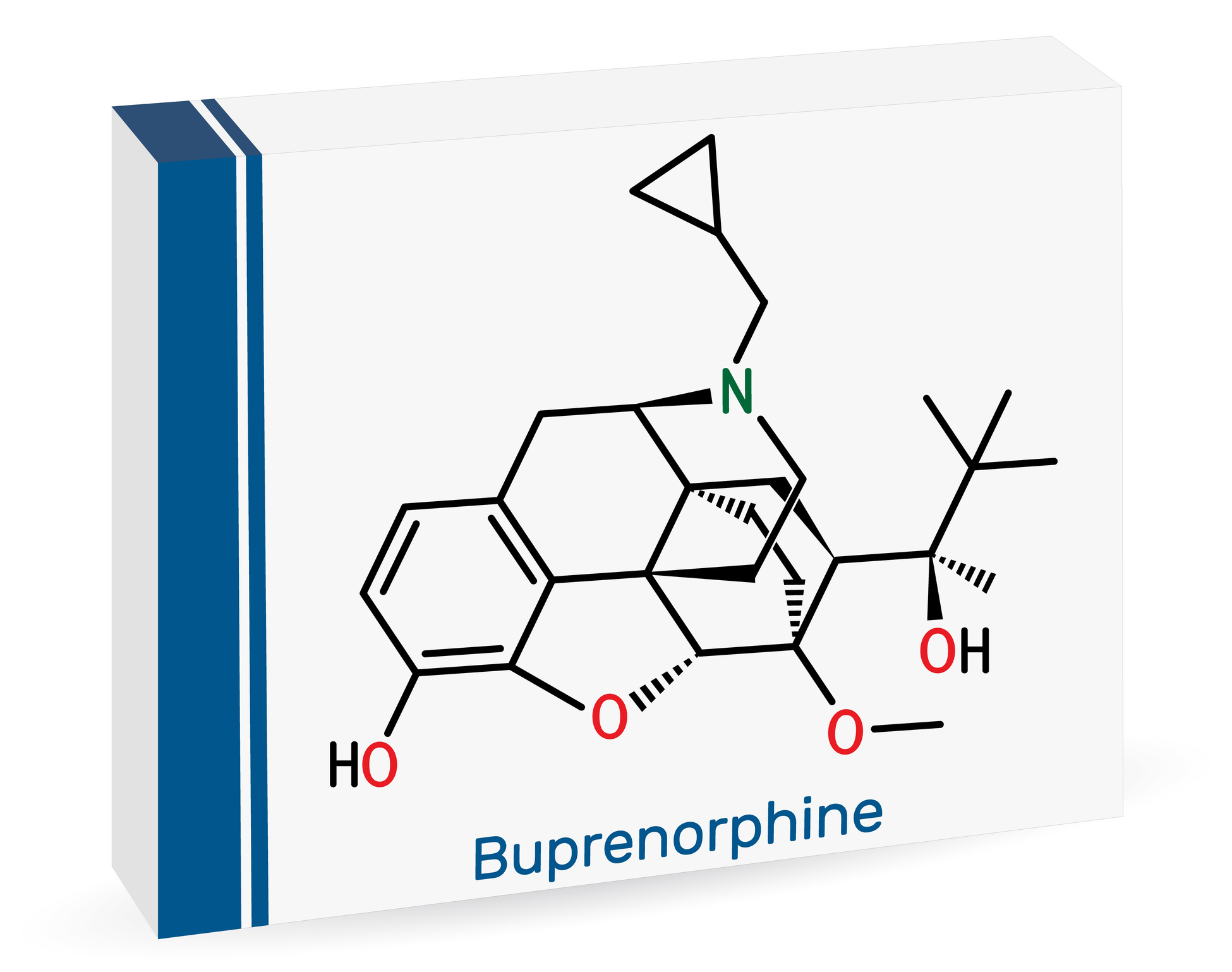
Is Buprenorphine Subject to the STOP Act’s Prescribing Limits?
Recently the North Carolina Medical Board (NCMB) has received inquiries about whether prescriptions for buprenorphine that are written for the treatment of opioid use disorder are subject to prescribing limits established for certain controlled substances by the NC STOP Act of 2017. The answer is, unequivocally, no.
The STOP Act places 5-7 day limits only on initial prescriptions for acute pain and post-operative pain. Per N.C. Gen. Stat. 90-106(a)(1), these limits do not apply to prescriptions for medication-assisted treatment for a substance use disorder, which is explicitly excluded from the definition of acute pain.
NCMB offers this guidance in the hope that prescribers will refrain from inappropriately limiting buprenorphine prescriptions from patients initiating treatment for substance use disorder. Increasing access to substance use disorder is a key part of North Carolina's Opioid Action Plan to address the opioid overdose epidemic.
The Board has drafted a new FAQ, which will be added to its existing STOP Act prescribing limit FAQS on the Board's website, to address questions about whether buprenorphine prescriptions for substance use disorder must be limited:
Q: Are prescriptions for buprenorphine for the treatment of substance use disorder subject to the STOP Act’s 5- and 7-day limits?
A: No. As long as the buprenorphine prescription is prescribed to treat opioid use or other substance use disorder, the limits do not apply. Initial prescriptions for buprenorphine products that are only indicated for the treatment of acute pain are subject to the STOP Act limits and may not exceed 7 days. [source]
Cyberattack on UnitedHealth Firm Forces Doctors to Dig into Personal Savings
Health providers have been struggling with fallout from the Change Healthcare cyberattack
(CNBC, Ashley Capoot) -- On a Sunday in early March, Dr. Angeli Maun Akey noticed something peculiar while making payroll for her private practice in Gainesville, Florida: She was missing $19,000.
Akey owns and operates a primary care practice that serves around 3,500 patients in the area, many of whom suffer from chronic diseases. She opened in 2000 and manages a staff of nearly 20 people. Over the last two decades, Akey said, her practice and patients have been like an extension of her family.
When Akey first noticed the discrepancy in her cash flow, she thought the funds had been embezzled, something she said she’s experienced three times since graduating from medical school. But after searching online, Akey realized she had a much bigger problem.
The health-care technology company Change Healthcare had been breached in a cyberattack.
Change Healthcare offers payment and revenue cycle management tools, and other solutions such as electronic prescription software. On Feb. 21, UnitedHealth Group, which owns Change Healthcare, discovered that hackers compromised part of the unit’s information technology systems.
UnitedHealth said in a filing with the U.S. Securities and Exchange Commission that it isolated and disconnected the impacted systems “immediately upon detection” of the threat. In its first-quarter earnings report in April, UnitedHealth said the total cost of the cyberattack could be as much as $1.6 billion for the full year. The company’s stock is down nearly 8% year to date.
Akey said the outages from the cyberattack reduced her practice’s cash flow by more than 80% for six weeks. As of early April, she said, she had amassed more than $130,000 worth of insurance claims that she had not been able to get reimbursed for.
Making payroll quickly became a major concern, and Akey said she stopped paying her own salary to help support her staff. Her bank offered her a loan to keep her practice afloat, but it came with an 11% interest rate. Akey said she felt it was too high.
She turned to her patients for help, asking for voluntary $45 advances that would be repaid.
“I’ve had patients for like a quarter century, so a lot of them have been like, ‘No, no, I need to give you more.’ So there’s $100 checks, $200 checks, $500 checks, $2,000 checks,” Akey said. “They have had 0% responsibility for this situation, and they’re fronting the money to keep us going.”
Earlier this month, Akey liquidated her retirement investments as an extra precaution. She said she was feeling frustrated and vulnerable, especially as rumors were swirling about the possibility that a second breach had occurred. UnitedHealth told CNBC earlier this month that there is “no evidence of any new cyber incident at Change Healthcare.”
“I just decided I can’t do this again,” Akey said.
UnitedHealth said in an April 22 press release that it has been working to bring systems back online, and that Change Healthcare has made “continued strong progress.” Medical claims across the U.S. are flowing at “near-normal levels,” and payment processing by the company is at more than 85% of pre-incident levels, the release said.
“We know this attack has caused concern and been disruptive for consumers and providers and we are committed to doing everything possible to help and provide support to anyone who may need it,” UnitedHealth CEO Andrew Witty said in the release.
Akey said payments have begun flowing back into her practice, though levels are still down between 30% and 40% from where they normally are.
She said the restarted payments have lifted a “humongous weight” off her back, but the road ahead will be difficult. Even so, she thinks her practice will be able to pull through, and she will be able to restore her retirement investments some time in the next few months.
“We love our patients, and that’s why I’m fighting so hard,” Akey said.
A quiet health-care giant

(UnitedHealth Group Inc. headquarters stands in Minnetonka, Minnesota, U.S. Mike Bradley | Bloomberg | Getty Images)
Change Healthcare is not a household name for most Americans and even many health-care workers. Much of the company’s technology helps facilitate billing, payments, benefits evaluations and information exchanges behind the scenes.
Change Healthcare is the largest U.S. clearinghouse for medical insurance claims. A clearinghouse is like a middleman for the transactions between providers — such as doctors, hospitals and pharmacies — and payers — such as insurance companies, Medicare and Medicaid.
A clearinghouse helps deliver the right bills to the correct payers. It’s just one of the ways Change Healthcare touches cash flow within the health-care sector.
The company operates on an enormous scale. Change Healthcare processes more than 15 billion billing transactions annually, and 1 in 3 patient records passes through its systems, according to its website. That means Change Healthcare’s reach extends beyond UnitedHealth’s already sizable customer base.
Money stopped flowing when the company’s systems were disrupted due to the cyberattack, and a major source of revenue for thousands of providers across the U.S. screeched to a halt.
It’s caused a lot of sleepless nights for Dr. Barbara McAneny.
McAneny founded a multidisciplinary private practice with another physician in New Mexico in 1987. The practice now supports a staff of 280 people and offers a range of services, including cancer care. She also served as the president of the American Medical Association, or AMA, a research and advocacy group that represents physicians, from 2018 to 2020.
McAneny said she had tried to prepare for the possibility of a cyberattack, so the practice had contingency plans and funds stashed away to cover payroll and other expenses. However, she said she had “no idea” how she could have prepared for a breach of this magnitude. The practice felt the effects immediately.
“The cash flow for the practice went to zero that day,” McAneny told CNBC in an interview.
She said the practice’s partner physicians stopped taking a salary, and they told employees that they couldn’t approve overtime pay. Expenses became a real concern, but her “major fear” was whether the practice could continue purchasing chemotherapy for the cancer patients who rely on it for treatment.
McAneny’s practice buys chemotherapy from group purchasing organizations, or GPOs. It continued to place orders in the weeks following the cyberattack. But while Change Healthcare was down, there was no money to pay for the treatment. By April 10, the practice owed more than $6 million for chemotherapy alone.
“If the flow of chemotherapy stops from the GPOs that supply our chemotherapy, people will die,” she said.
McAneny said she lived in fear that supply would dry up. The thought had been waking her up in a cold sweat at night.
By mid-April, money started trickling back into McAneny’s practice, and it began chipping away at its $15 million claims backlog. She said claims started moving substantially in the last couple of weeks but that the practice’s cash flow is still only around 70% to 80% of what it normally is.
McAneny said the practice is “significantly in debt,” which will take several months to resolve. She said she is very worried about late fees. Even so, signs of progress have come as a relief.
“I might actually sleep through the night,” she said.
Funding assistance
Early in March, UnitedHealth launched a temporary funding assistance program to help support providers that have experienced cash flow disruptions due to the cyberattack. There are no fees, interest or other costs on top of the payments, and providers have 45 days to repay the funds once standard payment operations resume.
Eligible providers will get funds weekly, and the amount they get is based on the difference between their historical weekly claims or payment volume before the breach vs. after, according to the website.
UnitedHealth said it only has “partial visibility” into most providers’ histories and may be “unable to see the full impact of their needs.” Providers could see a gap in their funding amounts and, if they do, they are encouraged to submit a temporary assistance inquiry form through the website for additional support.
But for doctors such as Akey, the program has been a source of frustration. As of Thursday, Akey said she had been approved for around $31,000 worth of funding. She called the total “woefully inadequate” and said it amounts to less than two weeks of help.
Akey said Tuesday she was not aware she could have applied for additional funding support, despite reading the website and making repeated attempts to contact UnitedHealth.
Sarah Carlson, who owns and operates a marriage and family therapy practice in Boulder, Colorado, had a similar experience with the funding program.
Carlson’s practice amassed a $75,000 claims backlog by early April because of the cyberattack, she told CNBC. She said she had been fronting her employees her own money to make payroll, and after a couple of sleepless nights, she decided to temporarily stop accepting some new clients.
Carlson applied for UnitedHealth’s funding assistance program, but she said the payments up to that point had been negligible. One week, she said, she received just $10.
“It was comical. Literally, I think I laughed,” Carlson said in an interview.
UnitedHealth told CNBC that Carlson had not applied for additional funding. Carlson said she thought she had done so by filling out a new form, separate from her initial application, with information about the total amount of claims she was owed.
McAneny said that as of mid-April she had around $28,000 from UnitedHealth sitting in an account, which is only enough to cover the cost of about two drugs.
“It was useless to me,” she said.
McAneny has since applied for and received additional funding. She said she is using that money to help pay off the chemotherapy bills.
UnitedHealth told CNBC in a statement Tuesday: “We have issued more than $6.5 billion in assistance to providers and we continue to encourage any provider to reach out and our goals has always been to help get the word out to as many providers as possible here.”
A controversial merger

UnitedHealth’s ownership of Change Healthcare has raised eyebrows from the outset.
The company has two major business units: Optum and UnitedHealthcare. Optum offers a range of pharmacy services and consulting services and provides medical care for around 103 million consumers, while UnitedHealthcare provides insurance coverage and benefit services to more than 55 million people globally, according to the company’s website.
UnitedHealth’s reach is already substantial, so when it announced that Optum and Change Healthcare had agreed to combine in January 2021, it alarmed organizations such as the AMA.
The AMA sent a letter to the U.S. Department of Justice in April 2021 arguing the $13 billion deal would have “significant anticompetitive effects” on doctors, hospitals and insurers. The group urged the DOJ to look at the merger.
The DOJ sued to block the deal the following year, arguing that UnitedHealth’s proposed acquisition would harm competition in the sector. The suit was unsuccessful, and Optum announced that it completed its combination with Change Healthcare in October 2022.
In UnitedHealth’s quarterly call with investors in April, CEO Andrew Witty said the company’s ownership of Change Healthcare is “important for the country.” He said the cyberattack likely would have happened either way, but if UnitedHealth did not own the company, Change Healthcare would not have had the resources or support necessary to bring its systems back online.
“We’re going to bring it back much stronger than it was before,” Witty said.
The AMA has also been outspoken about the cybersecurity breach. In a letter to the U.S. Department of Health and Human Services in March, for instance, the organization said it is concerned about the “undue financial hardships facing physician practices” if the cyberattack was not resolved quickly. The AMA said it is particularly concerned about small, rural and less-resourced practices, according to the letter.
In late February, the DOJ launched an antitrust investigation into UnitedHealth, according to a report from The Wall Street Journal. The investigation is exploring issues such as its doctor group acquisitions and the relationships between Optum and UnitedHealthcare, the report said. UnitedHealth declined to comment on the matter during its investor call.
The DOJ declined to comment.
‘It’s a mess’

There’s no quick fix for providers affected by the breach. Switching to another clearinghouse can take weeks to months, and submitting claims manually creates mountains of extra work for practices that are often already overwhelmed with administrative and clerical tasks. Some payers don’t even accept paper claims anymore.
“It’s not been fun,” said Dr. Tyler Kisling, who with his wife owns and operates an orthodontic and pediatric dentistry practice in California.
Kisling said the pair have taken out around $20,000 from their personal savings to help keep things afloat since the cyberattack. The breach has created a lot of stress, Kisling said, and he’s resorted to printing out paper calendars to help keep track of bills and due dates.
The company that operates their practice’s patient management software has worked to get set up with another clearinghouse, but as of April 19, Kisling said it was still not running. The workaround has been to fill out all of the practice’s claims by hand, put them in envelopes and mail them off to insurers. Kisling said the task has been like a new full-time job.
Payments are just starting to trickle in, and Kisling said he thinks it is largely because the practice took steps to mail in claims. There’s still a long road ahead.
“I just don’t know how much longer it’s going to take to catch up with all the backlog,” he said.
McAneny said her practice switched to another clearinghouse during the breach but that they all have different peculiarities that can be difficult to work out. She said she had 5,000 rejected claims in a week, which meant the practice had to go through each one to determine what needed to be fixed.
“The comma goes here, or the date of birth goes over there or whatever they want,” she said.
McAneny said it’s been a “huge amount” of work. Her billing staff has been working a lot of overtime.
Dr. Purvi Parikh, an allergist and immunologist with a private practice in New York City, said her practice reconnected with Change Healthcare after seven weeks of outages. It was a welcome sign of progress, especially because Parikh and the other doctors who own the practice had been covering payroll and expenses out of pocket.
But figuring out how to file seven weeks’ worth of claims has been draining for Parikh’s staff and the practice’s already diminished resources.
“It’s such a waste of everyone’s time,” she told CNBC in an interview. “We spend hours and hours, or even days, trying to figure out where to get money from, how to now resubmit through a new clearinghouse, and then resubmit again back through Change Healthcare. It’s a mess.”
UnitedHealth told CNBC that it has been working to communicate with providers, government officials, health systems, trade associations and customers about the breach from the outset.
The company said it has provided updates through Change Healthcare’s product website, and it launched a separate website about its response to the cyberattack that has received millions of page views. UnitedHealth said it also launched a multimillion-dollar social media and digital campaign to raise awareness about its funding assistance program.
Additionally, UnitedHealth has hosted calls with security executives, providers, customers and advocacy groups that have been attended by thousands, the company said.
Nevertheless, some providers said getting information about the breach has been challenging.
As of mid-April, Parikh hadn’t been able to get anyone from Change Healthcare on the phone. She said she was getting all her information directly from her billing company. There has been “zero communication” from UnitedHealth, Optum or Change Healthcare, she said.
Kisling said his office received no formal notification about the breach, and that he heard about it in the media. His office manager had to call one of the practice’s software vendors to ask what was happening.
“We all just kind of had to figure it out on our own,” he said.
Many doctors have been leaning on one another to share information and tips about how to handle the breach. On platforms such as Doximity, which is a medical website used by more than 80% of U.S. physicians, doctors have been “exchanging notes” about how they’ve managed, said Dr. Amit Phull, the chief physician experience officer at Doximity.
Phull said there were a lot of people posting about the breach who didn’t know what to do. Initial feelings of “bewilderment” quickly progressed to anxiety, fear and anger, he said.
Providers are left with questions

UnitedHealth said in late February that the ransomware group Blackcat was behind the cyberattack. Blackcat, which also goes by the names Noberus and ALPHV, steals sensitive data from institutions and threatens to publish it unless a ransom is paid, according to a December release from the DOJ.
The company said its investigation into the breach is ongoing, and it could be months before the company can identify and notify affected individuals. UnitedHealth is working with law enforcement officials, cybersecurity experts and regulators to assess the breach, according to its website.
On April 22, UnitedHealth told CNBC that it paid a ransom in an effort to protect patient data. It did not specify the amount. The company also confirmed that files containing protected health information and personally identifiable information were compromised.
Providers have been left with questions about what happens next.
“How are they going to keep this from happening in the future?” said John Bieda Jr., who owns and operates a marriage and family therapy practice in California.
Bieda said he founded his practice with funds he inherited from his parents after they died. He told CNBC he is very proud of what he has built, and he wishes his father were around to see it. But he said his experience with the Change Healthcare breach has left him feeling lost, and at times like he does not want to own his own company anymore.
As of Friday, Bieda said he had around $109,000 of claims outstanding. He has taken $241,000 out of his retirement accounts to keep the practice afloat.
“I have been on the verge of tears significantly,” Bieda said. “It just is devastating.”
McAneny said many providers have opened lines of credit due to the breach, which raises questions about how UnitedHealth will address problems around interest, late fees and damage to credit ratings.
“They’ve caused a lot of harm to a lot of practices,” McAneny said. “How are they going to make up for the losses that we have had?”

CPT Codes for Ambulatory Surgery Setting Updates

Effective with date of service of January 1, 2024, the Centers for Medicare & Medicaid Services (CMS) has identified the following new CPT codes as separately reimbursable in the ambulatory surgery setting:
27278
33276
33278
33279
33280
33281
33287
33288
52284
58580
64596
64598
Providers are now able to resubmit NC Medicaid Direct claims for services rendered on or after January 1, 2024. Providers are advised to contact their contracted managed care plans for assistance regarding the submission process for ambulatory surgery claims for NC Medicaid Managed Care.
For questions, contact NC Tracks Call Center, 800-688-6696.

New Guidance Lowers Breast Cancer Screening Age for Women at Average Risk
The U.S. Preventive Services Task Force, a major task force consisting of expert physicians providing recommendations in the primary care setting for routine medical screenings, behavioral counseling, and preventive medications, is now recommending breast cancer screening with mammograms every other year for women with an average risk of developing breast cancer, starting at age 40. This guidance was previously drafted in May 2023, and nearly one year later, these recommendations have been finalized without major changes.
Previously, the USPSTF guidance said screening should start no later than age 50. The Task Force recommended that women in their 40s talk to their doctor about their individual risk. The age for routine screening was dropped to account for the 2% increase in breast cancer diagnosis rates each year among women in their 40s.
Read the full article here.
Keep Your Patients Cool this Summer with Help from Operation Fan Heat Relief!
The North Carolina Department of Health and Human Services’ Division of Aging is partnering with the N.C. area agencies on aging and local service providers to distribute fans to eligible recipients through Operation Fan Heat Relief from May 1–Oct. 31.
People 60 and older, as well as adults with disabilities, are eligible to sign up for assistance from May 1–Oct. 31 at local aging agencies across the state. Since 1986, the relief program has purchased fans for older adults and adults with disabilities, providing them with a more comfortable living environment and reducing heat-related illnesses.
The program is made possible by donations from Duke Energy Carolinas, Duke Energy Progress, Dominion and Valassis. Operation Fan Heat Relief allows regional area agencies on aging and local provider agencies to purchase fans for eligible individuals. Local provider agencies can also purchase a limited number of air conditioners based on a person’s specific health conditions.
Last year, the division received $86,000 in donations, allowing for the distribution of 3,097 fans and 21 air conditioners.
As individuals age and develop chronic medical conditions, they are less likely to sense and respond to changes in temperature, and they may also be taking medications that can worsen the impact of extreme heat. Operation Fan Heat Relief helps vulnerable adults at risk for heat-related illnesses stay safe during the summer.
In addition to applying for fans, people age 60 and older, as well as adults with disabilities, can take the following steps during high temperatures:
- Increase fluid intake
- Spend time in cool or air-conditioned environments regularly
- Reduce strenuous activity during the afternoon
- Speak with their physician before summer about how to stay safe while taking medication that can affect the body's ability to cool itself (e.g., high blood pressure medications)
For more details, individuals may contact their area agency on aging or the Division of Aging at 919-855-3400.
More information about Operation Fan and Heat Relief, including tips on preparing for extreme heat and a list of local agencies distributing fans, is available at www.ncdhhs.gov/divisions/aging/operation-fan-heat-relief.
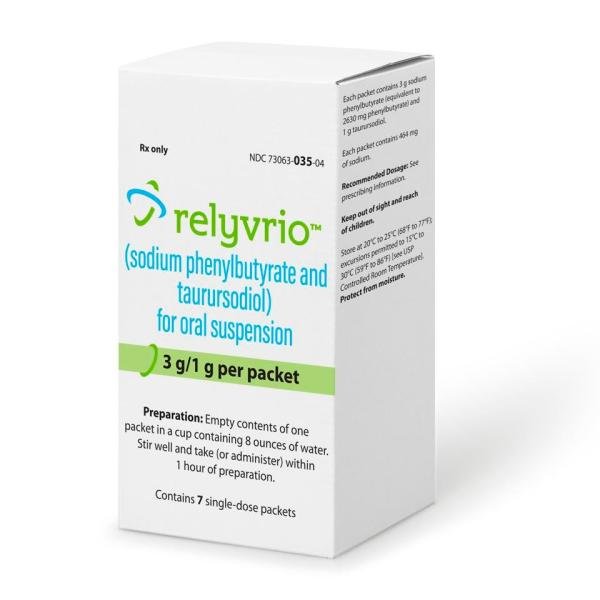
NC Medicaid Preferred Drug List Update
Amylyx Pharmaceuticals has formally announced that Relyvrio (sodium phenylbutyrate and taurursodiol) is no longer available to new patients as of April 4, 2024. Amylyx has initiated a process with the U.S. Food and Drug Administration (FDA) to voluntarily discontinue the drug and remove it from the market.
According to a press release from the manufacturer, patients currently receiving treatment who, in consultation with their physician, wish to continue can be transitioned to a free drug program.
As a result of this announcement, Relyvrio is no longer covered at point-of-sale, effective April 4, 2024 and the product will be removed from the NC Medicaid Preferred Drug List (PDL).

Confused on How to Properly Remove a Tick from Your Skin? Tick Bite Bot May Help.
The Centers for Disease Control and Prevention's (CDC) Tick Bite Bot is an interactive tool that will assist individuals on removing attached ticks and determining when to seek health care, if appropriate, after a tick bite.
The online mobile-friendly tool asks a series of questions covering topics such as tick attachment time and symptoms. Based on the user’s responses, the tool then provides information about recommended actions and resources.
Get started here.

The Wait is Over! NCMS 2024 NCMS Photo Contest is Now Open!





Photo submissions are currently being accepted for 2024!
Now in its 16th year, the NCMS Photo Contest is an annual tradition that has gained national recognition, and we want you to be a part of it! Submissions are currently being accepted for the 2024 contest. Think you have the perfect picture to send in?
Check out the rules here.






Happy Birthday to Our Members Celebrating This Month!
Grab your party hats and noisemakers and let’s celebrate!
Ole S. Aassar, MD
William B. Abernethy, Jr., MD
Surafeal G. Abraha, MD
Peter K. Acheampong, MD
Maureen N. Achuko, MD
Douglas H. Adams, MD, MPH
Van L. Adams, MD
Henry T. Adkins, Jr., MD
Kerry E. Agnello, DO
Julian S. Albergotti, Jr., MD
Dustin B. Alderson, MD
Fuad Y. Aleskerov, MD
Chelley K. Alexander, MD
Erin B. Allen, PA-C
Sridevi Allu, MD
Ghiath M. Almasri, MD
Terrence P. Almengual, MD
David A. Altman, MD
Harry T. Ameredes, MD
Ginette A. Archinal, MD
Brooktiete Asseres, MD
Emily L. Averbook, MD
Ramesh Avva, MD
P. William Aycock, Jr., MD
Richard E. Babb, PA-C
Gopal H. Badlani, MD
Hasan A. Baloch, MD
John A. Bardini, MD
Victor R. Barnes, MD
James D. Barnwell, MD
Katherine E. Barrett, MD
Scott J. Bartkoski, MD
Dwight D. Bates, MD
Mckenzie A. Bauman, PA-C
John N. Beard, MD
George H. Beckwith, MD
Matthew T. Bennett, MD
Brendan C. Berry, MD
Michelle M. Bertsch, MD
Gideon Besson, MD
Bhavna Bhat, MD
Pouru P. Bhiwandiwalla, MD
Andrew T. Billingsley, MD
Mott P. Blair, IV, MD
Robert A. Blake, MD
Kelly T. Blount, PA-C
Elizabeth R. Blyth, MD
Ann L. Bogard, MD
Michael A. Bohl, II, MD
Andrew J. Bojanowski, PA-C
Debra A. Bolick, MD
E. Arthur Bolz, MD
W. Kent Bonney, MD, FAAP
David W. Boone, MD
Madison N. Botts, MD
Bryon J. Boulton, MD
Benjamin C. Bowen, MD
Kellie M. Bowen, PA
James R. Bowers, MD
Umar Bowers, MD
Brian P. Bowman, MD, PhD
Douglas R. Boyette, MD, FACC
Thomas A. Brackbill, MD
J. Lawrence Brady, Jr., MD
Jonathan L. Brandon, MD
Amy E. Brantley, PA-C
David S. Brantley, MD
Charles C. Bremer, MD
Mathijs H. Brentjens, MD
Sarah L. Brewington, MD, FAAP
Dewey H. Bridger, III, MD
James W. Britt, MD, FAAP
Robert C. Brock, MD
Seth C. Brody, MD
Per G. Brolinson, DO
Rebecca M. Brooks, MD
Robert A. Buchanan, Jr., MD
Robert T. Buchanan, MD
Barry D. Bunn, MD
James O. Burke, Jr., MD
Pamela A. M. Burleson, PA-C
Scott J. Burner, MD
Henry W. Burnett, MD
John W. Burnett, Jr., MD
M. Alan Burns, MD
Robert H. Butler, MD
Christopher S. Byrd, MD
Chasitty C. Calhoun, PA-C
Gregory J. Cannon, MD, FACEP
Jeffrey P. Carley, DO
Nicole S. Carroll, MD
Mark V. Cavaliere, PA-C
S. Nicole Chadha, MD
T. Brent Chafin, MD
Eric D. Challgren, MD
Peter G. Chan, MD
Audrey O. Chang, MD
Alexander C. Chavez, MD
Julie S. W. Childers, MD, PhD
Monique V. Chireau Wubbenhorst, MD
Ann Y. Chung, MD
Ian T. Churnin, MD
Justin E. Cimring, MD, FAAP
Kenneth J. Clark, Jr., MD
Talaya B. Clark, MD
Noellee T. Clarke, MD
John R. Collier, Jr., MD
Michelle S. Collins, MD
David M. Colonna, MD
Christopher D. Connolley, MD
Dana L. Cornwell, DO
Christopher D. Corso, MD
Daniel E. Couture, MD
Michael R. Cram, MD
Steven T. Crawford, MD
Trey B. Creech, MD
William D. Crocker, MD
Jessica B. Crouch, PA-C
Peter P. Cullen, MD
Lawrence M. Cutchin, MD
Charles L. Czermak, Jr., MD
Seema N. Daigle, MD
Vincent Q. Dam, MD
Danielle M. D'Angelo, PA-C
Drew E. Davis, MD
W. Hodges Davis, MD
Philip C. Deaton, MD
Robert Deepe, MD
Timothy B. Deering, MD
Martin C. DeGraw, MD
Maria V. Delbono, DO
David T. Dellaero, MD
Priyank K. Desai, MD
Sunil J. DeSai, MD, FACC
Tapan Desai, DO
Gary J. DeSalvo, MD, DMD
Gautam Dev, MD
Sanjeev K. Deveshwar, MD
Tejpal S. Dhillon, MD
Janice F. Dickerson, MD
F. Keels Dickson, MD
Milan M. DiGiulio, MD
Jennifer M. Dimovski, MD
Christopher A. Dixon, DO
Leah Doane, PA-C
Michael L. Dockery, MD
Robert P. Doolittle, MD
Benedict R. Dorsam, PA-C
Nirali M. Dubal, MD, MPH, FAAP
Eric D. Duberman, MD
Andrew C. Dukowicz, MD
Jennifer A. Durand-Smith, MD
Edward B. Eadie, Jr., MD
Colston A. Edgerton, MD
Dave S. Eichman, MD
Maxlyn L. Ellison, MD
John J. Engemann, MD
Kelly A. Erola, MD
Vicky A. Erwin, DO
George K. Escaravage, Jr., MD
James M. Essenberg, MD
E. Harvey Estes, Jr., MD
Bradley H. Evans, MD
E. David Evans, MD
Joanna L. P. Evans, MD
Susan L. Evans, MD
William J. Faircloth, MD
Randall K. Falls, Jr., DO
Nicholas Farina, MD
Sarah L. Fernandez, PA-C
Robert J. Ferrall, MD
James V. Ferris, MD
Karen E. Fieselman Stroud, MD, FAAP
Mario G. Fiorilli, MD, MPH, FACPM, FACP
Michael J. Fisher, MD
Otis N. Fisher, MD
James P. Flanagan, MD
Anna M. Fleischman, MD
Catherine P. Fleming, PA-C
D. Francis Fleming, Jr., MD, FAAN
Christopher D. Flood, MD
Robert A. Flores, MD
Theresa M. Flynn, MD
Toinette H. Fontrier, MD
Samuel E. Ford, MD
Garett R. Franklin, MD
Jonathan P. Fritz, MD
Michael M. Fujimagari, MD
Mary Susan K. Fulghum, MD
Jeffrey G. Gaca, MD
Vikram Gahlot, MD
Denise M. Gallagher-Sanchez, DO
Robert T. Gallaher, MD, FACP
Dionne P. Galloway, MD
Kenneth R. Gallup, Jr., MD
Jacques P. Ganem, MD
Christopher A. Gardner, MD
Donald N. Gardner, MD
John B. Garrett, Jr., MD
Carolyn M. Garrett Piggott, MD
Sheli R. Garrett-Albaugh, DO
Robert W. Garrison, MD
W. Blake Garside, MD
Michael S. Gart, MD
Steven M. Genkins, MD
Michael B. Gentry, MD
Boyan A. Georgiev, MD
P. Pressly Gilbert, MD
Russell V. Gilchrist, DO
C. Lee Gilliatt, Jr., MD
Ronald A. Gioffre, MD
Nathan C. Givens, MD
Brian M. Go, MD
Rolf P. Gobien, MD
Ismael R. Goco, MD
Ronald L. Godbold, MD
Manlio A. Goetzl, MD
David A. Goff, MD
John P. Goldfield, MHS, PA-C
Thomas E. Goodin, III, MD
James O. Goodwin, MD
Maje D. Goodwin, MD
G. Michael Gould, DO
Paige M. Gower, PA-C
Hannah E. Grabow, PA
Mark L. Graham, II, MD
Emory D. Gray, MD
Arthur G. Green, III, MD
Lawrence H. Greenblatt, MD, FACP
Jerry H. Greenhoot, MD
Ashton T. Griffin, III, MD
Christopher P. Griffin, MD
Elaine C. Griffin, MD
Todd F. Griffith, MD, MHS
Robert L. Groat, MD
Jeremy G. Gue, MD
Robert C. Gunther, MD
Manu A. Gupta, MD
Paul P. Gwyn, Jr., MD
Robert D. Hagan, Jr., DO
Paul D. Hain, MD
Chad R. Haldeman-Englert, MD
Colin D. Hall, MD
Harold L. Hall, III, MD
John C. Hamrick, Jr., MD
Padma B. Hari, MD, FACC, FASE
Steven D. Harlan, MD
John S. Harman, MD
Mark D. Harris, MD
William L. Harris, MD
Zachary P. Harris, MD
Oliver J. Hart, Jr., MD
D. Daniel Hassell, III, MD
Amber G. Hatch, MD
Samuel P. Hawes, III, MD
Gordon L. Hazen, PA
Timothy R. Heacock, MD
John H. Heinzerling, II, MD
Masoud S. Hejazi, MD
Sydney E. Hendry, MD
Kevin O. Herman, MD
Ruthann A. Heron-Davis, MD
Juan G. Herrera, MD
Benjamin W. Herrick, MD
Robert A. Highland, MD
Patricia K. Hill, MD
Jeremy T. Hines, MD
John C. Hisley, MD
Beverly M. Hockenberger, PA-C
Matthew L. Hoimes, MD
Edward M. Hollander, MD
Robert O. Holmes, Jr., DO
J. Warren Holshouser, MD
John B. Holt, MD
Tamara S. Housman, MD
Thaddeus D. Houston, MD
Catherine M. Hren, MD
F. Alan Hubbard, MD
Anthony G. Hucks-Folliss, MD
Janice Huff, MD
Sarah P. Hughes, MD
Matthew W. Hunt, MD
Charles D. Hunter, PA-C
C. Blake Hutchinson, MD
Kimberly F. Ingersoll, MD
Karen M. Isaacs, MD, MPH
Bradley D. Isbister, MD
Rodger D. Israel, MD, MPH
Jonathan D. Jaffe, DO
Kimberly M. M. Jamison, MD
Thomas E. Jarrett, MD
Casey D. Jenkins, MD
Megan E. Jenkins, PA-C
Robert L. Jobe, MD
John A. Johnson, DMD, MD
Lorin E. Johnson, MD
P. Byron Johnson, MD
Gregory L. Jones, MD
Robyn R. Jordan, MD, PhD
Elizabeth P. Kanof, MD
James C. Karegeannes, MD
May M. Kassem, MD
Raghu R. Katuru, MD
Samuel L. Katz, MD
Barry J. Keane, MD
Amantia Kennedy, MD
Scott R. Kennedy, MD
Deborah Kessler Hudak, MD
Danielle D. R. Keyton, DO
Neelam S. Khan, MD
Stephen D. Kicklighter, MD
Stanley G. Kinkaid, MD
Adam J. Kinzel, MD
Alan N. Kirollos, MD
Mark Kirsch, MD
Valerie D. Knight, PA-C
Harvey D. Kohn, MD, FACOG
Courtney C. Kohne, MD
Alonzo D. Kornegay, MD
Janelle L. Krasovich, MD
Arthur F. Kriner, MD
Lauree S. Kruyer, PA-C
Alyson R. Kuroski-Mazzei, DO
Cherie M. Kuzmiak, DO
Mark S. LaFave, MD
Melissa J. Lamrissi, MD
Steven E. Landau, MD
Patrick E. Lantz, MD
Clark A. LaPrelle, II, PA-C
E. Joseph LeBauer, MD
James D. LeClair, MD
Esther J. Lee, MD
Jay U. Lee, MD
William J. Leland, MD
Dante N. Lewis, MD
Jody P. Lewis, MD
Lori B. Lilley, MD
Clinton R. Lincoln, MD
Christopher P. Lindsay, MD
William C. Lippert, MD
Andrew L. Lizek, MD
L. Phillip Lloyd, PA-C
Ginger N. Locklear, MD
William S. Logan, MD
Christine T. Lomboy, MD
Christopher M. Long, MD
Christopher E. Lord, MD
Jason B. Lowe, MD
Christie H. Lowery, PA-C
Michael H. Lowry, MD
Scott N. Lurie, MD
Matthew D. Lyons, MD
Frederick H. Mabry, III, MD
Andrea J. Machnitz, MD
Homa Magsi, MD
Danielle L. Mahaffey, MD, MMM
Mitchell A. Mah'Moud, MD
Jimmy J. C. Mali, MD
Craig A. Mangum, MD
Jennie C. Mangun, MD
Christopher H. Mann, MD
Sami W. Mardam-Bey, MD
Jordan A. Margo, MD
Marie-Claire Marroum-Kardous, MD
Maria N. Marshall, PA-C
Melanie K. Marshall, MD, DDS
Robert N. Marshall, III, MD
Kristie C. Martin, PA-C, MMS
Willis E. Martin, MD
Damien M. Marycz, MD
Marjorie E. Matthews, MD
Robert C. Matthews, MD
Michael A. McCall, MD
William McCall, Jr., MD
E. Lee McConnell, III, MD
Leslie A. McCutcheon, PA-C
Noel B. McDevitt, MD
James P. McDonald, MD
Wyman T. McGuirt, MD
Peter F. McIlveen, MD
William J. Meggs, MD, PhD
Carson Merenbloom, MD
Michael K. Merz, MD
Robert S. Meyer, MD, FAAFP
Assad Meymandi, MD, PhD
Melinda B. Michelson, MD
Igor D. Middlebrook, DO
Marcia G. Miedema, PA-C
Aaron J. Miller, MD
Donald S. Miller, MD
Stacey H. Miller, MD
John K. Min, MD
Gregory J. Mincey, MD
Madhur Mittal, MD, FAAP
Michael J. Modrow, PA-C
Vikki M. Mollette, PA-C
Thomas J. Monaco, Jr., MD
Arl V. Moore, Jr., MD
David F. Moore, Jr., MD
Edgar C. Moore, Jr., DO
John H. Moore, III, MD
John R. Moore, IV, MD
Kenneth E. Moore, MD
Koreen Morgan, PA-C
Richard E. Morgan, MD
Tiffany M. Morgan, MD
William G. Morrel, IV, MD
Luke L. Morrison, PA-C
Allison Mullin, PA-C
Colin B. Muncie, MD
John C. Murray, MD
Perry B. Myrick, MD
David A. Nachamie, MD
Madjimbaye C. Namde, MD
Sharad Nangia, MD
David C. Napoli, MD
Vandana Nayal, MD
Leonard D. Nelson, Jr., MD
Bryan R. Neuwirth, MD, DDS
Howard W. Newell, Jr., MD, FACP
George B. Newsome, MD
John C. Nicholls, MD
Karla N. Nieves Borrero, MD
Russell J. Norris, MD
Abigail W. North, PA-C
Michael Norton, MD
Pedro J. Nunez, MD
Suzanne H. Nutt, MD
Okechukwu E. Nwoko, MD
Daniel M. Oberer, MD
Megan M. O'Brien, PA
Cormac A. O'Donovan, MD
Todd E. Ogrodowczyk, MD
Sarah J. Olenick, MD, PhD
James H. Oliver, III, MD
Kenneth L. Oliver, MD
Leonard T. Ong, MD
David E. Ormond, MD
Samuel L. Orr, MD
Albert J. Osbahr, MD, MSCM, FACOEM
Thomas A. Ostergard, MD
Gerald V. Otteni, MD
Dean P. Ouano, MD
Preeti P. Ozarkar, MD
Shyamal K. Palit, MD
Gilbert F. Palmer, MD
Sravan Panuganti, DO
Sophia C. N. Paraschos, MD
Daniel A. Paredes, MD
Kishan S. Parikh, MD
Susan R. Parlow, MD
Justine M. Parmele, MD, FAAP
Thomas E. Parrish, PA-C
Joshua G. Paschall, MD
Pooja Sethi, MD
Sushma M. Patel, MD
Scott M. Paviol, MD
Gerald Pelletier, Jr., MD
Brian A. Perry, II, MD
Rachel L. Perry, PA-C
Robert D. Peters, MD
Cobern V. Peterson, Jr., MD
J. Duncan Phillips, MD, FACS, FAAP
Mark L. Phillips, MD
Douglas W. Picton, MD
John B. Pierson, MD
Stephanie J. Plummer, DO
Ricardo O. Pojol, MD, FAAP
James M. Polo, MD
Carina A. M. Pringle, PA-C
Nicole Proscia, MD
Colin J. Przybylowski, MD
Annie C. Pugh, MD
Sankalp Puri, MD, FACEP
Nina G. Quicksell, DO
Aveline Quinlan, MD
Romel O. Ramirez Garcia, PA-C
J. Laurence Ransom, MD
Tariq Rashid, MD
Candice M. Ray, MD
Justin J. Ray, MD
Jeremy K. Reading, MD
Whitman L. Reardon, MD
Kavya E. Reddy, MD
Michael P. Reddy-Miller, MD
Michael S. Rees, MD
Thomas E. Register, Jr., MD
Mark E. Reiber, MD
Gregory E. Reichert, DO
Nicholas D. Reid, MD
David P. Reilly, MD
John L. Remington, MD
Stefan A. Renaud, DO
Mary E. Renze, PA-C
Katlyn E. Rhodes, PA-C
Daniel C. Richard, MD
Brad A. Richter, MD
Erin L. Riley, PA-C
Diana Rivera, PA-C
G. Don Roberson, MD
Virgil O. Roberson, III, MD
W. Earl Roberson, MD
Crystal Roberts, PA-C
William S. Roberts, MD, FACC
Laurie C. Robinson, MD
Taylor J. Robinson, PA-C
Christopher P. Rodgers, MD
Thomas J. Rojy, Jr., MD
Hal J. Rollins, Jr., MD
Ronald Ross J. Romanelli, PA
Jacqueline L. Rookwood, MD
Steven D. Roos, MD
Raymond T. Rosario, MD
Anelia P. Rose, MD
Michael L. Ross, MD
Glen D. Rowe, DO
Kristina D. Rowe, MD
Samuel J. Roy, MD, DDS
Annemarie I. Russell, MD
John H. Russell, MD
Karel F. Rybnicek, MD
Maged H. Saad, MD
Steven M. Salisbury, II, MD
Bailey Sanders, MD
Madhupal K. Sandhu, MD
James B. Sanford, MD
David L. Sappenfield, MD
Julia M. M. Sargent, DO
Nakshatra Saxena, MD
Robert E. Schaaf, MD, FACR
Randie Schacter, DO
Debra Schardt-Sacco, DMD, MD
Herman E. Schmid, Jr., MD
Andrew M. Schneider, MD
G. Kenneth Scholl, Jr., MD
Kathleen R. Schurr, DO
Jennifer B. Scott, PA-C
Melissa S. Scott, PA-C
Craig J. Secosan, MD
Khaing Z. See, MD
William Lawrence Selby, Sr., MD
Phillip P. Shadduck, MD
Poorvi J. Shah, MD
Frank C. Sheldon, MD
Brian T. Sherrington, MD, FAAP
Marc T. Silver, MD
J. Dale Simmons, MD
Rebecca K. Simpkin, MD
Francis J. Sincox, Jr., MD
Kelley B. Singer, MD
Kimberly R. Singletary, MD
Stephen J. Sladicka, MD
Robert F. Sloop, Jr., MD
Thomas W. Smith, MD
Garrett W. Snyder, DO
Lewis C. Sommerville, MD
John P. Sorge, MD
Diana M. Spahlinger McCarthy, MD, MPH, MS
Jared E. Spector, MD
Sharon Y. Speed, MD
Clark L. Springs, MD
Richard S. Stack, MD
Mark J. Stallworth, MD
Sarah E. Starr, DO
Rebecca R. Steffens, MD
Jane L. Steiner, MD
G. Terry Stewart, MD
Volker W. Stieber, MD
Hunter G. Strader, Jr., MD
Michael Y. Streahle, PA-C
Ashley R. Strickland, MD
Bryan D. Stup, MD
Jennifer J. Styons, MD
Raymond C. Sullivan, Jr., MD
Kevin M. Supple, MD
Angelito C. Sy, MD, FAAP
Jeremy P. E. Sylvanus, MD
Stephen A. Szabo, MD
Gamal Tadros, MD
Paul J. Talerico, MD
Amanda T. Taylor, PA-C
Jacob M. Taylor, PA-C
Jimmy L. Taylor, MD
Robert E. Taylor, MD
Hillary A. Tester, PA-C
Patrick W. Tester, MD
Leelee Thames, MD
Christopher L. Tharrington, MD
Ann H. Thomas, PA-C
David S. Thomas, MD
Sandhya A. Thomas-Montilus, MD
James R. Thompson, MD
Jennifer A. Thompson, MD
Sean L. Thompson, PA-C
Brian D. Thorp, MD
W. Virgil Thrash, MD
Sheel Y. Tolia, DO
Gary M. Toppin, PA-C
Nancy L. Tove, MD
G. Reginald Tucker, Jr., MD
Murray W. Turner, MD
Steven H. Turner, MD
Liliane Z. Tyson, MD
Thurlow R. Underhill, MD
Ajay S. Unnithan, MD
Raja S. Vadlamudi, MD, MPH, FACP
Robert C. Vanderberry, Jr., MD
Rupashree Varadarajan, MD
Ajay K. Veeragandham, MD
Anne M. Verlangieri, MD
H. Ryland Vest, Jr., MD
Sajeev P. Vettichira, MD
Scott W. Visser, MD
Anton Vlasov, DO
S. Elizabeth von Biberstein, MD, FACS
Jaime S. Wagner, DO
John G. Wagnitz, MD
Constance E. Walker- McMullan, MD
Jack G. Wall, MD
Juliann S. Wallner, MD
Zane T. Walsh, Jr., MD
Alex J. Warren, MD
Toni Anne Washington, MD
Lawrence J. Watts, MD
Robert M. Wein, MD
David A. Wells, MD
Hamilton J. Wells, MD
Tyler J. Wenger, MD
Patricia W. Wesson, MD
Robert L. West, MD
James W. Wheatley, MD
William B. Wheatley, MD
John W. Whelan, Jr., MD
Winfry E. Whicker, MD
James Allen Whitaker, III, MD
Miles W. Whitaker, MD
Jeffrey J. White, MD
James D. Whitehouse, MD
Robert E. Wiggins, Jr., MD
Christy B. Wild, PA
Caroline L. Wilds, MD
Lauren E. Wilkinson, PA-C
Aerik A. Williams, MD
Jefferson G. Williams, MD
Nicole M. Wilson, DO
Ted R. Winneberger, MD
Lynne S. Wirth, MD
Frances O. Wood, MD, FACC
Wendell G. Yarbrough, MD
Joanna E. York, MD
Maghen K. York, PA
N. William Young, Jr., MD
Robert J. Young, III, PA-C
Robert L. Young, DO
Adam S. Zivony, MD

NC Health System Unveils Innovative Procedure to Treat Irregular Heart Rates
Catawba Valley Medical Center (CVMC) is now offering a unique new device to treat intermittent atrial fibrillation (AFib), known as an irregularly fast heart rate.
On April 25th, CVMC and Catawba Valley Cardiology performed the first procedure with the FARAPULSE™ Pulsed Field Ablation (PFA) System. Approved by the FDA in January, the innovative technology is described as a catheter device that uses electric fields during an ablation procedure to treat specific tissue areas around the heart that cause potentially life-threatening arrhythmia. CVMC is the first in the region to use such technology.
CVMC cardiology leadership explains this type of ablation procedure does not rely on previously used extreme temperatures and treats only specifically targeted areas of heart tissue. Called “groundbreaking,” the procedure more specifically targets the tissue creating the irregularity and leaves healthy tissue intact and healthy.
“Atrial fibrillation is the most common arrhythmia treated by cardiologist,” said cardiologist Patrick Whalen, MD, who performed the first procedure at CVMC. “Treatment for atrial fibrillation includes blood thinners for stroke prevention, and medications to control the heart rate and rhythm. Increasingly, catheter ablation has been used and this therapy has evolved significantly over the last 15 years.”
He added that it has become safer, faster, and better tolerated largely due to technology and physician experience.
“We have been involved in clinical research with pulse field ablation over the last three years and are excited to offer it to patients outside of clinical studies,” he said. “Without heating the tissue or cooling the tissue, it is significantly safer and more efficient than previous modalities. It has rapidly become the treatment of choice for our patients with atrial fibrillation. Safer, faster treatment means that we can offer this therapy earlier in the disease and to a wider array of patients.”
“We are truly excited to bring this new cutting-edge technology to our region,” said Chuck Scronce, CVMC assistant vice president for clinical support. “For Catawba to be able to provide what will become the new standard of care for treatment of arrhythmias is huge for our community. Going in for any type of cardiac procedure brings all kinds of anxiety and fear. Driving to Charlotte, Winston-Salem, or Asheville – the next closest locations only to offer this procedure – just compounds that stress on patients and families. Receiving a safer, more efficient treatment option for AFib while staying close to home is a direct reflection of our mission statement: Exceptional Healthcare. Every Person. Every Time.”
According to the Centers for Disease Control and Prevention, atrial fibrillation affects approximately seven million people in the United States and an estimated 12 million people in the U.S. will have it by 2030. People who suffer from the condition are at a much higher risk for stroke, heart failure and other heart-related complications.
Boston Scientific developed the FARAPULSE™ PFA System. [source]

Mark Your Calendar! 2024 NC Medicaid Quality Symposium: Partnering for Performance
The NC Medicaid 2024 Quality Symposium will highlight three topics that coincide with NC Medicaid quality improvement priorities. Presenters will share the quality improvement initiatives they have implemented to improve outcomes for Medicaid members. Click on each link below to learn more and register:
May 7, 2024 | 1 p.m. to 2 p.m. EDT
May 21, 2024 | 1 p.m. to 2 p.m. EDT
June 4, 2024 | 1 p.m. to 2 p.m. EDT
In Memoriam: NCMS Life Member Arthur J. Prange, Jr., MD
NCMS Life member Arthur J. Prange, Jr., died Saturday, April 6.
He was 97 years old.
After graduating from high school, Arthur J. Prange served briefly in the U.S. Navy toward the end of World War 2. He attended college and later medical school at the University of Michigan. He graduated in medicine in 1950.
After graduate training in general medicine and anesthesiology, Prange was called to serve in the Korean War. After other assignments, Prange was appointed medical officer of the U.S.S. Briareus.
On July 1, 1954, Prange became the first member of the first regular residency class in psychiatry at the medical school of the University of North Carolina. After his residency he was appointed an instructor in psychiatry. Decades later he served two years as acting chairman of the department. After 35 years he retired as the Boshamer Professor of Psychiatry.
Dr. Prange joined the NCMS in 1957.
The North Carolina Medical Society extends its deepest sympathies.
Read the full obituary, written by Dr. Prange, here.
New HHS Rule Strengthens Nondiscrimination Protections and Advance Civil Rights in Health Care
The U.S. Department of Health and Human Services (HHS) Office for Civil Rights (OCR) and the Centers for Medicare & Medicaid Services (CMS) issued a final rule under Section 1557 of the Affordable Care Act (ACA) advancing protections against discrimination in health care. By taking bold action to strengthen protections against discrimination on the basis of race, color, national origin, sex, age, and disability, this rule reduces language access barriers, expands physical and digital accessibility, tackles bias in health technology, and much more.
“Today’s rule is a giant step forward for this country toward a more equitable and inclusive health care system, and means that Americans across the country now have a clear way to act on their rights against discrimination when they go to the doctor, talk with their health plan, or engage with health programs run by HHS,” said Secretary Xavier Becerra. “I am very proud that our Office for Civil Rights is standing up against discrimination, no matter who you are, who you love, your faith or where you live. Once again, we are reminding Americans we have your back.”
“Section 1557 is critical to making sure that people in all communities have a right to access health care free from discrimination. Today’s rule exemplifies the Biden-Harris Administration’s ongoing commitment to health equity and patient rights,” said OCR Director Melanie Fontes Rainer. “Traveling across the country, I have heard too many stories of people facing discrimination in their health care. The robust protections of 1557 are needed now more than ever. Whether it’s standing up for LGBTQI+ Americans nationwide, making sure that care is more accessible for people with disabilities or immigrant communities, or protecting patients when using AI in health care, OCR protects Americans’ rights.”
“CMS is steadfast in our commitment to providing access to high-quality, affordable health care coverage for millions of people who represent the vibrant diversity that makes America strong,” said CMS Administrator Chiquita Brooks-LaSure. “Today’s rule is another important step toward our goal of health equity – toward the attainment of the highest level of health for all people, where everyone has a fair and just opportunity to attain their optimal health.”
The rule will restore protections gutted by the prior administration and help increase meaningful access to health care for communities across the country. The 1557 final rule draws on extensive stakeholder engagement, review of over 85,000 comments from the public, the Department’s enforcement experience, and developments in civil rights law. Among other things, the rule:
- Holds HHS’ health programs and activities to the same nondiscrimination standards as recipients of Federal financial assistance.
- For the first time, the Department will consider Medicare Part B payments as a form of Federal financial assistance for purposes of triggering civil rights laws enforced by the Department, ensuring that health care providers and suppliers receiving Part B funds are prohibited from discriminating on the basis of race, color, national origin, age, sex and disability.
- Requires covered health care providers, insurers, grantees, and others, to proactively let people know that language assistance services are available at no cost to patients.
- Requires covered health care providers, insurers, grantees, and others to let people know that accessibility services are available to patients at no cost.
- Clarifies that covered health programs and activities offered via telehealth must also be accessible to individuals with limited English proficiency, and individuals with disabilities.
- Protects against discrimination by codifying that Section 1557’s prohibition against discrimination based on sex includes LGTBQI+ patients.
- Respects federal protections for religious freedom and conscience and makes clear that recipients may simply rely on those protections or seek assurance of them from HHS.
- Respects the clinical judgement of health care providers.
- Protects patients from discriminatory health insurance benefit designs made by insurers.
- Clarifies the application of Section 1557 nondiscrimination requirements to health insurance plans.
Given the increasing use of artificial intelligence (AI) in health programs and activities, the rule clarifies that nondiscrimination in health programs and activities continues to apply to the use of AI, clinical algorithms, predictive analytics, and other tools. This clarification serves as one of the key pillars of HHS’ response to the President’s Executive Order on Safe, Secure, and Trustworthy Development and Use of Artificial Intelligence. Specifically, the rule:
- Applies the nondiscrimination principles under Section 1557 to the use of patient care decision support tools in clinical care.
- Requires those covered by the rule to take steps to identify and mitigate discrimination when they use AI and other forms of decision support tools for care.
Through partnership and enforcement, HHS OCR helps protect access to health care, because all people deserve health care that is safe, culturally competent, and free from discrimination. Learn more about the robust protections of Section 1557 of the ACA at www.HHS.gov/1557 .
The Final Rule may be viewed or downloaded here.
NCIOM Names New President & CEO

Michelle Ries, MPH; Photo by Matthew Ramey
Chapel Hill, NC (April 29, 2024) -- After a leadership search led by the Board of Directors, former Associate Director Michelle Ries, MPH, has been named President and CEO of the North Carolina Institute of Medicine.
“Michelle is the perfect fit to lead the North Carolina Institute of Medicine,” said Adam Sholar, NCIOM Board Chair and President and CEO of the North Carolina Health Care Facilities Association. “She has a masterful understanding of health care policy in North Carolina and nationally, and a unique ability to effectively communicate about the issues in a way that conveys understanding, empathy, and expertise.”
A 10-year veteran of the NCIOM, Ries takes on this role in an official capacity after serving as Interim President and CEO during two previous periods of transition, August – December 2020 and January – April 2024. She has served as Associate Director since 2020, and previously led task forces as a Project Director for six years.
“I am deeply committed to our mission of developing evidence-based strategies to improve health across our state, and I am excited to continue this important work in this new capacity,” said Ries.
The NCIOM President and CEO reports to an independent 21-member Board of Directors appointed by the Governor and the North Carolina General Assembly.
“The search committee spent six months conducting an extensive national search and talked with many impressive individuals from across the country,” said Sholar. “At the end of the process, we realized the best person for the job was right here the whole time. The Board of Directors is very excited about our future under Michelle's leadership.”
Ries will continue to provide strategic direction, oversight, and development of programmatic activities of the NCIOM including statewide convenings, task force reports, and other special projects. In addition, Ries represents NCIOM across statewide committees and coalitions that serve the mission of the NCIOM, including the NC Center on the Workforce for Health, the NC Youth Behavioral Health Thought Partnership, the North Carolina Serious Illness Coalition, and the North Carolina Opioid Settlement Coordination Group. [source]
The North Carolina Institute of Medicine (NCIOM) was founded in 1983 by the North Carolina General Assembly to serve as a source of non-partisan information and analysis to promote effective health policies focused on improving the health and well-being of all North Carolinians. Learn more at nciom.org.
Share Your Thoughts on New Environmental Health Draft Policy
The North Carolina Medical Society's (NCMS) Policy Committee is charged with developing policies that align with the NCMS Mission and the NCMS Guiding Principles.
The Policy Committee recently came together to create a policy addressing environmental health. This policy will serve as an effective tool to guide and support NCMS advocacy efforts addressing environmental health in North Carolina.
The NCMS Policy Committee invites you to review the draft policy and share your feedback. The form will close on May 17th.

Register Now! Side-by-Side Webinar with NCDHHS' Mental Health Division

Join the NCDHHS' Division of Mental Health, Developmental Disabilities and Substance Use Services on May 6 at 2 p.m. to learn more about policies and programs that affect the Mental Health, Intellectual and Developmental Disabilities, Substance Use Services and Traumatic Brain Injury community.
The goal of these monthly webinars is to bring everyone together in one (virtual) place to share ideas for public policy that will improve the lives of North Carolinians. This group includes consumers, families, advisory groups, LME/MCOs, community members and partner organizations.
Download a flyer to share here.

Capitol Chronicle: North Carolina Ophthalmologists Take Priorities to Capitol Hill

North Carolina Ophthalmologists Take Priorities to Capitol Hill
On April 18, 2024, a contingent of North Carolina ophthalmologists traveled to Capitol Hill to meet with North Carolina’s members of US Senate, US House and their staff. The occasion was the American Academy of Ophthalmology’s 2024 Congressional Advocacy Day and participants included:
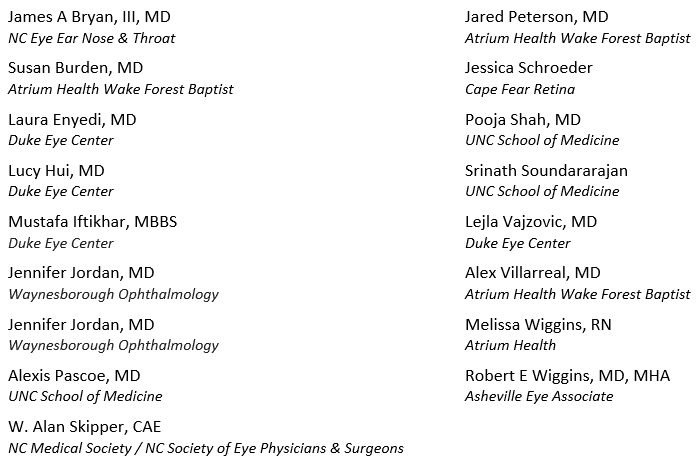
The day included visits to all 14 House offices and 2 Senate offices. The issues presented included:
> Medicare Physician Payment Reform
> Veterans Access to Quality Eye Care
> Utilization Management Relief – Prior Authorization and Step Therapy Relief
> Access to Pediatric Ophthalmology Care
> Support for Vision Research Funding
 2024 AAO CAD – N.C. Participants
NC Group with Rep./Dr. Greg Murphy
NC Group with Rep. Kathy Manning
Do you know your state and federal legislators? More importantly, do your legislators know you?
The NCMS can help you connect with policy makers as a constituent and advocate!

FTC Finalizes Changes to Data Privacy Rule, Bringing More Scrutiny of Digital Health Apps
The Federal Trade Commission (FTC) finalized a rule Friday that aims to tighten the reins on digital health apps sharing consumers' sensitive medical data with tech companies.
The agency issued a final version of its revised Health Breach Notification Rule (HBNR) to underscore the rule’s applicability to health apps in a bid to protect consumers' data privacy and provide more transparency about how companies collect their health information.
The Health Breach Notification Rule requires vendors that manage digital health records, including health apps, that are not covered by the Health Insurance Portability and Accountability Act to notify individuals, the FTC, and, in some cases, the media of a breach of unsecured personally identifiable health data.
Read the full article here.

Measles Cases Now Highest in US Since 2019

Several outbreaks, including one in Chicago, led to an early spike in measles cases this year. A chart shows how the case count compares to past years
(NBCNews, Aria Bendix and Joe Murphy) -- This year's measles case total is now the highest of the last five years. The United States has seen 125 cases across 17 states as — its largest annual tally since 2019, according to the Centers for Disease Control and Prevention.
From January to March, the U.S. recorded around 30% of the total cases seen since the beginning of 2020, according to a CDC report released earlier this month.
The authors warned that the rapid increase in cases "represents a renewed threat to elimination."
Most cases reported this year were linked to international travel, and the majority were among people who had not received a measles, mumps and rubella (MMR) vaccine or whose vaccination status was unknown.
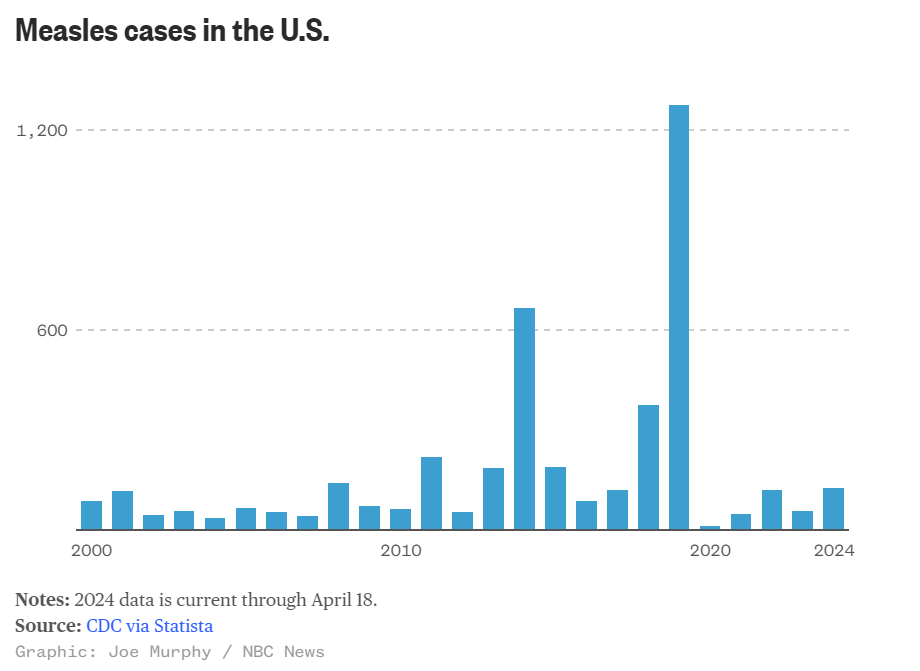
Two doses of the vaccine are 97% effective, but the CDC said in an advisory to health care providers last month that "pockets of low [vaccination] coverage leave some communities at higher risk for outbreaks."
This year's early spike in measles cases was driven in part by outbreaks centered in a migrant shelter in Chicago, an elementary school in southeast Florida and a children’s hospital and a day care center in Philadelphia.
Chicago continues to confront its outbreak. As of Monday, its case count had reached 63, with the most recent recorded last week. More than half of the cases were among children under age 5.
Though disease experts have expressed concern about the early rise in cases, the U.S. isn’t close to its total from 2019, when the country nearly lost its measles elimination status. Most of the 1,249 cases that year were associated with outbreaks in Orthodox Jewish communities in New York.
Measles is highly contagious: An infected person can spread it to up to 90% of people close to them if those contacts aren’t immune. Thanks to widespread vaccination, measles was eliminated in the U.S. in 2000 — meaning that it’s no longer constantly present, though there are still occasional outbreaks.
Most people who get measles now are unvaccinated. Children in the U.S. are meant to get their first vaccine dose between 12 and 15 months and their second between 4 and 6 years old.
However, vaccination rates have fallen in the last few years. For nearly a decade, 95% of U.S. kindergartners had received two doses of the MMR vaccine. That rate fell to 94% in the 2020–21 year, then to 93% in the 2022–23 school year.
Measles symptoms usually start with a high fever, cough, conjunctivitis (pink eye) and runny nose. Two to three days later, people may notice tiny white spots in their mouth. On days three to five of symptoms, a blotchy rash often forms at the hairline before spreading to the rest of the body.
Some people may develop severe complications from measles, including pneumonia, swelling of the brain or a secondary bacterial infection. Before measles vaccines became available in 1963, around 48,000 people were hospitalized and 400 to 500 people died of the disease each year in the U.S.
Today, 1 in 5 unvaccinated people who get measles are hospitalized, and roughly 1 to 3 out of every 1,000 children with measles die from respiratory and neurological complications, according to the CDC.

Want to Slow Down Aging? There May Be A Cheap Way To Do It.

A drug taken by millions of people to control diabetes may do more than lower blood sugar
(NPR, Allison Aubrey) -- Research suggests metformin has anti-inflammatory effects that could help protect against common age-related diseases including heart disease, cancer, and cognitive decline.
Scientists who study the biology of aging have designed a clinical study, known as The TAME Trial, to test whether metformin can help prevent these diseases and promote a longer healthspan in healthy, older adults.
Michael Cantor, an attorney, and his wife Shari Cantor, the mayor of West Hartford, Connecticut both take metformin. "I tell all my friends about it," Michael Cantor says. "We all want to live a little longer, high-quality life if we can," he says.
Michael Cantor started on metformin about a decade ago when his weight and blood sugar were creeping up. Shari Cantor began taking metformin during the pandemic after she read that it may help protect against serious infections.
The Cantors are in their mid-60s and both say they feel healthy and have lots of energy. Both noticed improvements in their digestive systems – feeling more "regular" after they started on the drug,
Metformin costs less than a dollar a day, and depending on insurance, many people pay no out-of-pocket costs for the drug.
"I don't know if metformin increases lifespan in people, but the evidence that exists suggests that it very well might," says Steven Austad, a senior scientific advisor at the American Federation for Aging Research who studies the biology of aging.
An old drug with surprising benefits
Metformin was first used to treat diabetes in the 1950s in France. The drug is a derivative of guanidine, a compound found in Goat's Rue, an herbal medicine long used in Europe.
The FDA approved metformin for the treatment of type 2 diabetes in the U.S. in the 1990s. Since then, researchers have documented several surprises, including a reduced risk of cancer. "That was a bit of a shock," Austad says. A meta-analysis that included data from dozens of studies, found people who took metformin had a lower risk of several types of cancers, including gastrointestinal, urologic and blood cancers.
Austad also points to a British study that found a lower risk of dementia and mild cognitive decline among people with type 2 diabetes taking metformin. In addition, there's research pointing to improved cardiovascular outcomes in people who take metformin including a reduced risk of cardiovascular death.
As promising as this sounds, Austad says most of the evidence is observational, pointing only to an association between metformin and the reduced risk. The evidence stops short of proving cause and effect. Also, it's unknown if the benefits documented in people with diabetes will also reduce the risk of age-related diseases in healthy, older adults.
"That's what we need to figure out," says Steve Kritchevsky, a professor of gerontology at Wake Forest School of Medicine, who is a lead investigator for the Tame Trial.
The goal is to better understand the mechanisms and pathways by which metformin works in the body. For instance, researchers are looking at how the drug may help improve energy in the cells by stimulating autophagy, which is the process of clearing out or recycling damaged bits inside cells.
Researchers also want to know more about how metformin can help reduce inflammation and oxidative stress, which may slow biological aging.
"When there's an excess of oxidative stress, it will damage the cell. And that accumulation of damage is essentially what aging is," Kritchevsky explains.
When the forces that are damaging cells are running faster than the forces that are repairing or replacing cells, that's aging, Kritchevsky says. And it's possible that drugs like metformin could slow this process down.
By targeting the biology of aging, the hope is to prevent or delay multiple diseases, says Dr. Nir Barzilai of Albert Einstein College of Medicine, who leads the effort to get the trial started.
The ultimate in preventative medicine
Back in 2015, Austad and a bunch of aging researchers began pushing for a clinical trial.
"A bunch of us went to the FDA to ask them to approve a trial for metformin,' Austad recalls, and the agency was receptive. "If you could help prevent multiple problems at the same time, like we think metformin may do, then that's almost the ultimate in preventative medicine," Austad says.
The aim is to enroll 3,000 people between the ages of 65 and 79 for a six-year trial. But Dr. Barzilai says it's been slow going to get it funded. "The main obstacle with funding this study is that metformin is a generic drug, so no pharmaceutical company is standing to make money," he says.
Barzilai has turned to philanthropists and foundations, and has some pledges. The National Institute on Aging, part of the National Institutes of Health, set aside about $5 million for the research, but that's not enough to pay for the study which is estimated to cost between $45 and $70 million.
The frustration over the lack of funding is that if the trial points to protective effects, millions of people could benefit. "It's something that everybody will be able to afford," Barzilai says.
Currently the FDA doesn't recognize aging as a disease to treat, but the researchers hope this would usher in a paradigm shift — from treating each age-related medical condition separately, to treating these conditions together, by targeting aging itself.
For now, metformin is only approved to treat type 2 diabetes in the U.S., but doctors can prescribe it off-label for conditions other than its approved use.
Michael and Shari Cantor's doctors were comfortable prescribing it to them, given the drug's long history of safety and the possible benefits in delaying age-related disease.
"I walk a lot, I hike, and at 65 I have a lot of energy," Michael Cantor says. I feel like the metformin helps," he says. He and Shari say they have not experienced any negative side effects.
Research shows a small percentage of people who take metformin experience GI distress that makes the drug intolerable. And, some people develop a b12 vitamin deficiency. One study found people over the age of 65 who take metformin may have a harder time building new muscle.
"There's some evidence that people who exercise who are on metformin have less gain in muscle mass, says Dr. Eric Verdin, President of the Buck Institute for Research on Aging. That could be a concern for people who are under-muscled.
But Verdin says it may be possible to repurpose metformin in other ways "There are a number of companies that are exploring metformin in combination with other drugs," he says. He points to research underway to combine metformin with a drug called galantamine for the treatment of sarcopenia, which is the medical term for age-related muscle loss. Sarcopenia affects millions of older people, especially women.
The science of testing drugs to target aging is rapidly advancing, and metformin isn't the only medicine that may treat the underlying biology.
"Nobody thinks this is the be all and end all of drugs that target aging," Austad says. He says data from the clinical trial could stimulate investment by the big pharmaceutical companies in this area. "They may come up with much better drugs," he says.
Michael Cantor knows there's no guarantee with metformin. "Maybe it doesn't do what we think it does in terms of longevity, but it's certainly not going to do me any harm," he says.
Cantor's father had his first heart attack at 51. He says he wants to do all he can to prevent disease and live a healthy life, and he thinks Metformin is one tool that may help.
For now, Dr. Barzilai says the metformin clinical trial can get underway when the money comes in.

New WFU School of Medicine Study: Racial Discrimination Associated with Alzheimer's Disease

Study Suggests Racial Discrimination During Midlife Associated with Alzheimer’s Disease Pathology
Later in Life
(WakeHealth) -- Racial discrimination experienced during midlife is associated with Alzheimer’s disease pathology, according to a new study from researchers at Wake Forest University School of Medicine and the University of Georgia.
The findings appear online today in Alzheimer’s & Dementia: The Journal of the Alzheimer’s Association.
“We know that Black Americans are at an elevated risk of Alzheimer’s disease and other dementias compared to non-Hispanic white Americans, but we don’t fully understand all the factors that contribute to this disproportionate risk,” said Michelle Mielke, Ph.D., professor of epidemiology and prevention at Wake Forest University School of Medicine.
Mielke, who is a co-corresponding author of the study, said that these racial disparities cannot be attributed to only genetic differences and that research suggests that exposure to racism and its associated stress may increase the risk of dementia.
For the present study, the research team used 17 years of data, which included interviews and blood draws, from a sample of 255 Black Americans who participated in the Family and Community Health Study, a multi-site and longitudinal investigation, which was initiated in 1996 and included more than 800 families in the U.S.
Since the beginning of the Family and Community Health Study, data has been collected every two to three years to study the health and well-being of Black Americans.
In the current study, researchers analyzed serum biomarkers, which are associated with Alzheimer’s disease and related dementias, including serum phosphorylated tau181 (p-Tau181), a marker of Alzheimer’s pathology; neurofilament light (NfL), a non-specific marker of neurodegeneration; and glial fibrillary acidic protein (GFAP), a marker of brain inflammation.
To measure racial discrimination, the study team surveyed individuals about discriminatory events they experienced such as encountering disrespectful treatment by store owners, salespeople or police officers, being called racial slurs, being excluded from social activities, and not being expected to do well because of being a Black American.
“We found no correlations between racial discrimination and increased levels of the serum biomarkers in 2008 at Wave 5 when participants were a mean age of 46 years,” said Ronald L. Simons, Ph.D., professor of sociology at the University of Georgia and co-corresponding author of the study. “However, 11 years later when the study participants were roughly 57 years old, we found that increased discrimination during middle age significantly correlated with higher levels of both p-Tau181 and NfL.”
While additional research is needed to better understand the complexity of these processes, Mielke said it’s clear that future studies should also focus on the challenges and racism experienced by Black Americans to further understand their risk of dementia.
“These findings provide evidence that the chronic stress of racial discrimination often encountered by Black Americans in midlife become biologically embedded and contribute to Alzheimer’s disease pathology and neurodegeneration later in life,” Mielke said. “This research can help inform policies and interventions to reduce racial disparities and reduce dementia risk.”
This work was supported by the National Institute on Aging (RF1 AG077386 and R01 AG055393), and the National Heart, Lung, Blood Institute (R01 HL118045).

NCMS Proudly Graduates the 2024 Health Care Leadership and Management Class

Participants from across North Carolina Gather in Raleigh to celebrate!
On Sunday, April 21, 2024, NCMS proudly graduated it’s 2024 Health Care Leadership and Management (HCLM) class of clinicians and health care administrators. HCLM is led by NCMS members, Drs. Genie Komives, CMO, WellCare of NC, and Bryant Murphy, Vice Chairman for Clinical Operations at UNC HealthCare.
The scholars convened in Raleigh at NCMS headquarters last weekend for their final lecture session led by Jonathan Vehar titled, Mastering Leadership. The session culminated a year’s long training that included 1:1 coaching sessions, lecturing, and CBO site visits to glean new management strategies from CFOs, COOs, CEOs, and CMOs throughout the state. Sunday’s session highlighted the work of the scholars where they presented projects demonstrating leadership insights, strategic thinking, financial understanding, and innovation in tackling a real-world problem.
Team One members were comprised of Sankalp Puri, MD; Tambetta Ojong, MD, FAAFP; Nicole Six, LCSW; Kalpana Iyer, MBA. Their presentation was entitled, Fueling Hope: Your guide to beating food insecurity with flavor and fun.
Team Two members were comprised of Colby Dendy, MD, MPH, FAAP; John Nicholls, MD, JD, DFAPA; Debbie Naylor; and Kelly Phillips, MBA. Their presentation was entitled, Revolutionizing Mental Healthcare in Rural North Carolina.
The 2024 cohort participants hailed from Asheville to Wilmington, NC.
HCLM is a renowned leadership program designed to provide a strong framework for professionals in healthcare administrative roles. The program consists of intensive training sessions and tools to navigate organizational financial strategies, negotiate contracts, master leading C-suite executives and more. Scholars are nominated or self-identified as exceptional leaders in their healthcare community to join other elite healthcare leaders throughout NC. To learn how you can join the next HCLM cohort, contact Erica Neal, Manager, Professional Growth.
Congratulations to our 2024 HCLM graduates!