
By Cady Thomas, JD – Partner, Focus Public Affairs Consultants
Key Results
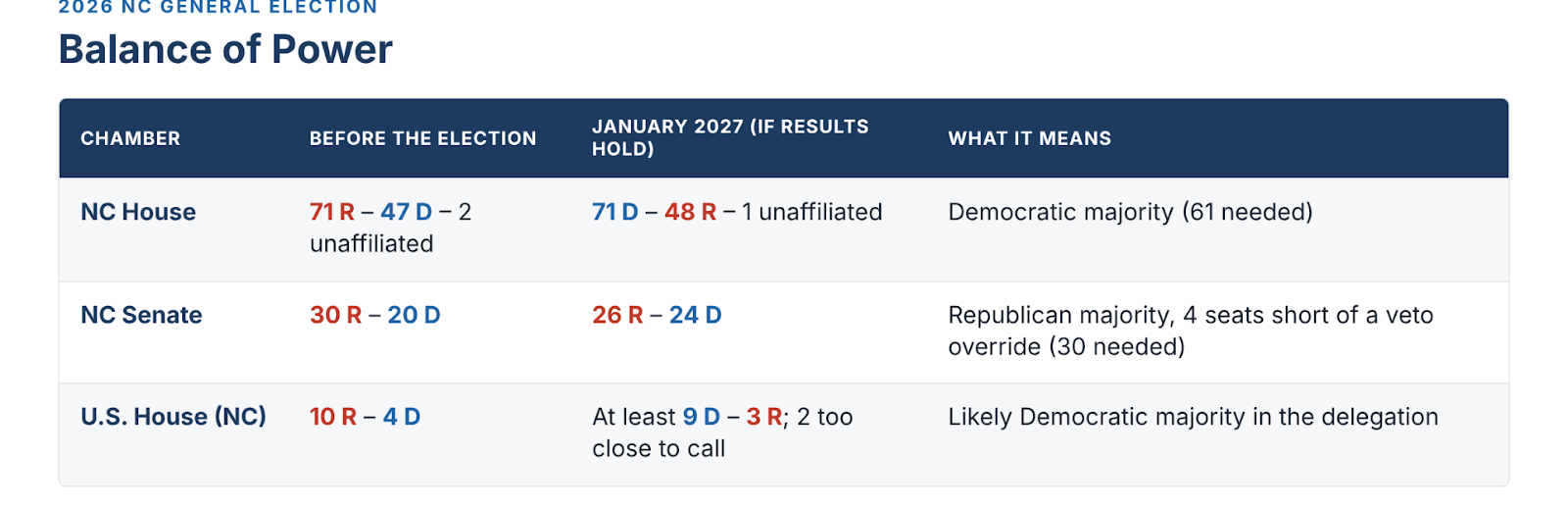
- Divided government in Raleigh. Democrats win the NC House majority for the first time since 2010. Republicans keep the Senate 26-24. Starting in January, Gov. Josh Stein will work with a split legislature for the first time.
- A 25-25 split is possible in the Senate with a recount likely underway in Senator Danny Britt’s district (268 votes).
- No veto-proof majority in either chamber – yet. Republicans fall four seats short of the 30 Senate seats needed to override a veto, so Gov. Stein’s vetoes will stand.
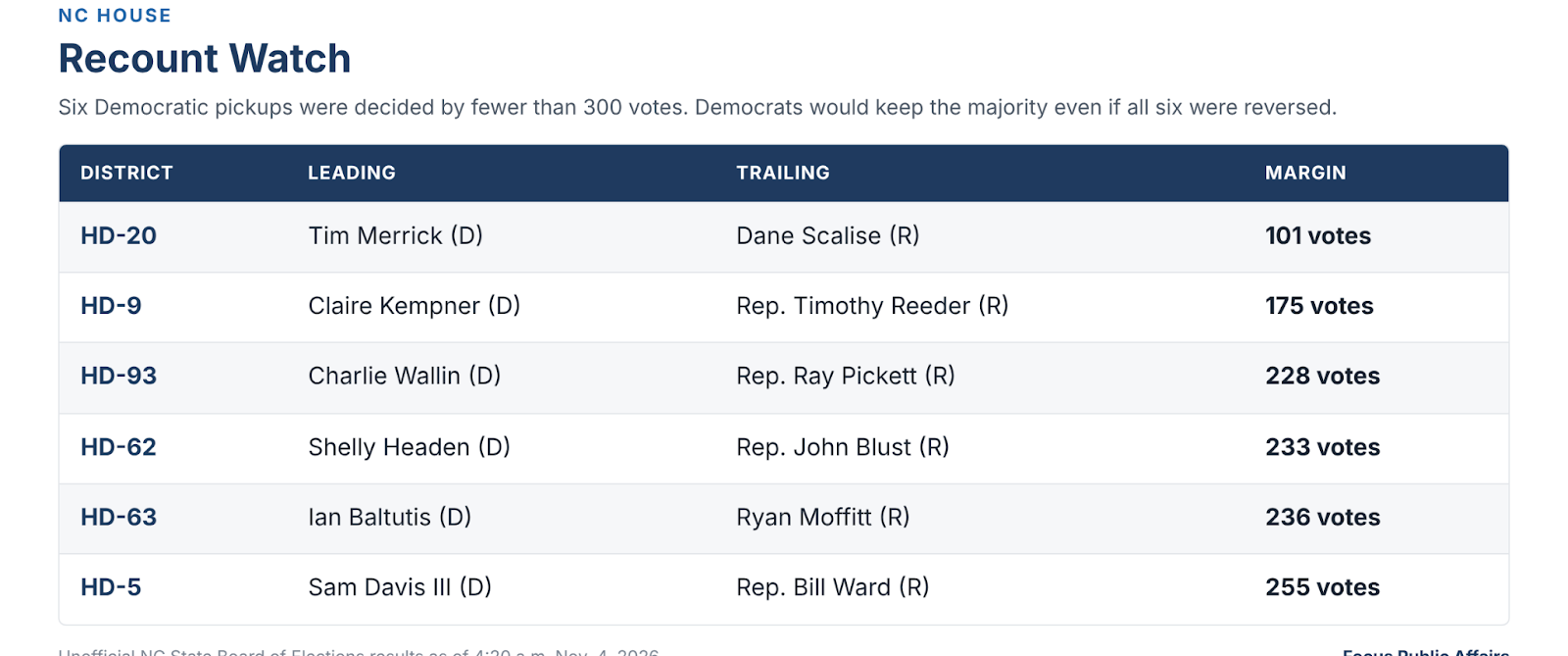
- The House Democrats MAY have a working supermajority as 5 of the 71 races are within recount numbers and 1 Unaffiliated winner will caucus with Democrats – which would make the count 72-48.
- New leadership in both chambers. House Democratic Leader Robert Reives is in line to become Speaker. Senate leadership will also change; President Pro Tem Phil Berger lost his March primary.
- Democratic sweep statewide. Roy Cooper won the U.S. Senate seat by nearly 20 points, and Democrats won every statewide judicial race on the ballot.
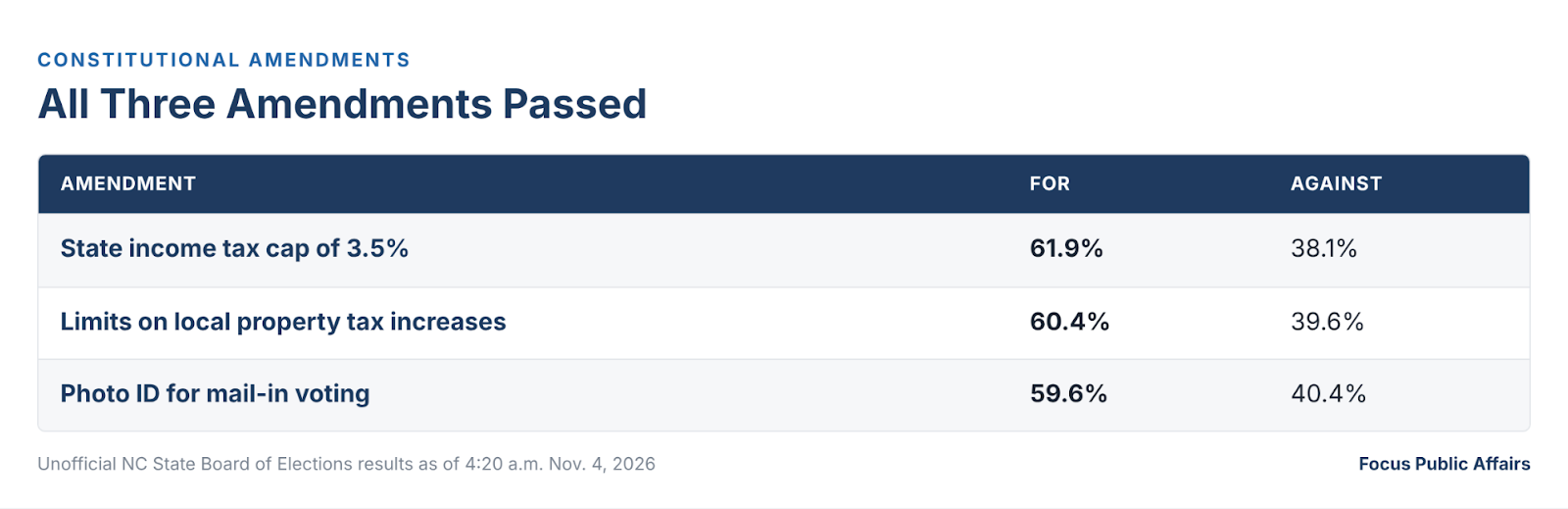
- All three constitutional amendments passed with roughly 60% support each.
NC House
- Democrats grew from 47 seats to 71. Republicans are on track to lose 23 seats, and 18 Republican incumbents were defeated or are trailing.
- Defeated or trailing incumbents include Rep. Donny Lambeth, a lead House budget writer, and Rep. Tricia Cotham.
- Unaffiliated candidate April Montgomery won the open Republican-held HD-51.
- Republican losses came across the state, including Wake, Johnston, Nash, Cabarrus, Forsyth, Mecklenburg, Alamance, and Swain counties.
The last time Democrats took the House majority from Republicans was 1998.
Recount Watch
- Six Democratic pickups were decided by fewer than 300 votes in the NC House. Democrats would keep the majority even if all six were reversed.
NC Senate
- Republicans hold the majority at 26–24 if results hold. Democrats gained four seats.
- Democrats defeated Sens. Buck Newton, Michael Lee and Lisa Barnes and won an open seat in Cabarrus County.
- The margin is narrow: Sen. Danny Britt (R-Robeson) leads his race by 268 votes.
Statewide Judicial Races
- NC Supreme Court, Seat 1: Justice Anita Earls (D) won a second eight-year term, 58.9% to 41.1%, over Sarah Stevens (R). The court remains 5–2 Republican.
- NC Court of Appeals, Seats 1–3: Democrats held all three. John Arrowood won with 56.8%, Toby Hampson with 56.8% and Christine Walczyk with 57.1%.
Constitutional Amendments
- All three amendments passed. None of the three amendments changes a tax rate for 2027. The property tax amendment directs the General Assembly to set the actual limits by law, so that framework will be written by the new, divided legislature.
Congress
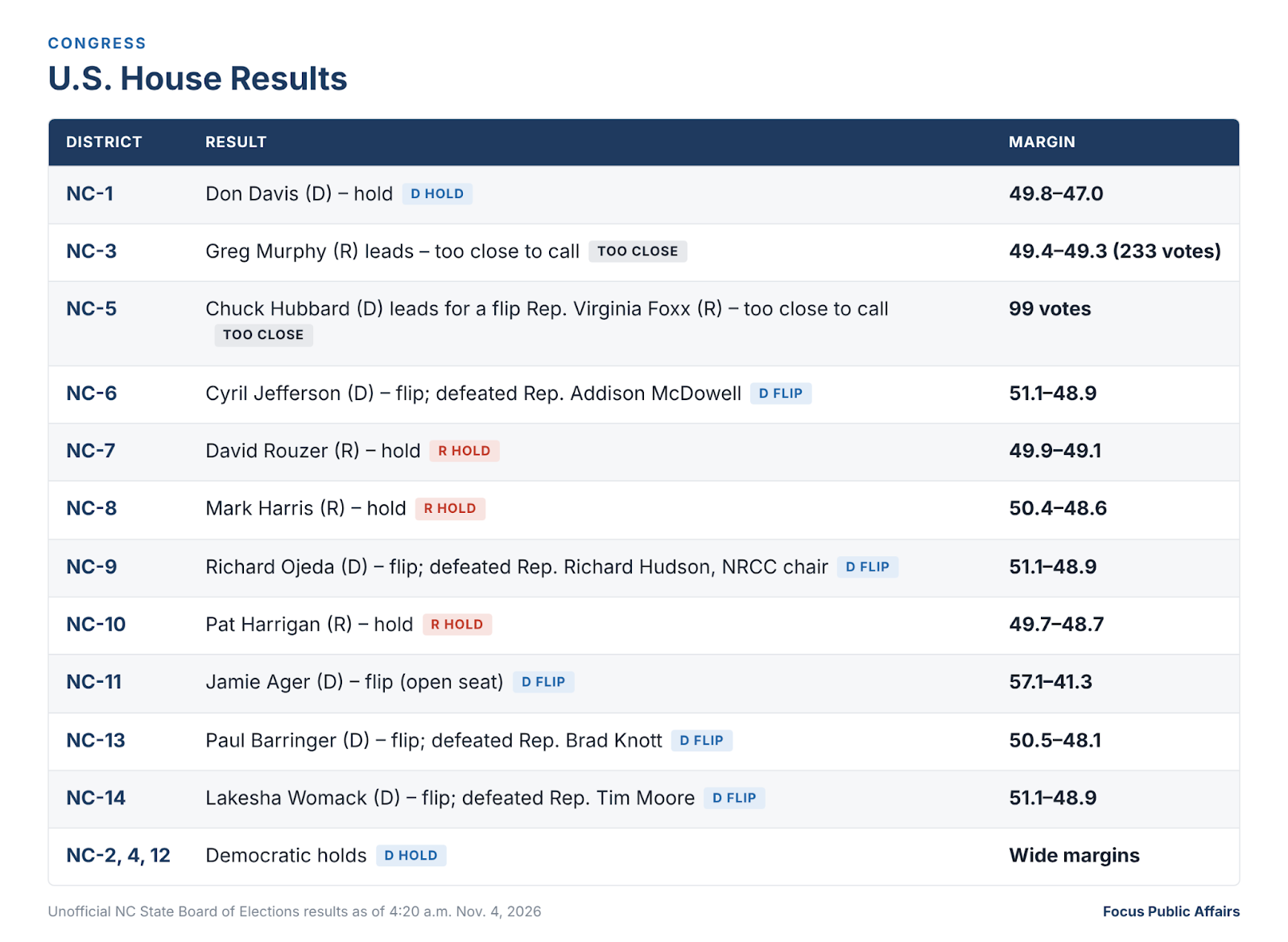
- U.S. Senate: Former Gov. Roy Cooper defeated Michael Whatley, 58.7% to 39.1%, for the seat held by retiring Sen. Thom Tillis. He is North Carolina’s first Democratic U.S. Senate winner since Kay Hagan in 2008.
What It Means
- Every major bill now needs three-way agreement: a Democratic House, a Republican Senate and a Democratic governor. Expect fewer party-line bills and more negotiated packages.
- A working supermajority in the House means little. The scenario of the House sending Stein a bill to veto when he will be on the ballot in 2028 is slim.
- The next state budget will be a bipartisan negotiation. Budget priorities will need support in both chambers.
Gubernatorial vetoes will stick. Without override margins in either chamber, the governor’s office becomes a central negotiating partner earlier in the process. - Committee chairs and leadership teams will turn over. House committee leadership will shift to Democrats, and the Senate will choose new leadership.
- Federal outlook shifts. A likely Democratic majority in the NC congressional delegation and Sen.-elect Cooper change the state’s federal foothold.
Key Dates Ahead
- Nov. 13: County boards of elections canvass and certify results. Races within 1% may go to a recount.
- November: Will there be a lame duck session?
- November–December: NC House and NC Senate caucuses organize and select leadership.
- January 2027: The new General Assembly convenes.

About the author:
Cady Thomas, JD, is a Partner at Focus Public Affairs, a government relations and strategic consulting firm based in Raleigh, North Carolina. With a background in law, business, and legislative advocacy, she provides legislative and regulatory tracking, advocacy, engagement strategy, and strategic consulting for a diverse clientele. Prior to working at Focus Public Affairs, Cady led the government affairs department for the NC Association of Realtors for ten years.