
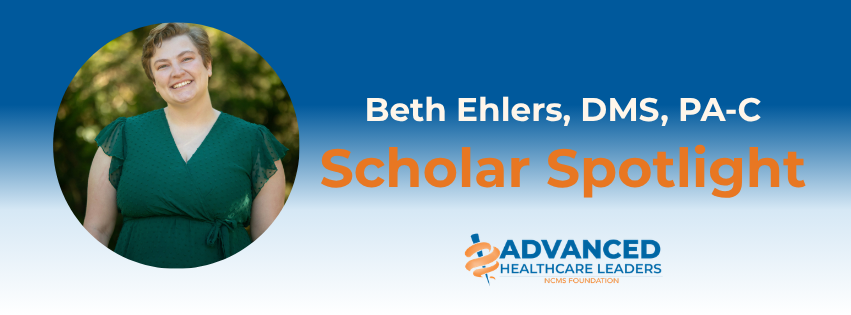
Beth Ehlers, DMS, PA-C, has always been drawn to the medical field. Her mother worked in healthcare, and Ehlers began shadowing different providers to explore the possibilities. She worked as a physical therapy technician and medical assistant and gained experience in several specialties before becoming a physician assistant. Although she initially had an interest in orthopedics, her first clinical rotation changed her direction.
She fell in love with psychiatry, drawn to the one-on-one time with patients and the opportunity to see how medication management could help people. Her interest in leadership development and work with the NC Academy of PAs brought her to the Advanced Healthcare Leaders (AHL) program.
For Ehlers, leadership development is closely connected to providing better support for providers and patients. She is particularly passionate about treating patients with schizophrenia and bipolar disorder and believes healthcare providers need to stay educated about new medications and know where to find reliable information.
Her project, “Antipsychotic Medication Guide for New Grads & Non-Psychiatry Providers,” focuses on helping PAs and other providers working in psychiatry navigate rapidly changing medication options.
Ehlers reached out to PAs who had recently graduated and were entering psychiatry, as well as providers who had recently transitioned into or out of psychiatry, to better understand where they felt unprepared or were still struggling. A common concern was the pace of change in antipsychotic medications. Even new graduates can find themselves behind when medications have been introduced while they were in school.
With the AHL leadership support, she decided to create a quick-reference guide as a starting point for providers, covering medication options, labs to monitor, potential interactions, and resources for finding more in-depth information. She hopes the guide will give providers another resource when considering different medication options and help support higher quality care for patients with mental health conditions.
The AHL program has also prompted Ehlers to reflect on her own leadership. She has gained a better understanding of the leadership styles that work well for her while becoming more conscious of behaviors that may come across as abrasive. Recognizing her tendencies in different situations has helped her determine when to step back and allow someone else to lead.
For Ehlers, the program’s interprofessional connections have been particularly valuable. Working alongside physicians, social workers, and others exposed her to different perspectives and approaches to problems. Feedback from faculty and staff provided a sounding board as she developed her project, helping ensure that the work was useful and would benefit the people she hoped to help.
Interested in learning more about this and other AHL scholars’ projects? Register here to attend the virtual graduations on September 28 and October 1.
The Academy for Healthcare Leaders is now accepting applications for the Advanced Healthcare Leaders and the Executive Healthcare Leaders programs. Full-tuition scholarship are available for eligible participants.
Questions about programs, scholarships, or employer tuition support, Contact Monecia Thomas/Lydie Ky